
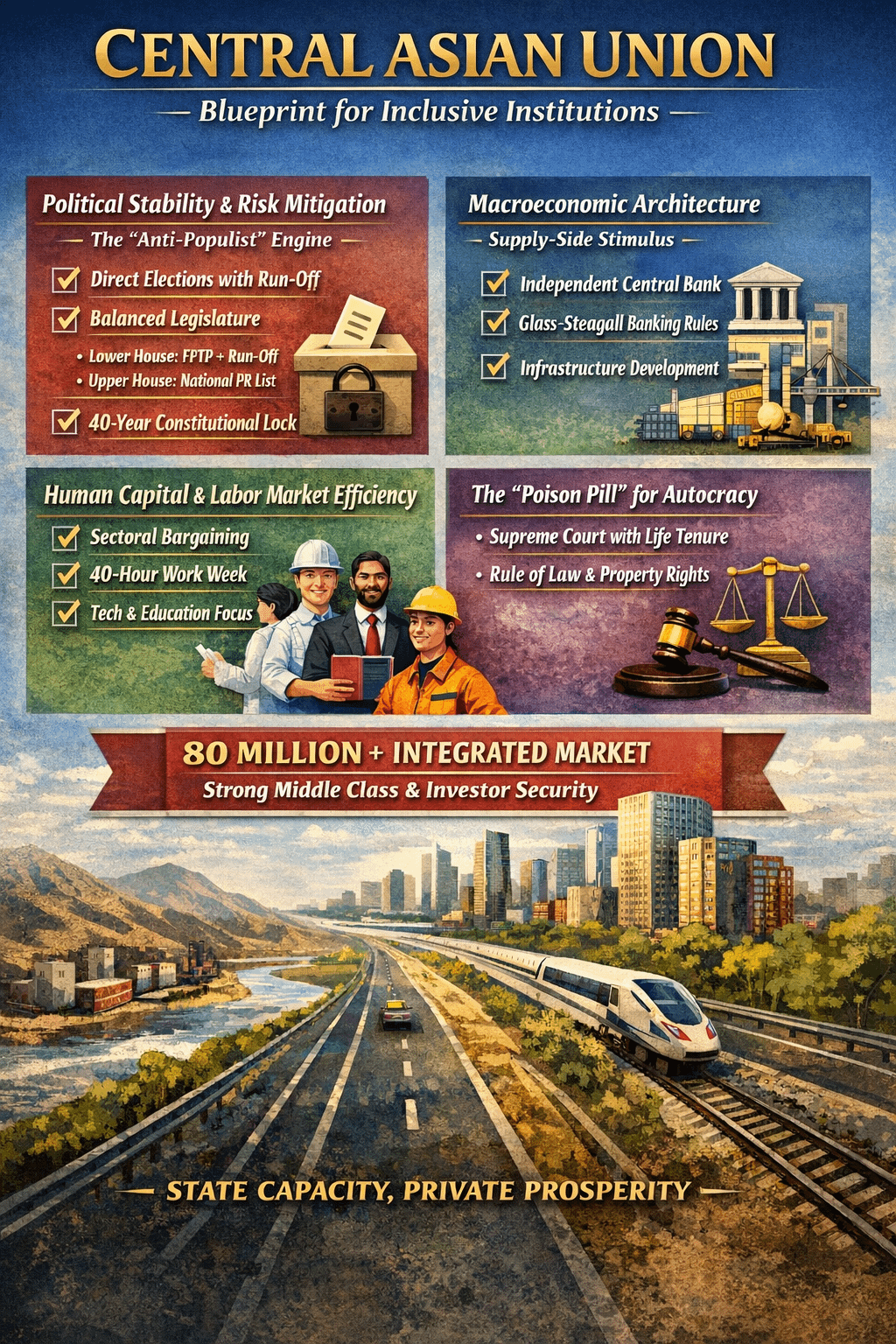
I've been modeling a theoretical framework for unifying Central Asian economies (Post-Soviet bloc) to prevent them from sliding into Autocracy or becoming vassal states to China/Russia.
The goal is to design a system of "Inclusive Institutions" (à la Acemoglu & Robinson) that guarantees property rights, encourages FDI (Foreign Direct Investment), and creates a massive internal market of 80M+ people.
Here is the blueprint. I’m looking for critique from an institutionalist perspective. Is this robust enough to prevent state capture?
1. Political Stability & Risk Mitigation (The "Anti-Populist" Engine)
Investors hate instability. To ensure long-term policy predictability and preventing "Strongman" rule:
- Executive: Direct elections with Mandatory Run-off.
- Why: Prevents radicals or populists with a 30% base from seizing power. Forces candidates to move to the center and form stable coalitions.
- Legislature:
- Lower House: FPTP + Run-off. Ensures local accountability.
- Upper House: Single National Constituency with Open List PR.
- Mechanism: Parties compete nationally, breaking down ethnic/regional clans. The Open List empowers voters to bypass corrupt party bosses, increasing meritocracy.
- Safety Valve: A 40-year Constitutional Lock on electoral laws to ensure "Rules of the Game" remain constant for long-term investors.
2. Macroeconomic Architecture (Supply-Side Stimulus)
Instead of vague welfare, the state focuses on CAPEX (Capital Expenditure) to lower costs for business.
- The Central Bank: Independent, but with a Dual Mandate (Price Stability + Maximum Employment).
- Rationale: Prevents the "Japanese deflationary trap." Ensures monetary policy supports labor utilization.
- Banking Regulation: Strict separation of Commercial and Investment banking (Glass-Steagall style).
- Why: Developing markets cannot afford financial contagion. Banks must focus on lending to the real sector (SMEs, Industry) rather than speculation.
- Infrastructure as a Service: The State acts as the primary developer of Logistics (Roads/Rail/Energy).
- Neoliberal Logic: This reduces transportation costs for private business and boosts labor mobility. It’s not "socialism," it’s creating the Market Platform.
3. Human Capital & Labor Market Efficiency
To avoid the "South Korean Demographic Collapse" (which destroys long-term growth), the system prioritizes a sustainable workforce.
- Sectoral Bargaining (The Nordic Model): Instead of a government-imposed minimum wage, independent Unions negotiate wage floors for entire industries.
- Benefit: Prevents a "Race to the Bottom." High wages force companies to innovate and automate (increasing productivity) rather than relying on cheap labor. Creates a robust middle class with high consumption power.
- Work-Life Balance enforcement: Rigid 40-hour weeks.
- Economic Logic: Solves the fertility crisis destroying East Asia. Ensures a future labor supply and domestic demand.
- Education: Focus on Industrial Policy history and technical skills. Creating a bureaucracy based on merit (French ENA style) to ensure competent technocrats run the regulatory agencies (FDA/FBI equivalents).
4. The "Poison Pill" for Autocracy
This system is designed to be indigestible for Russia or China.
- A unified market with a strong middle class, independent courts, and high labor standards makes external capture expensive and politically impossible.
- Rule of Law: A Supreme Court with life tenure appointed at inception to guard property rights against future executive overreach.
The Thesis:
This isn't "Big Government" for the sake of it. It's "State Capacity Building". By building roads and enforcing high labor standards, the State creates a high-consumption, high-productivity environment where private enterprise can actually thrive, rather than stagnating in a low-wage extraction economy.
Does this institutional design create enough checks and balances to prevent corruption? Or is the Executive still too strong?
Posted by mercurygermes