
Submission statement.
This article encapsulates all of the themes this sub is interested in: how demographic change, immigration, nativism, and neoliberalism converge in politics. This discusses the role nativism and demographics play in Mumbai politics and how their changing demographics influence elections, including the upcoming BMC (municipal corporation) ones. It also talks about the role neoliberalism has played in reshaping Mumbai.
The article comments are below
Posted by ewatta200
1 Comment
**Mumbai**: In 1956, Guru Dutt produced the neo-noir thriller *C.I.D.*, whose song ‘*Ae dil hai mushkil jeena yahaan… zara hatke zara bachke, yeh hai Bombay meri jaan’* became iconic. A lyrical ode to the city, it captured Bombay’s culture, commerce, and the daily struggle to survive.
Seven decades later, both the city’s name and its character have transformed. Vast textile mills have been replaced by malls, protests have been confined to a corner of Azad Maidan, the communist leadership has been overshadowed by capitalists, and sprawling chawls have given way to soaring high-rises.
[](https://vdo.ai/contact?utm_medium=video&utm_term=theprint.in&utm_source=vdoai_logo)
Along with these cosmetic changes, Mumbai has undergone drastic changes in its demographics—a key parameter that will decide the upcoming BMC polls and the future of the city.
The BMC elections on 15 January, 2026 will be a crucial test for the Thackeray legacy in Mumbai, where the Shiv Sena dominated civic politics for 25 years at a stretch. But the city’s changing demographics and economy have had a far reaching effect on its voting pattern.
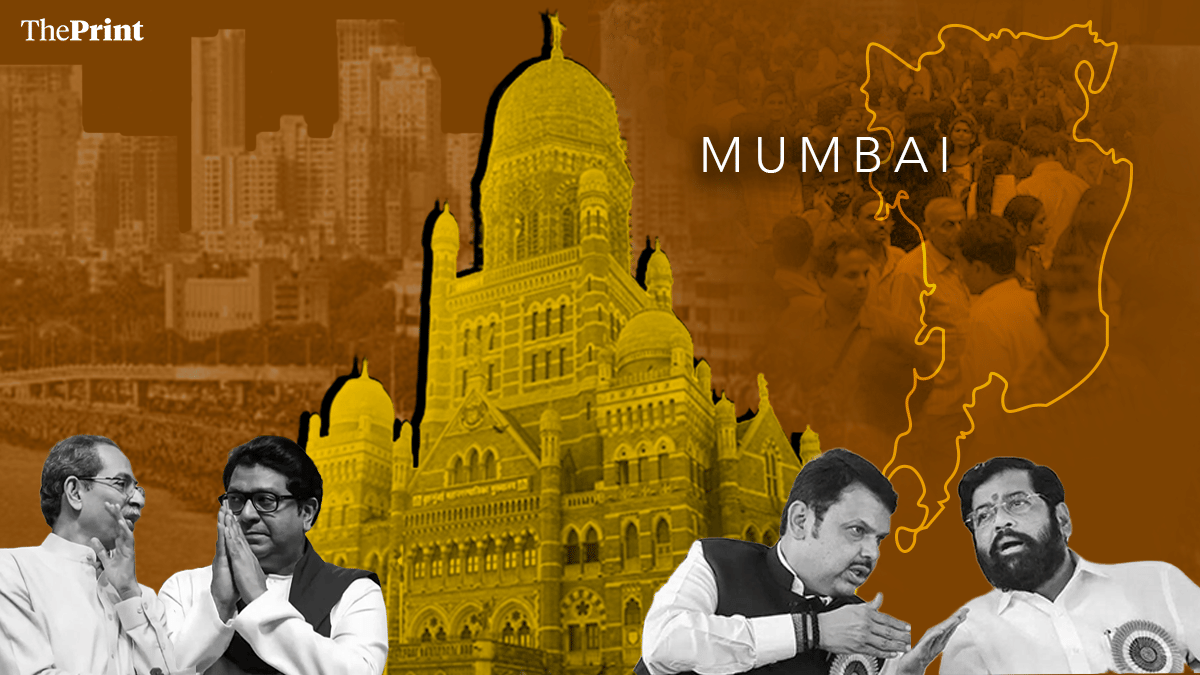
This year, the contest has taken on new dimensions. The principal contenders are the ruling Mahayuti alliance, comprising the Eknath Shinde–led breakaway Sena faction and the BJP, whose seat-sharing negotiations have threatened to complicate the contest, and a re-energised opposition bloc led by Uddhav Thackeray’s Sena and Raj Thackeray’s Maharashtra Navnirman Sena. A diminished force in the city, the Thackerays are campaigning on a shared ‘Marathi manoos’ plank to consolidate regional support.
https://preview.redd.it/aqxkopvjj7ag1.png?width=1200&format=png&auto=webp&s=f13680e610e7157606d1764bb6ba10389c3a59f1
“At one point, Shiv Sena represented the aspirations of a certain linguistic group of people, but their number is going down, and on the other hand, you have another party catering to similar aspirations, irrespective of the linguistic composition, today,” said Uttara Sahasrabuddhe, a former professor at Mumbai University.
The Congress, meanwhile, is struggling to gain traction. Crippled by infighting within its local units, it is set to contest the elections independently. Despite being part of the Maha Vikas Aghadi, it is taking on both the Mahayuti and the Sena–MNS combine.
The Hindi speaking population has crossed, or probably in the next five years will cross, the Marathi speaking population, city chronicler Bharat Gothosakar of Khaki Tours told ThePrint. “That is what will make a difference in the way voting will happen in the city,” Gothoskar said.
He also noted that Mumbai has one of the largest Muslim populations in a non-Islamic country, about 17-18 percent of the voters, and there will also be a huge impact of Muslim votes.
In Mumbai today, no single language is spoken as a mother tongue by more than a third of the population, reflecting its cosmopolitan character. According to estimates by political parties, now the Marathi speaking population could be at 30 percent, very close to the Hindi speaking population.
Historical data illustrates that the dominance of Marathis has declined over time. The 2011 Census showed that Marathis remained the largest linguistic group at 35.9 per cent. Hindi speakers accounted for 22.9 percent, Urdu speakers 13.5 percent, and Gujarati speakers 11 percent, with many other languages spoken in smaller numbers. The 2001 Census had shown Marathi speakers making up about 39 percent of the city’s population, with Hindi, Urdu, and Gujarati speakers accounting for 16 percent, 15 percent, and 11 percent, respectively.