
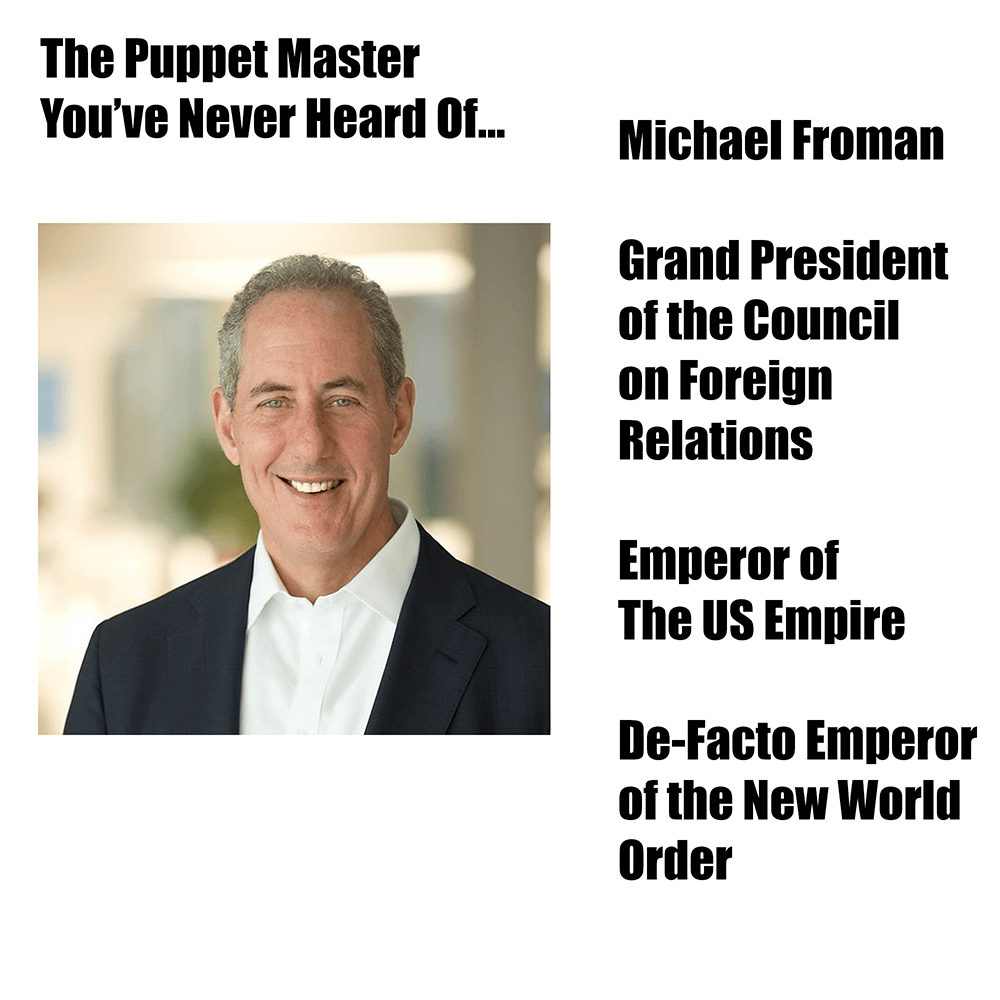
Before becoming President of the Council on Foreign Relations, Michael Froman had a very classic elite U.S. political-economic résumé—almost a textbook case of the finance ↔ state ↔ global governance pipeline,
Here’s the clean breakdown.
1. Obama’s Top Trade Architect (2013–2017)
Froman was United States Trade Representative (USTR) under Barack Obama.
In that role, he:
- Led negotiations for TPP (Trans-Pacific Partnership)
- Oversaw TTIP talks with the EU
- Managed WTO relations and U.S. trade disputes
- Pushed the “rules-based international order” framing of globalization
This made him one of the most powerful unelected economic policymakers in the world during that period.
2. Senior Economic Advisor in the Obama White House (2009–2013)
Before USTR, he was:
- Deputy National Security Advisor for International Economic Affairs
- Later Assistant to the President
This position is important because it sits above Treasury, Commerce, and USTR in coordination terms. It’s where:
- Financial policy
- Trade policy
- Sanctions
- Development banks
are synthesized into a single strategic worldview.
This is pure imperial plumbing, not domestic economics.
3. Citigroup: The Financial Core (1999–2009)
Before government, Froman was a senior executive at Citigroup, working directly with Robert Rubin.
Key points:
- Rubin → Treasury Secretary → Citigroup
- Froman followed Rubin from government into finance
- Worked on global strategy, not retail banking
- Focused on emerging markets, sovereign risk, and capital flows
This is where Froman learned how states actually depend on private finance, not the other way around.
4. Treasury Department in the Clinton Era (1990s)
Earlier still, Froman served at the U.S. Treasury Department, including:
- Chief of Staff to Robert Rubin while Rubin was Treasury Secretary
- Involved in:
- NAFTA aftermath
- Asian Financial Crisis (1997)
- IMF coordination
- Capital account liberalization debates
This period hard-wired the Washington Consensus into his worldview.
5. Elite Formation: Education & Networks
- Harvard College
- Harvard Law School
- Rhodes Scholar at Oxford
He overlaps socially and professionally with:
- Treasury officials
- IMF/World Bank alumni
- Wall Street executives
- Foreign policy think-tank leadership
So by the time he reaches CFR, he isn’t “entering” the network—he’s returning to its control room.
6. Why CFR Was the Logical Next Step
When Froman became President of the Council on Foreign Relations:
- He already embodied CFR’s core synthesis:
- Finance
- Trade
- Diplomacy
- Institutional globalism
- He had credibility with:
- Governments
- Banks
- Multinationals
- International institutions
CFR didn’t capture him—he is CFR in human form.
Posted by joan_of_arc_333
2 Comments
Thanks for his CV
Fun fact: His brother Abe was once considered the Sausage King of Chicago.