
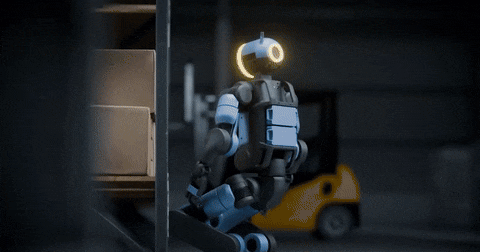
The labor union at Hyundai Motor Company announced on the 22nd its open opposition to the deployment of humanoid robots on production lines, stating that it “will not accept even a single robot without a labor–management agreement.” The statement appears to target the humanoid robot Atlas, which Hyundai Motor Group unveiled earlier this month at CES 2026, the world’s largest IT and technology exhibition. As robot deployment in production sites accelerates, a clash between management and the union now appears unavoidable.
The Hyundai Motor branch of the Korean Metal Workers’ Union said in a bulletin distributed on the 22nd, “Overseas production transfers and the introduction of new technologies (robot automation) are being pushed through unilaterally without labor–management agreement,” adding, “This is absolutely unacceptable.” The union emphasized that “the introduction of robots into production sites is expected to cause serious employment shocks,” warning, “Make no mistake—without labor–management agreement, not a single robot will be allowed onto the shop floor.”
Earlier this month, Hyundai Motor Group publicly unveiled the humanoid robot Atlas for the first time at CES 2026, held from January 6 to 9 (local time) in Las Vegas. The group announced plans to position itself as a “physical AI” company, with robotics as a core growth engine. It also presented a roadmap to establish a mass-production system for 30,000 Atlas units by 2028, build a robot manufacturing base in the United States, and gradually deploy robots in manufacturing sites. The market response to Atlas was highly positive, and Hyundai Motor’s share price surged.
In response, the union stated that while Hyundai Motor’s core business remains “automobile manufacturing and sales,” the recent surge in its stock price—lifting it to third place by market capitalization—has been driven by its revaluation as a physical AI (robotics) company. “We don’t know whether to laugh or cry,” the union said, adding that Hyundai is now being valued not merely as an automaker but as a robotics and AI company.
While Hyundai’s robot technology may positively affect corporate value, the union expressed concern that it could lead to job insecurity and restructuring of labor conditions. The union argued that robot adoption is likely to result in workforce reductions and presented cost comparisons to support its claim.
“Assuming an average annual salary of 100 million won, operating 24 hours a day requires labor costs of 300 million won per year for three workers,” the union said. “Robots, by contrast, only incur maintenance costs after the initial purchase, which makes them an attractive justification for capital seeking to maximize long-term profits.” It added that “the deployment of AI robots aimed at cutting labor costs is becoming increasingly visible at Hyundai Motor.”
Industry estimates put the annual maintenance cost of humanoid robots like Atlas at around 14 million won per unit. By comparison, labor costs at Hyundai Motor Group’s major listed affiliates average about 130 million won per employee per year. Aside from time spent replacing batteries, humanoid robots can effectively operate around the clock.
Union leadership warned that robot deployment and production transfers are “absolutely unacceptable,” stating, “If management wants to see the collapse of labor–management relations, we will show them how far this can go.”
Posted by Freewhale98
3 Comments
1. Summary
Hyundai Motor Labor Union declared total against robots, declaring not a single robot would be let into the factory without labor-management agreement. Recent the Atlas robot presentation and possible deployment plan to Hyundai factories greatly enraged Hyundai auto workers.
2. How is this related to sub
Labor-management tensions over AI: The workers fearing for their loss of jobs are resisting the deployment of physical AI.
3. My opinion
The concerns of labor unions should be heard. They are indeed great concerns that unrestrained deployment of physical AI would wipe out manufacturing jobs, causing a crisis of mass-unemployment. But, in the era of population decline, physical AI is needed. There needs to be social dialogues between labor unions and business community on what is the socially responsible ways to deploy AI. Recent AI basic Act of Korea is a great fist step of that social dialogues.
Have the robots been proven to work? Going off the promotional video there, they seem rather proof-of-concept-esque. Not to mention, isn’t much of the assembly of vehicles at modern car factories already automated?
Hey at least it isn’t just American unions ranting about automation now