
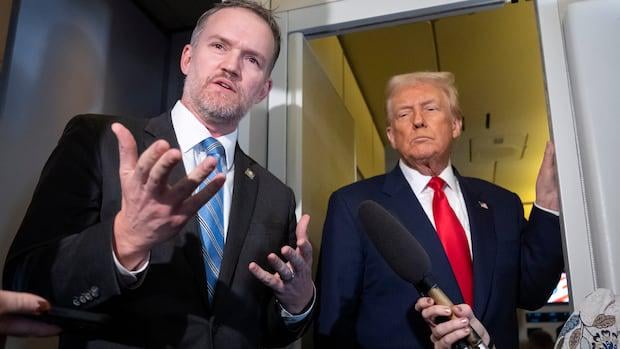
Jamieson Greer tells CBC News that tariffs will feature even in renegotiated CUSMA
U.S. President Donald Trump's point man on trade talks says Canada needs to accept that tariffs will be a part of any deal with the administration, including renewal of the Canada-U.S.-Mexico Agreement (CUSMA).
In interviews with two CBC News journalists on Capitol Hill just after Trump's state of the union address Tuesday night, U.S. trade representative Jamieson Greer suggested Canada can't expect to land a trade agreement that is free of tariffs.
"When we go to other countries, and we make a deal with them … they agree that we can have a tariff on them," Greer told CBC News correspondent Katie Simpson.
"If Canada wants to agree that we can have some level of higher tariff on them while they open up their markets to us on things like dairy and other things, then that's a helpful conversation."
It's the clearest signal yet from the Trump administration that it's aiming for a fundamental rewrite of the free-trade deals that have existed between the U.S., Canada and Mexico since NAFTA took effect in 1994.
CUSMA is up for review this year, and the Trump administration has already imposed a raft of tariffs on Canadian exports, including on steel, aluminum, softwood lumber and the auto sector.
Each of the three countries must indicate by July 1 whether they want to extend the agreement, renegotiate its terms or let it expire.
Canada and the U.S. have yet to launch formal talks on the trade deal, although Prime Minister Mark Carney's government has indicated negotiations will start within a few weeks.
'Stricter rules'
Greer, expected to be a key figure in those negotiations, indicated the Trump administration does not want to renew CUSMA as-is because the agreement — signed by Trump in 2018 — did not do enough to bring industrial production to the U.S.
"If you want to have that deal, you need to have better rules, stricter rules," he said.
"We don't want a situation where countries like Vietnam or China can send a bunch of stuff to Canada, do a screwdriver operation and send it across the border into the United States duty-free."
He also criticized Canada for failing to agree to U.S. requests to back off from "practices that we think are unfair," including measures that Canadian governments imposed last year in retaliation against Trump's tariffs.
"Put American wine and spirits back on the shelf; they haven't done that," Greer told CBC News producer Sylvia Thomson. "To reopen to America procurement opportunities; they haven't done that. To give us fair access to their dairy markets; they haven't done that
"It's quite a contrast with Mexico."
Trump and his officials have previously floated negotiating better terms in CUSMA, breaking it into separate deals with Canada and Mexico or abandoning it altogether.
The agreement exempts a significant portion of Canadian and Mexican exports from across-the-board tariffs that Trump imposed last year, which the Supreme Court struck down last Friday as unconstitutional. Trump immediately moved to replace those tariffs with a 10 per cent levy using a different law.
Champagne says Canada needs to diversify trade
"Canada, if you look at the data, is still the country which is paying the lowest price to enter the U.S. market," he said on his way into Wednesday's caucus meeting. "So Canada, in a sense, is in a good position."
Finance Minister François-Philippe Champagne says Canada has open lines of communication and "many points of contact" with the U.S. administration and those channels have been used to sell free trade as something that makes both countries more competitive.
The finance minister explained that while the economy as a whole may have better access than other countries, specific sectors like steel, aluminum and softwood lumber, which face much higher sectoral tariffs, may feel "a very different way."
Every country around the world now understands there's a price to enter the U.S. market, Champagne said, which is why it is more important than ever to diversify Canada's trading relationships.
Industry Minister Mélanie Joly said the Canadian government has remained engaged with the U.S. administration and U.S. businesses and now has "a really good plan" for how it will help the auto, steel and aluminum industries hit by tariffs.
"Also we have a new Defence Industrial Strategy that will be able to create good jobs, particularly in the sectors that are impacted by the tariffs, and we see this strategy as an economic stimulus at the time of a trade war," Joly said.
The industry minister noted that she visited Germany earlier in the week, where she signed an auto manufacturing memorandum of understanding with the German government, and met with Volkswagen to push for more investment in Canada.
"GM and Stellantis have been cutting jobs here in Canada. Well, we will look towards Koreans, we will look towards Germans, and we will look toward Chinese investments, because we believe in our auto workers," she said.
Posted by IHateTrains123
4 Comments
>”When we go to other countries, and we make a deal with them … they agree that we can have a tariff on them,” Greer told CBC News correspondent Katie Simpson.
>”**If Canada wants to agree that we can have some level of higher tariff on them while they open up their markets to us on things like dairy and other things, then that’s a helpful conversation.**”
So Canada should open up protected sectors of their economy, and in exchange, the US will place high tariffs on Canada.
Well how can we say no to a deal like that?
!ping Can&Containers
I’ve said it a few times before but tariffs aren’t a negotiating tool for trump, he literally thinks they’re a benefit to have enacted permanently.
Sounds like the continued strategy of wait and do nothing is the correct course of action