
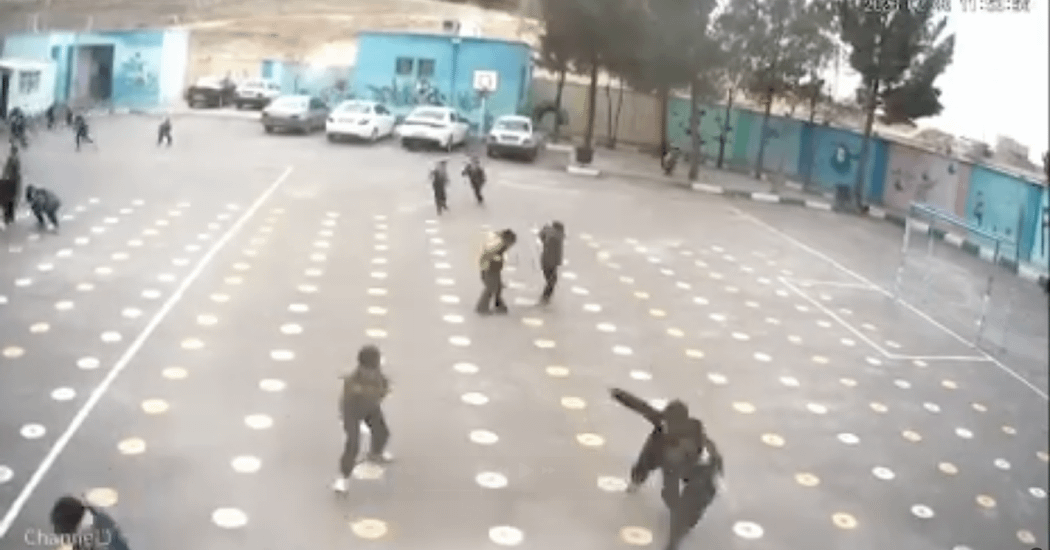
At the Imam Reza Elementary School for boys in Abyek, a small city in the Qazvin Province, west of Tehran, security camera footage from Feb. 28 shows scenes from an ordinary morning. Some 40 boys play on the playground. A few wander around, others linger by the soccer goal and a large group gather in a circle.
That was just hours after the first joint Israeli and U.S. strikes on Iran, according to Iranian state media. Schools were still open.
Then, the footage shows a large explosion at the top of the screen, where a communications tower stands on a hill.
The blast rips through the area, damaging the school. The footage shows windows shattering. Children run, some with hands over their ears. A child falls to the ground by a soccer goal post, seemingly hit by a piece of debris. Tasnim, a semiofficial Iranian news agency, identified the child as Mahyar Zanganeh and said he had not survived.
The video remained virtually unseen until it was posted online on Friday. It has since been verified by The New York Times.
The footage captures one of two known explosions near a school in service on Feb. 28, the first day of U.S.-Israeli attacks. The other hit a girls’ school in Minab, where 175 people, many of them children, were reported killed.
No side has taken responsibility for that strike so far. Videos verified by The Times show a Tomahawk cruise missile hitting a naval base operated by the Islamic Revolutionary Guards Corps beside the school in Minab. (The U.S. military is the only force involved in the conflict that uses Tomahawk missiles.)
The footage from the school in Abyek was shared by the official channel of the Coordinating Council of Iranian Teachers’ Unions, one of the largest trade unions in the country; some of the group’s members have been imprisoned by the Iranian government in the past for their activism.
Using before and after satellite imagery, The Times, as well as geolocation experts, have determined that the communications tower where the explosion was observed in the security camera footage seemed to have been the intended target. The structure, less than 400 feet from the playground, was reduced to rubble after the explosion.
“We have active members in Qazvin Province and in the teachers’ movement there,” said Shiva Amelirad, an international representative in Toronto for the Coordinating Council of Iranian Teachers’ Unions. “But unfortunately contact has not been possible yet, due to widespread internet disruptions across the country.”
In a public statement, the union emphasized that targeting schools and hospitals was “rejected under any circumstances,” stressing that attacks on such spaces “were not only a violation of fundamental humanitarian principles, but also a clear breach of international law and human rights conventions.”
The U.S. and Israeli militaries did not respond to requests for comment.
Posted by John3262005
3 Comments
Arms manufacturers were having a special on kid-seeking missiles, I guess
Hegseth himself inadvertently gave the most likely explanation for the spate of child-killing by the US & Israeli militaries: removal of those pesky woke rules of engagement. These boys, like the girls at the other school, were acceptable collateral damage.
American weapons are accurate enough so that this wasn’t a sloppy strike. Israeli intelligence is good enough that they knew exactly what buildings were in the blast radius. So then what’s the most charitable explanation, since we can’t blame these attacks on technological or intelligence limitations? It’s that they realized they were going to put the lives of hundreds of children at risk but it was a price they had no problem paying for the payoff of taking out nearby (supposedly) military targets.
This demonstrates how much Trump administration is focused on gender equality u stupid liberals