
Eric Saddigh was only 16 when he fled Iran with his family. Like thousands of others who fled the country after the 1979 Islamic revolution, they landed in Los Angeles, joining what has since become the largest Iranian community outside Iran.
“I’m a refugee,” says Saddigh, owner of the Farhad Rug Gallery in the heart of “Tehrangeles”, a thriving Iranian corridor along Westwood Boulevard. “All the people here are.”
Despite living most of his life in America, Saddigh, now in his sixties, thinks he may soon be able to move back to his homeland. For this he gives all credit to US President Donald Trump and Israeli prime minister Benjamin Netanyahu for killing Iran’s supreme leader Ayatollah Ali Khamenei, a move he believes will lead to a collapse of the regime.
“Trump and Netanyahu, oh, my God, the amount of — excuse my language — balls they have,” he says. “They’re not gonna stop until they get rid of this regime. Trump is gonna be written in history.”
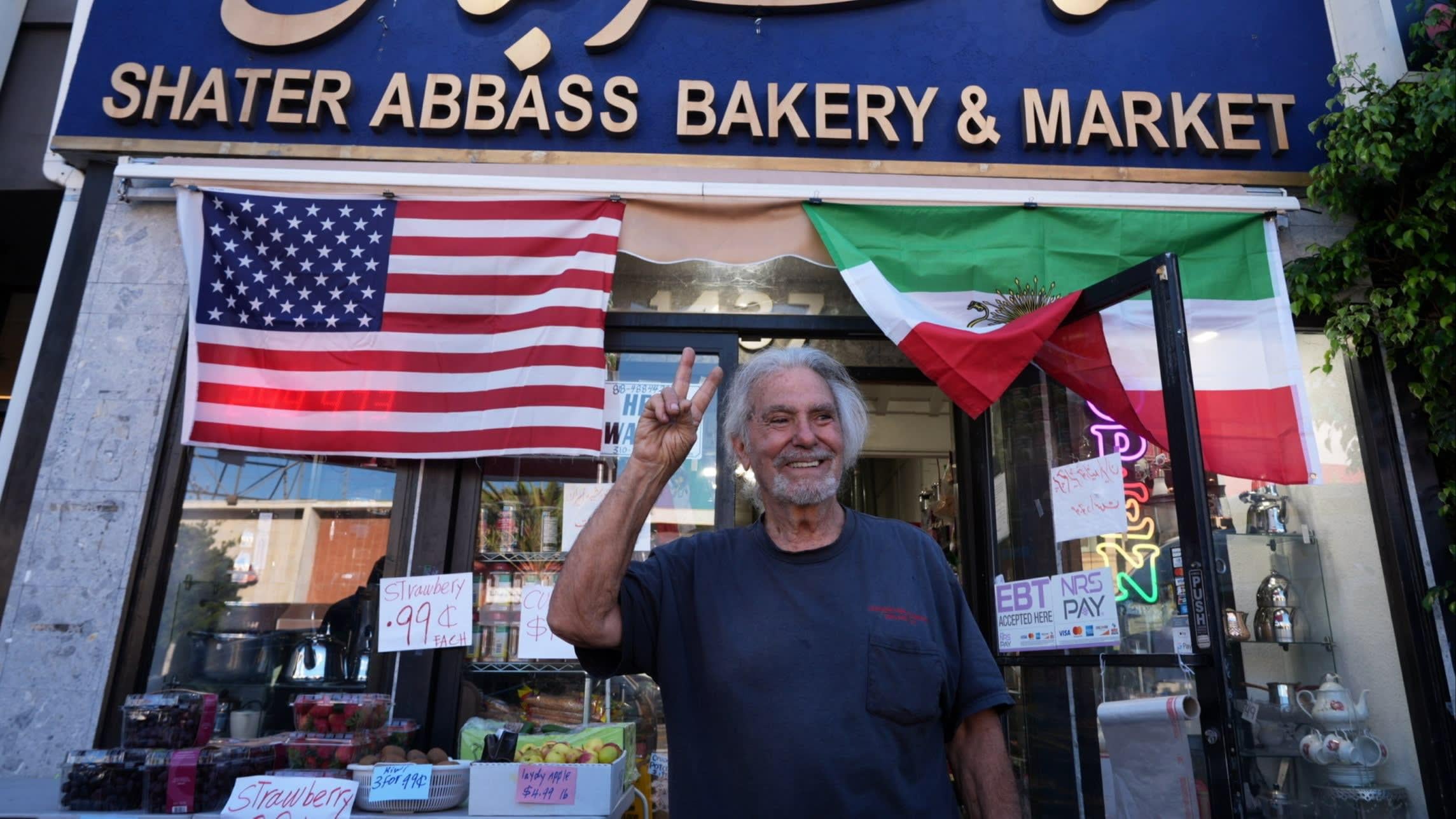
Support for the US-Israeli attacks on Iran has been widespread in the neighbourhood, where there was dancing in the streets on the night of the initial attacks. Since the US and Israeli air strikes began at the end of February, Westwood Boulevard’s Persian markets, kebab shops, bookstores and rug merchants have been festooned with Iran’s pre-revolution “lion and sun” flag by locals who hope the war will return Iran to the country they knew over four decades ago.
At the Naab Café, which serves kebabs and other Persian food, there is a poster pasted on the front window with the slogan Make Iran Great Again. Nearby shops feature tapestries bearing the image of the last Shah of Iran and many windows feature the likeness of his exiled son, Reza Pahlavi, whom some hope will emerge as the leader of the country.
Pahlavi’s campaign to position himself as the country’s leader-in-waiting has not persuaded Trump, however. This is the only point on which Saddigh seems to diverge from the US president. “It’s not up to Trump after this regime is gone,” he says. “The people are gonna say who they want. That’s it.”
Mohammad Ghafarian, owner of the Shater Abbass Bakery & Market, says he is feeling a mixture of “happiness and fear”.
“I’m happy because they have taken out the regime,” he says. “The fear is over the bombing of Iranians everywhere.” He has two brothers and two sisters still living in Tehran, and is worried about their safety.
Ghafarian’s small shop is full of Persian teas, pistachios, dried figs and other specialities and he is worried that the war has made it more difficult to import goods. He says he is already running low on dried figs.
But while Saddigh talks about returning to Iran when — or if — the regime falls, Ghafarian seems content to stay in LA. He left Iran for Canada in 1974, then moved to the US in 2001, where he raised his family.
“We are happy,” he says, bragging about his children and the degrees they received at UCLA and other American universities. “We succeeded here.”
Like many other Iranians in Tehrangeles, he also has warm words for Israel. “Most of my customers are Israelis,” Ghafarian says. “And I love them.”
This sentiment — an Iranian shopkeeper expressing love for his Israeli customers — runs counter to the decades of hostility between the governments of Israel and Iran. But in Tehrangeles, Israel and the US are regarded as allies liberating long-suffering Iranians from a brutal regime.
The community is not far from Beverly Hills, which has significant numbers of Iranian Jewish residents. The mayor of Beverly Hills, Sharona Nazarian, is an Iranian Jew who fled the country in 1979 with her family.
Last week Nazarian wrote a message on Instagram that encapsulated the feelings of many Los Angeles-based Iranians watching the war unfold thousands of miles away. “Many in our community have deep family ties, personal memories, and strong emotional connections to what is happening [in Iran],” she posted. “They have waited for this moment for 47 years.”
Posted by Zealousideal-Rich455
3 Comments
This comment in the article really clarified the dynamic with Iranian and other diaspora communities. I have always found it perplexing how hawkish the Iranian diaspora are against their homeland.
>The late Fred Halliday, a professor of international relations at LSE, wrote that diasporas usually have a negative impact on the politics of their country of origin. There are several reasons but they all tend to make diasporas more nationalist than the nationalists, more traditionalist than the traditionalists, and definitely less willing to let go of old grievances. The impact plays out in different ways: I srael might have become rather different but for the vast influence of American and Russian money; Ukrainian diasporas in North America insist on written language differences which really should be let go of and often do on the ground where people aren’t much fussed if you say the the equivalent of either “Hallo” or “Hello” ; Armenian diasporas don’t want the governments and people living in Armenia to let go of old grievances – perfectly genuine grievances but it serves no one if you constantly nurture them. I would be very wary of I ranian diasporas.
Rooting from abroad for their homeland to burn. Common exile L.
>he says he is already running low on dried figs
Oh damn I gotta see if they still got some in the bulk bin at the grocery store. Always gotta have some dried figs on hand.