
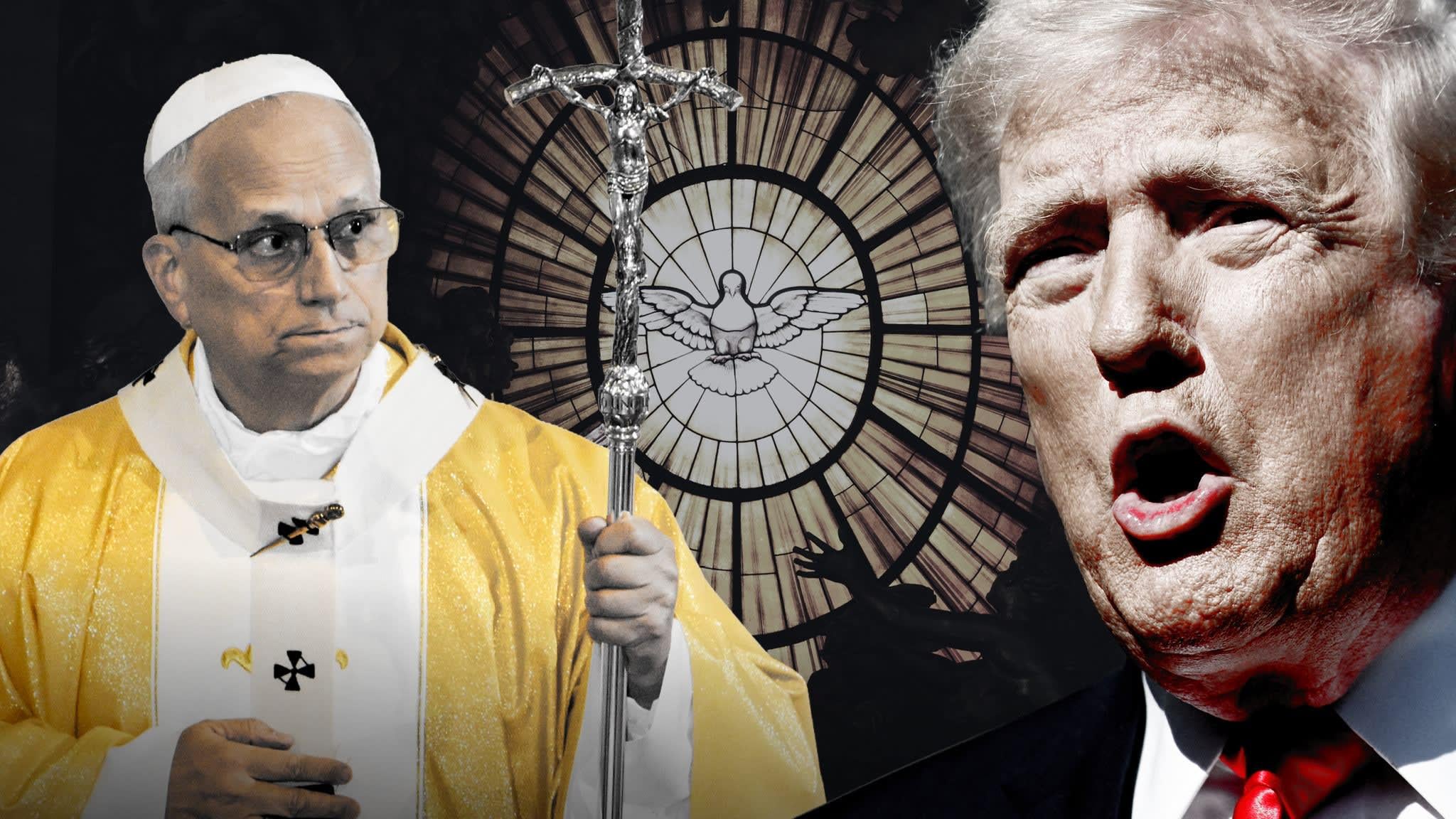
“I have no fear of the Trump administration,” the leader of the Catholic Church said this week, as he became a global rallying point for critics of the US president.
In the past few days, Pope Leo XIV, a low-profile cardinal just a year ago, has traded barbs with Donald Trump, the most powerful man in the world. The dispute is more reminiscent of the rivalry between medieval popes and emperors than of the Vatican-White House co-operation that helped win the cold war.
“We are not politicians — we don’t deal with foreign policy with the same perspective as he might understand it,” the 70-year-old from Chicago said of the 79-year-old from Queens, hours after Trump called on him to “stop catering to the Radical Left and focus on being a Great Pope, not a Politician”.
But by seeking to mobilise his compatriots to stop what he dubs an “unjust war” on Iran, Pope Leo has waded deep into the politics of his homeland all the same.
At a time when there is no single voice of opposition to Trump at home or abroad, the first US-born pope’s attack on the administration’s policies could have electoral consequences in his native country, while risking political peril for the president.
“Trump does not really understand that he has run into a more than 1,500-year-old theological tradition — a set of moral teachings about war and violence,” says Robert Jones, founder of the Public Religion Research Institute, an independent think-tank. “It is perhaps not the smartest thing to be picking a fight with the pope.”
The pontiff, born Robert Prevost, has taken the debate to Trump in a way that his predecessor Pope Francis, who spoke little English, never could.
As his own remark suggested, the pope also differs from other leaders who may have more to fear from the US’s economic and military power that was used to threaten Nato allies over Greenland just a few months ago.
“Donald Trump is used to sycophancy from world leaders who are generally too terrified of his reprisals to oppose him,” says Thomas Wright, a senior fellow at the Brookings Institution. “Trump can’t use his normal tools of intimidation, like tariffs and abandoning security commitments, against the Vatican.”
The president’s criticism of the pope has hit a nerve even among some of Trump’s allies. Giorgia Meloni, the Italian prime minister, has called his attack on Leo “unacceptable”.
Within the US, the pope’s popularity appears to far outstrip Trump’s. An NBC News poll last month gave him a 34-point net favourability rating, compared to a minus 12 rating for the president in the same survey.
At root, Vatican officials say, Leo’s concern about Trump reflects a widening ideological divide between Washington and the Church over the future of the global order and the legitimacy of violence as a means of resolving disputes.
“Leo is not attacking a president,” says Father Antonio Spadaro, under-secretary of the Vatican’s culture and education department. “The conflict is the visible symptom of a much deeper collision between two incompatible operating systems of the world.”
The Holy See is alarmed at a more theological politics, Spadaro adds, in which “God is enlisted to bless the strong”.
Leo has also joined critics who say the Trump administration’s approach to immigration enforcement is cruel and unjust. “Someone who says, ‘I’m against abortion but I’m in agreement with the inhuman treatment of immigrants in the US,’ I don’t know if that’s really pro-life,” he said last year.
Catholic clergy deep in the heartlands of Trump’s Maga movement have made even stronger statements. Bishop Anthony Taylor of Little Rock, Arkansas, spoke in January of “obvious parallels” between 1930s Germany and Immigration and Customs Enforcement raids.
But this week the confrontation has hit new heights. On Monday, Trump told reporters he saw no need to apologise to the pope, whom he blamed for the current war of words. “He went public,” the president said. “I’m just responding.”
Hours later, Trump told CBS News the pope was “wrong on the issues”, adding: “I don’t think he should be getting into politics.”
Fears of a Catholic pope seeking to influence American politics have loomed over the US all the way back to the country’s founding by strict Protestants.
So sensitive did the issue become that on a 1963 trip to the Holy See John F Kennedy, the country’s first Catholic president, declined to kneel and kiss the papal ring.
That spectre of papal influence had been largely illusory — but now, perhaps, no longer.
Last week Leo made an unprecedented appeal to American citizens to call their congressional representatives to come out against Trump’s attacks on Iran.
“When a pope invites people to contact their political representatives, the implicit message is, ‘this is a government that is not pursuing the interests of the people’,” says Massimo [F.], a professor of theology and religious history at Trinity College Dublin.
“One of the conditions of the acceptability of Catholics in the American political project was that the Vatican would not interfere with American democracy,” [Massimo] adds. “The pope doing what he did crossed that line . . . He is clearly trying to influence voters in America.”
Leo — heir to a progressive Catholic tradition committed to social justice — sees himself as a defender of the ideals of the multilateral order promoted by the US after the second world war, according to officials in the Holy See.
That is in line with the modern Vatican’s view of Catholicism as a universalist, humane and compassionate faith that should side with the weak and coexist peacefully with other religions and beliefs.
By contrast, Trump sometimes appears to anticipate a new world order in which strong military powers — such as the US, China and Russia — each have spheres of influence. In Washington, top officials now deploy Christian rhetoric to try to sanctify that approach — such as US defence secretary Pete Hegseth, an evangelical Christian widely criticised for praying for “overwhelming violence” and “righteous targets” in the war with Iran.
“There is a clear clash of civilisations between very different types of Christianity,” [Massimo] says. “Pope Leo is the face of the resistance against the militarisation” of the faith.
The dispute is deeply uncomfortable for vice-president JD Vance, who converted to Catholicism in 2019, and has a new book coming out soon about his embrace of the faith.
Vance said this week that he was “frustrated” some Catholic clergy had “attacked mercilessly the Trump administration on immigration”, given his contested view that dangerous criminals have taken advantage of lax enforcement to cross into the US. “How is it humane to allow drug traffickers and sex traffickers to bring little kids across the southern border?” he asked.
The vice-president insists the administration “respects” the pope. Speaking to Fox News, he said it was a “good thing” that Leo was “advocating for things that he cares about”, calling it “reasonable” for Washington and the Catholic Church “to disagree on substantive questions from time to time”.
But he has called on the Vatican to “stick to matters of morality”. On Wednesday, he added: “In the same way that it’s important for the vice-president of the US to be careful when I talk about matters of public policy, I think it’s very, very important for the pope to be careful when he talks about matters of theology.”
Responding to Vance’s comments, Spadaro of the Vatican says: “The question of war and peace is a moral issue and an integral part of the Church’s doctrine.”
The ideological clash between pontiff and president represents a battle for the hearts and minds of the US’s estimated 53mn Catholics, who represent around 20 per cent of the country’s population.
With Trump’s Republican Party fighting to keep hold of both chambers of Congress in November’s midterm races, the dispute could also have electoral reverberations.
Jones at the Public Religion Research Institute, which studies religion, culture and politics, says white, non-Hispanic Catholics have been “very critical to [Trump’s] electoral success” in Midwestern battleground states such as Pennsylvania, Michigan, Ohio and Wisconsin.
Recent polling suggests that Trump’s standing among Catholic voters had already been slipping ahead of the Iran war, amid a wider backlash against the administration’s immigration tactics and a cost of living crisis fuelled by high petrol prices and steep import tariffs.
A CBS News/YouGov survey this month, before Trump’s outburst at the pope, found 54 per cent of American Catholics disapprove of the job Trump is doing as president, compared with 46 per cent who approve. A majority disapproved of the US military action against Iran.
The poll found that church attendance was a key indicator of support for Trump among Catholics, with 58 per cent approval for the president among those who attend church at least weekly, compared with a 42 per cent approval rating among those who go to mass less often.
But Trump’s Iran comments have rocked even his Catholic base.
“With all due respect, we believe that President Trump is in the wrong to try to say that Pope Leo should not be speaking up about [the Iran war],” says John Yep, founder of Catholics for Catholics, a conservative group that has campaigned for Trump.
“That is most certainly what he should be doing as the vicar of Christ. He is not a political figure, but he is a spiritual father for millions of people around the world.”
While Yep says he is not concerned about the impact on the midterms, he adds: “A Catholic or a Christian should never expect their vote to be taken for granted. It is healthy for us to continue to speak up no matter what. If you don’t, you fall into the risk of a cult.”
Indeed, for much of the 20th century, Catholic voters were more aligned with the Democratic Party. But they shifted to the right in the 1980s, as the Republican Ronald Reagan endorsed the anti-abortion or “right to life” movement and established diplomatic relations with the Holy See.
Washington and the Vatican also worked together in the battle against communism, bound by a shared commitment to religious freedom. John Paul II collaborated closely with Reagan, particularly in supporting the Solidarity movement of the then pope’s native Poland.
Despite frictions over George W Bush’s 2003 US-led invasion of Iraq during the papacy of John Paul II, his successor, the conservative Pope Benedict XVI, found common ground with Republicans about the impact of radical Islam and the secularisation of the west.
Discourse within American Catholicism has also shifted right in recent years, with influential laypeople spending significant sums on conservative institutes, media and conferences.
But tensions between Washington and the Vatican opened up under Pope Francis, an Argentine populist with a strong streak of anti-Americanism, who shifted the Church’s primary focus from issues such as abortion to topics such as climate change and developing country debt.
“He was considered a biased pope against Yankees, against gringos,” says Massimo Franco, author of the new book Popes, Dollars and Wars: The Power of America in the Vatican from Past Taboos to Pope Leo XIV. “It was easy to make a caricature of his approach to the US.”
Such attacks are much harder to deploy against the White Sox-loving, pizza-eating Leo from the South Side of Chicago.
Despite a lack of religiosity that led him to joke last year that he would not “make heaven”, Trump has earned plaudits from many Catholics for his appointment of conservative judges, including three Supreme Court justices who helped to overturn Roe vs Wade, which guaranteed the constitutional right to an abortion.
The president himself was raised as a Presbyterian, but more recently has self-identified as a non-denominational Christian and filled the top ranks of his administration with devout evangelicals and conservative Catholics.
But many in the Holy See believe the US Church has allied itself too closely with the Republican Party in recent years. Prominent conservative clerics such as Cardinal Timothy Dolan, former archbishop of New York, publicly repudiated Democrats such as former president Joe Biden, himself a Catholic, instead embracing Trump and the Maga movement.
Leo, like Francis before him, has indicated he would like to see the US Church move away from such explicit partisanship and the hot-button issues of the culture war to focus on broader issues such as economic inequality.
Spadaro of the Vatican talks of “the possibility that American Catholicism rediscovers itself as a Church rather than as a tribe, less a cultural identity in the culture wars, more a community of moral discernment”.
The pope’s power and influence over American Catholics is “confusing” to Trump, says Christopher Hale, who helped lead Catholic outreach for President Barack Obama’s 2012 re-election campaign. “He completely overturns how Donald Trump conceives of power because he gets it not by force, but by moral authority.”
Many Christians were also taken aback by Trump’s use of swear words in a social media post on Iran on Easter Sunday and by his posting of an image at the weekend that appeared to depict him as Jesus, laying a healing hand on a man in a hospital bed. The president said that he thought the AI-generated picture, which he later deleted, showed him as a doctor rather than the Messiah.
John Kenneth White, professor emeritus of politics at the Catholic University of America, argues that Trump’s attack on the pope is likely to backfire badly.
“It is politically dumb. It makes absolutely no sense,” he says. “Trump’s political coalition is under a great deal of tension, and Catholics are not immune to that. It is more of a swing vote and more shakeable than perhaps Trump realises.
“The pope is now the most important American on the world scene,” White adds. “Trump just cannot stomach it.”
Posted by IHateTrains123
2 Comments
First American pope and “God’s President” goes after him. I want conservative Catholics to make it make sense.
Moral integrity and intellectual stewardship make the art resonate with what so many recent converts miss in just idealizing ornate doors or stained glass: the celebration of humanity made in the image of God is worthy of celebrating. Destruction is incompatible with this.
This exchange is also so telling:
>As his own remark suggested, the pope also differs from other leaders who may have more to fear from the US’s economic and military power that was used to threaten Nato allies over Greenland just a few months ago.
>“Donald Trump is used to sycophancy from world leaders who are generally too terrified of his reprisals to oppose him,” says Thomas Wright, a senior fellow at the Brookings Institution. “Trump can’t use his normal tools of intimidation, like tariffs and abandoning security commitments, against the Vatican.”
He is so used to getting his way someone standing up for themselves and especially for others is genuinely shocking, because no one but him has agency.