
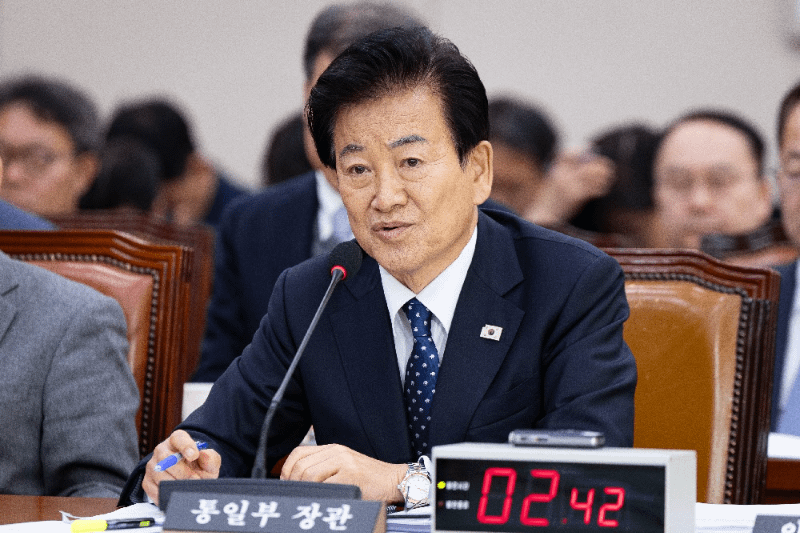
The United States has reportedly informed South Korea that it intends to partially restrict intelligence sharing on North Korea after Unification Minister Chung Dong-young identified Kusong, North Pyongan Province, as North Korea’s third nuclear facility last month. Observers say the move may reflect U.S. dissatisfaction over discord between Seoul and Washington on pending bilateral issues, using Chung’s remarks as a pretext.
According to South Korean and U.S. sources on the 16th, after Chung’s comments regarding the Kusong nuclear facility, the U.S. strongly protested through multiple channels over the disclosure of sensitive information to the outside. One source said, “The U.S. appears dissatisfied that information shared with South Korea was made public.” A U.S. source also said, “The intention to scale back intelligence sharing was conveyed to the South Korean government.”
The U.S. is said to have partially limited intelligence exchanges with South Korea regarding North Korea. South Korea still relies heavily on the United States in the area of surveillance and reconnaissance concerning North Korea. If U.S. sharing of satellite intelligence and other information is reduced, it could directly affect South Korea’s monitoring posture toward the North.
Previously, at a full session of the National Assembly Foreign Affairs and Unification Committee on the 6th of last month, Chung said, “There are uranium enrichment facilities in Yongbyon, Kusong, and Kangson.” In response, the Ministry of Unification stated, “The minister’s remarks were based on publicly available information known through U.S. think tanks and other open sources,” adding that “No information related to Kusong was provided by any other government agency.”
The U.S. has previously expressed concern over other issues as well. Some observers say Washington may partially restrict the sharing of reconnaissance intelligence.
The revelation that the United States has conveyed plans to partially restrict intelligence sharing regarding North Korea has raised concerns that bilateral coordination toward North Korea could suffer. Although Chung’s public mention of Kusong was the immediate trigger for the U.S. reaction, analysts point to accumulated dissatisfaction over a series of diplomatic and security disagreements between Seoul and Washington as the deeper cause. U.S. officials are also said to have expressed concerns even before Chung’s remarks about the South Korean government’s handling of information disclosure.
At the National Assembly committee meeting last month, Chung emphasized the need to halt North Korea’s advancing nuclear capabilities and identified Kusong in North Pyongan Province as a uranium enrichment site. Chung said, “IAEA Director General Rafael Grossi reported to the Board of Governors on the 2nd that there are uranium enrichment facilities in Yongbyon, Kusong, and Kangson.”
However, Grossi did not mention Kusong in the keynote speech cited by Chung.
A uranium enrichment facility in Kusong has never been officially confirmed by South Korean or U.S. intelligence authorities. The Ministry of Unification explained, “Since a 2016 report by the Institute for Science and International Security (ISIS), as well as more recent research institute and media reports, there has been discussion of possible uranium enrichment activity in Kusong. Based on those reports, the minister understood that a facility existed there.”
The ministry added, “Even during his confirmation hearing in July last year, before assuming office, Chung referred to Kusong. He did not make the statement based on information provided by any government agency.”
ISIS stated in that report that “an early centrifuge research and development facility is believed to have existed at a factory near Banghyon Air Base, about 45 kilometers west of Yongbyon.” It added that the site may have housed as many as 200 to 300 centrifuges. Banghyon Air Base is located in Kusong.
Unlike plutonium extraction at the 5MW reactor in Yongbyon, which requires large reprocessing facilities more easily exposed to reconnaissance assets, highly enriched uranium production can be conducted in smaller facilities and hidden underground, making detection by South Korean and U.S. authorities more difficult.
North Korea has publicly exposed HEU facilities only twice. Although Rodong Sinmun did not identify the locations visited by Kim Jong Un, South Korean and U.S. intelligence reportedly assessed that he visited the Kangson HEU facility in September 2024 and the Yongbyon HEU facility in January last year.
As North Korea’s covert production of nuclear materials is believed to be ongoing, South Korean and U.S. authorities have closely monitored suspected HEU activity across the country.
Following Chung’s mention of Kusong, the U.S. reportedly raised objections through multiple channels. One source said, “The U.S. appears to have partially restricted intelligence sharing between the two countries.”
The information reportedly affected includes intelligence gathered through surveillance and reconnaissance assets. South Korea is improving its independent reconnaissance capability through the “425 Project,” which aims to deploy five military reconnaissance satellites by 2027, but it still depends significantly on the United States in this field.
In response, the Ministry of Unification stated, “We sufficiently explained the background of the minister’s remarks, and the U.S. side indicated understanding,” adding that “Even if any U.S. measures were taken, they are not directly related to Minister Chung’s remarks.”
Some analysts note that the latest expression of U.S. dissatisfaction cannot be separated from a broader pattern of friction between Seoul and Washington over other diplomatic and security issues.
Posted by Freewhale98
1 Comment
1. Summary
Trump administration restricts intelligence sharing with Korea after Reunification Minister Chung Dong-young told National Assembly Foreign Affairs and Reunification Committee about the whereabouts of North Korean nuclear sites. Analysts say it is a reflection of strained relations between the US and Korea over Korean troops in Iran War and the THAAD re-deployment to the Middle East.
2. How is this related to the sub
(1) Iran War aftermath: Trump administration is punishing allies who didn’t help his war on Iran.