
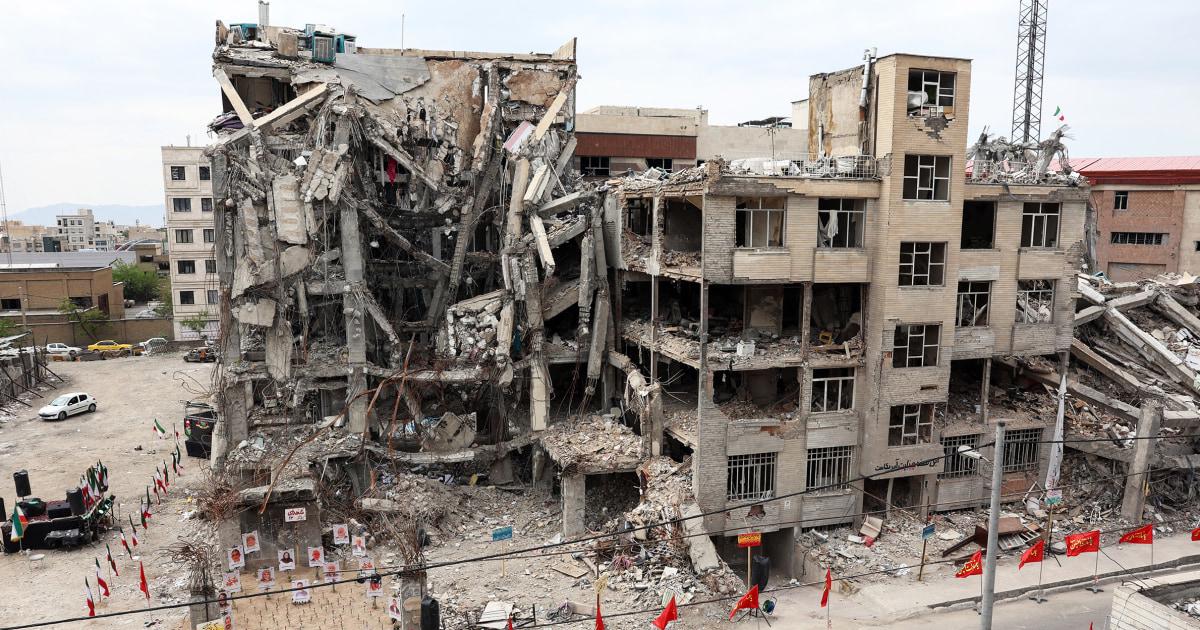
American military bases and other equipment in the Persian Gulf region suffered extensive damage from Iranian strikes that is far worse than publicly acknowledged and is expected to cost billions of dollars to repair, according to three U.S. officials, two congressional aides and another person familiar with the damage.
The Iranian regime swiftly retaliated after the Trump administration attacked on Feb. 28, hitting dozens of targets across U.S. military bases in seven Middle East countries. Those attacks struck warehouses, command headquarters, aircraft hangars, satellite communications infrastructure, runways, high-end radar systems and dozens of aircraft, according to the U.S. officials and an assessment by the American Enterprise Institute, a conservative think tank in Washington, D.C.
In the initial days of the war, an Iranian F-5 fighter jet bombed the U.S. base Camp Buehring in Kuwait, despite the base having air defenses, a rare breach that marked the first time an enemy fixed-wing aircraft has struck an American military base in years, according to two of the U.S. officials.
The U.S. bases that came under attack are home to thousands of American troops, and in some cases their families, though they were largely cleared out in the days and hours before the U.S. and Israeli went to war with Iran.
The Pentagon has not detailed the extent of the damage to U.S. military bases publicly or, according to the U.S. officials, to members of Congress.
“We do not discuss battle damage assessments for operation security reasons,” a Pentagon official said in a statement. “Our forces remain fully operational, and we continue to execute our mission with the same readiness and combat effectiveness.”
U.S. Central Command declined to comment on battle damage assessments.
Last month, the administration asked private satellite companies, including Planet Labs, to withhold imagery of the bases from the public, making the extent of the destruction difficult to assess, according to the U.S. officials and experts, including a statement from Planet Labs to their customers.
The administration’s request remains in place, a Planet Labs spokesperson said. A White House spokesperson declined to comment.
Some Republican lawmakers privately have expressed frustration directly to senior Pentagon officials about their refusal to provide information about the extent of the damage or any cost estimate for repairs, according to two GOP congressional aides.
“No one knows anything. And it’s not for lack of asking,” one of the aides said. “We have been asking for weeks and not getting specifics, even as the Pentagon is asking for a record high budget.”
Asked for comment, White House spokesperson Olivia Wales said the U.S. had achieved the military objectives of Operation Epic Fury. “As the president has said, this was the last, best time to strike, and — thanks to our heroic warfighters — the operation was a tremendous success,” Wales said in a statement. “President Trump took decisive action to ensure that Iran can never have a nuclear weapon to threaten the United States or our assets and allies in the region, and Americans are already safer for it.”
The damage to and cost of repairing the bases could reignite a yearslong debate over the merits of maintaining U.S. bases in such close proximity to an adversary like Iran. Some national security officials, including some serving in the Trump administration, have for years pushed to move U.S. bases in the region further east and away from Tehran’s reaches. The issue also could embolden critics of America’s military presence overseas who have advocated for shrinking the U.S. presence in the Middle East, one U.S. official and one person familiar with the matter said.
The three U.S. officials familiar with the damage to U.S. bases in the Middle East described it as extensive. The headquarters building for the U.S. Navy in Bahrain, the nerve center for the Navy’s operations in the region, sustained serious damage, the officials said. They said other parts of the base in Bahrain also suffered significant damage that is likely repairable.
Multiple hangars and warehouses at Ali Al Salem Air Base in Kuwait also were struck, according to the American Enterprise Institute’s unofficial assessment that was reviewed by NBC News. The assessment also shows a munitions storage facility at a military base in Erbil in northern Iraq was damaged and a runway at the sprawling Al-Udeid Air Base in Qatar was destroyed.
U.S. bases had been cleared of U.S. troops and other personnel, so many of the bases were left essentially empty and vulnerable to attack by Iranian missiles and drones. Many of the troops who were temporarily relocated are expected to return to the bases once tensions in the region subside.
Thirteen U.S. troops have been killed in the conflict and as many as 400 have been wounded, although more than 90% have returned to duty, according to the U.S. military.
The Pentagon has refused to provide specifics, but during an April 8 briefing, Chairman of the Joint Chiefs of Staff Dan Caine said the U.S. and partners in the Gulf region intercepted 1,700 ballistic missiles and one-way attack drones during the war. A fourth U.S. official said only a fraction of the projectiles actually got through the U.S. and ally defenses.
Congress is considering legislation to support the cost of the war, including unspecified repairs and other costs in a so-called supplemental bill that could exceed $100 billion, according to two of the U.S. officials and two other people familiar with the matter.
According to the AEI’s assessment, Iran hit more than 100 targets across 11 bases in seven Gulf countries. Those attacks fell on U.S. and host-nation bases in Qatar, the United Arab Emirates, Bahrain, Jordan, Kuwait, Iraq and Saudi Arabia.
“As part of Epic Fury, the potential future costs to rebuild American military infrastructure overseas may include repair, reconstruction, outright replacement, or even abandonment/decommissioning of locales,” Mackenzie Eaglen, a senior fellow at AEI, said in a statement about the group’s assessment. “War damage also includes estimated costs for infrastructure that is unsalvageable.”
Eaglen’s cost estimate for repairing the infrastructure is more than $5 billion, but that amount does not account for some of the radar systems, weapons systems, aircraft and other equipment destroyed in the Iranian strikes, she said. Eaglen has worked on defense and budgetary and military readiness issues for years and is a former Pentagon official.
The Iranians damaged at least two air defense systems in the region, according to the U.S. officials.
Iran has also destroyed U.S. military aircraft. NBC News reported that at least one fighter jet, more than a dozen MQ-9 Reaper drones, two MC-130 tankers and four helicopters known as “little birds” were also destroyed.
Additional helicopters, tankers, an E-3 Sentry plane and two more helicopters known as Jolly Greens were also damaged, according to U.S. officials and information provided during a Pentagon briefing.
Radar systems in the UAE and a satellite communication system in Bahrain were also damaged the U.S. officials said, but it’s not clear whether Bahrain or the UAE would cover the cost of those systems.
Posted by John3262005
1 Comment
More stuff for the next Democratic admin to spend political and actual capital to patch up instead of focusing on doing new and better things
Great