
West bengal was the longest lasting democractically elected communist government on earth 34 years. the longest continuous reign of any party in one state.
now? its bascially dead zero seats in any house . Now in India, it fights for its life as it still struggles to retain relevance. now Shekhar Gupta's writing on the wall series is one of the best things (its what got me into indian poltics) so I highly recommend people read it
Posted by ewatta200
1 Comment
ow can you read the writings on the wall in poll-bound West Bengal without stepping into Kolkata? You come with me, nearly 600 kilometres north to the Siliguri corridor, the narrow, 60-kilometre, or if you stretch it right back to North Dinajpur district, 90-kilometre strip joining the Bengali mainland to its Himalayan and Dooars districts to the north and the east, respectively. And more precisely, we begin with the walls of Naxalbari.
[](https://vdo.ai/contact?utm_medium=video&utm_term=theprint.in&utm_source=vdoai_logo)
If anybody kept track of these things anymore, we would now be observing the 59th anniversary of the armed Maoist uprising that began right here, this precise week in 1967.
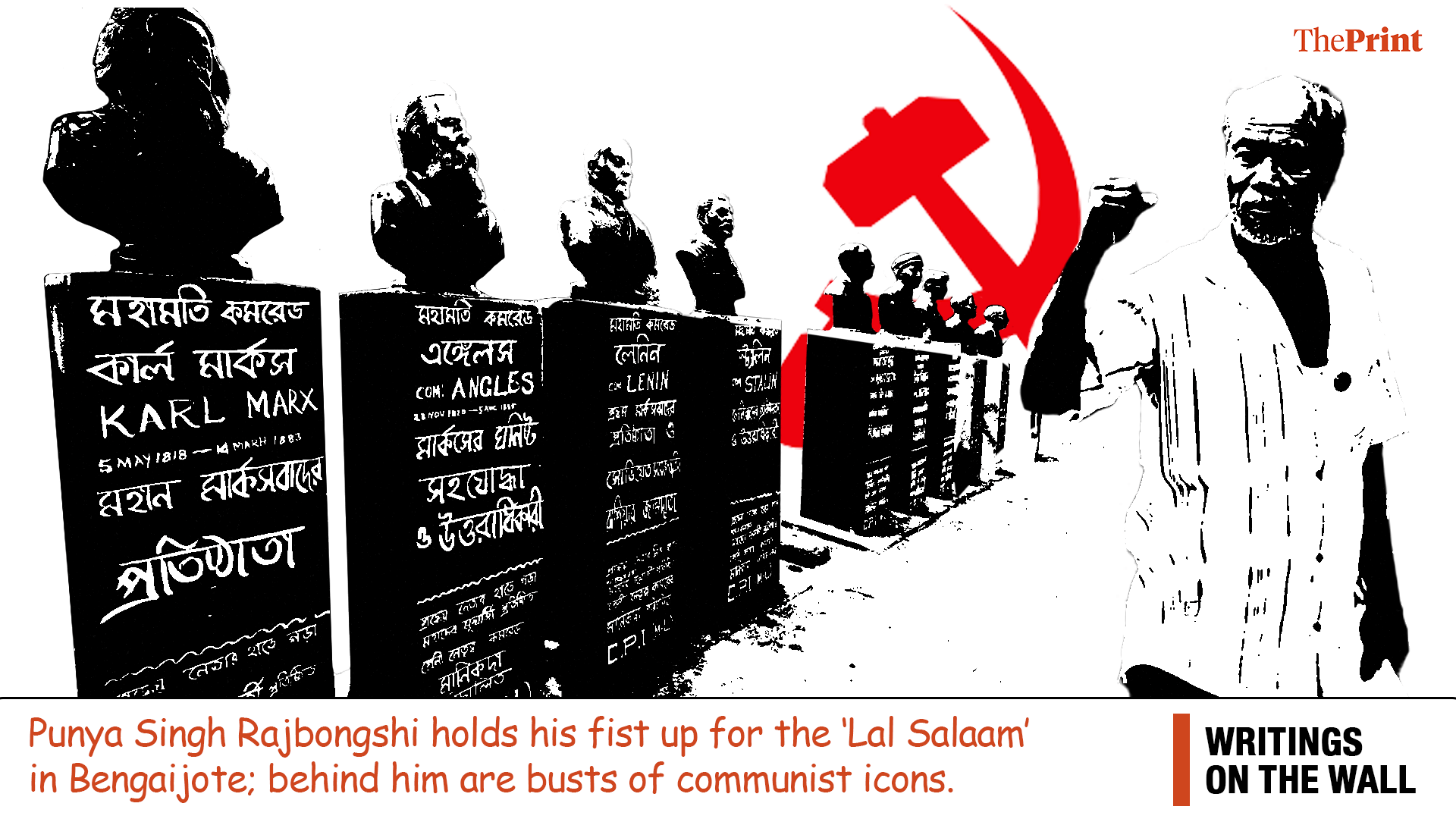
That’s why the first writings on the wall we read are in village Bengaijote, part of the Naxalbari cluster, where the Maoist insurgency saw its first spark.
Serendipity, or reporter’s luck, I came here in that anniversary week and found two old comrades busy giving a fresh coat of paint and a vigorous ‘*jhaadu-pochha*’ (scrub) to the storied memorial to that lost revolution, where busts of Marx, Lenin, Engels (spelt Angles, never mind), Stalin, Mao, Charu Mazumdar and Saroj Dutta stand. I’ve deliberately excluded one for now. The first five were the grand deities the revolution prayed to. The last two were its local founder and his successor, respectively. And then the name I excluded mischievously but here we are.
Standing shoulder-to-shoulder with Mao, is Marshal Lin Piao (Biao), the strongman boss of the Chinese PLA, and often seen as the second most powerful figure in the Communist Party of China. Until, one day all of a sudden (13 September, 1971), he was gone. The aircraft carrying him and his family crashed in Mongolia in what history knows as the Lin Biao incident. The official Chinese explanation was that he was fleeing after a failed coup, or the so-called ‘Project 571’.
Illustration: Shruti Naithani/ThePrint
As with much of that history of Communism, doubts and arguments persist but it’s believed he was escaping to the Soviet Union. By this time, as we well know, a Pakistani-brokered thawing had taken place between China and the US. Nevertheless, Lin was condemned as a traitor and charged with planning a coup along with Mao’s wife Jiang Qing. Both were consigned to the CPC’s hall of shame as ‘counter revolutionaries’. But, not in Naxalbari. Here, Bengaijote is probably the only spot in the world where you’ll still find Mao and Lin next to each other. And the ‘history’ doesn’t bother Punya Singh Rajbongshi, a Scheduled Caste comrade sprucing up the memorial for the anniversaries; Naxalbari uprising’s 59th and 156th of Lenin’s birth (22 April).
How can you have Lin Biao with Mao, I ask.
‘Because Lin Biao and Chairman Mao, our Chairman, were great comrades,’ Rajbongshi says.
But, didn’t Lin betray Mao who, in turn, had him killed? I persist.
‘No, that’s propaganda. It’s that Liu Shaoqi who conspired against him,’ Rajbongshi was firm. I didn’t remind him that Liu had died almost two years earlier. Why argue with the faithful.
On the memorial wall meanwhile, another old comrade, in a significantly higher ‘spiritual’ state, is sticking pre-painted wallpaper that says, translated from Bangla: “There’s no liberation through votes. Liberation is only through revolution on the path of Naxalbari.” This, days before Naxalbari witnessed 92 percent turnout. Vote is the only revolution people believe in now.
Illustration: Deepakshi Sharma/ThePrint
If Naxalbari is where the revolution rose, it’s also where it lies buried. In 2021, the seat went to the BJP. Its candidate Anandamay Burman won by nearly 71,000 votes, netting 58 percent of the vote. About an hour’s drive off the highway we catch him doing a door-to-door campaign in Matigara (the constituency is now called Matigara-Naxalbari). The soft-spoken schoolteacher and lifetime RSS karyakarta says the revolution brought people nothing but misery.
In this West Bengal election the Left is in a dead heat with the Congress for the wooden spoon. This, also when the latest avatar of the Naxals, in East-Central India, has been entombed. Far in the South, in Kerala, the Left fights double incumbency. And unless it pulls off an incredible surprise on 4 May, we could proclaim the conclusive marginalisation of all Left in our independent history. A united Communist Party of India (CPI) won 16 Lok Sabha seats even in the 1951 general election.
The end of armed Communism was a matter of time. The marginalisation of the mainstream Left is self-inflicted. They were taken down by just one sentiment from their peak of 53 seats in 2004: anti-Americanism. They pulled out of the UPA and tried to pull it down, even joined hands with the BJP over the nuclear deal. They’ve only rolled downhill since, the Pinarayi Vijayan exception apart.
In so many decades of disagreeing and arguing with the Left, I’ve always found them civilised, open-minded and good-humoured. But, unchanging. In 1988 I was intrigued that the communists in Beijing and Moscow were changing but not in Calcutta. That question took me to Calcutta. My abiding memory is sitting with state secretary Saroj Mukherjee under portraits of Lenin, Stalin, Marx, the usual suspects.
Deng and Gorbachev have changed their Communism. Why aren’t Indian communists reforming, I asked.
“Because my Communism,” he said, looking up at the portraits as if for inspiration, “is purer than that of Deng and Gorbachev.” You can find that article in the *India Today* archives.
Almost two decades later one of his successors, Buddhadeb Bhattacharjee, tried to change too. I had two long WalkTheTalk conversations with him and asked him, inevitably, how his invitation to private and foreign capital squared with his ideology.
“My ideology is my belief,” he said, “But, I’m not running a revolutionary government. I have to work within my Constitution.” Now, that was change but not the kind the ideological base was ready for.
The mass campaign against his planned industrial townships Singur and Nandigram was led not by his political opposition but ideological comrades far to his Left, many of them from the intellectual clique.
For them this was a betrayal. They killed his dream, burned his party and Mamata Banerjee rose to bury it. The BJP is building its new home over that grave. Even in that most unlikely event of Pinarayi Vijayan salvaging Kerala, this election cycle will mark a most dramatic demise of a formidable political force. And if you did manage to build a mausoleum or a memorial for India’s Left, the epitaph could read something like: Because I let doctrine become my dogma, and ideology my obstacle. That, too, will be a writing on the wall, even if on an imaginary one.
*Postscript: Naxalbari is now mostly forgotten but Siliguri is top of the mind. The BJP has made its vulnerability a key electoral plank, linking it to “demographic change” and dovetailing neatly into its polarisation pitch.*
*The BJP’s point is made somewhat more understatedly by former foreign secretary and now Rajya Sabha MP Harsh Shringla. “The sensitivity of the region makes any further demographic changes a problem.” Infiltration, he says, continues because too much of the border is still not fenced in sensitive areas.*