
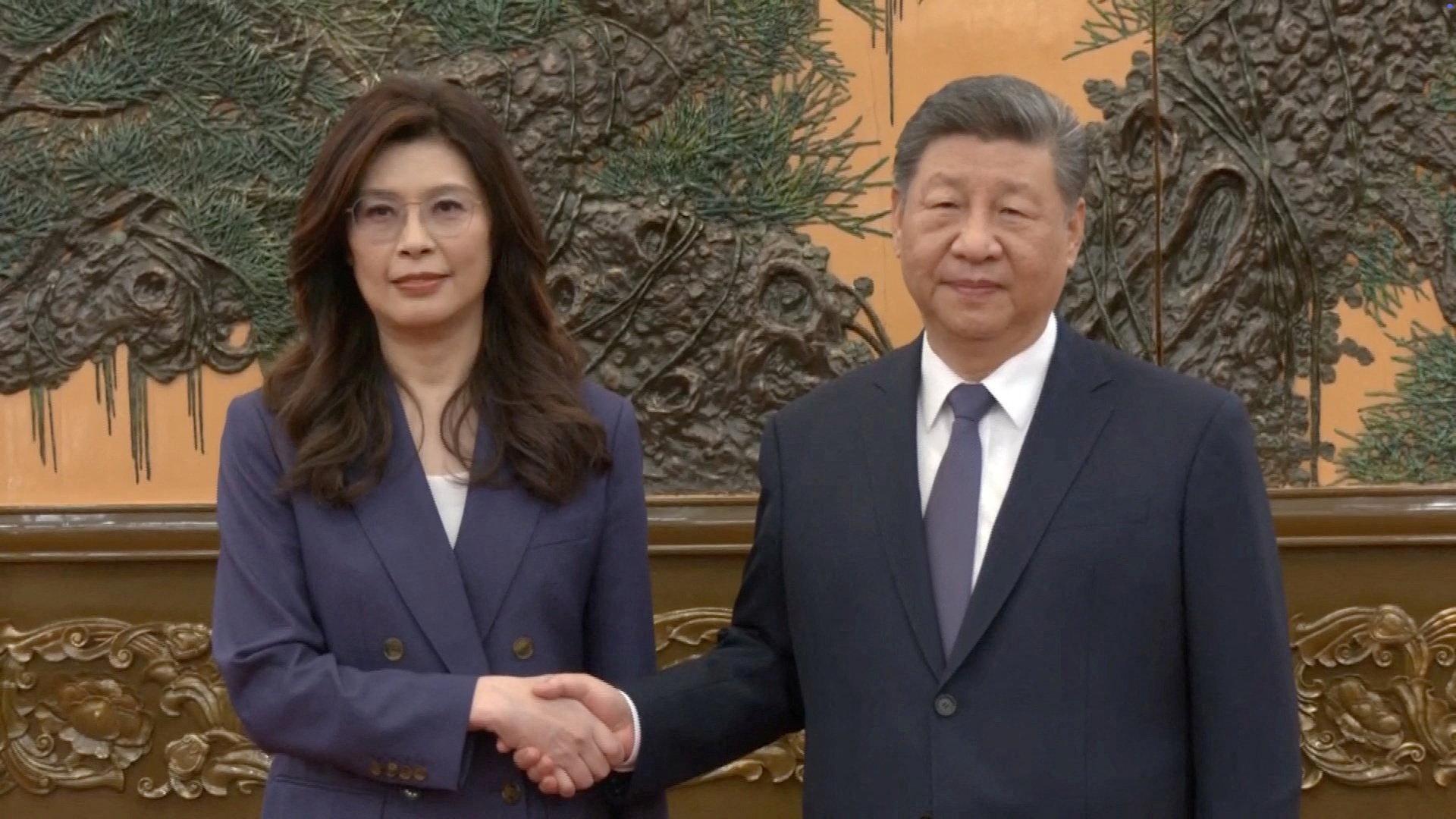
As tensions across the Taiwan Strait escalate, Taiwan’s main opposition party, the Kuomintang (KMT), has chosen to intensify its engagement with the Chinese Communist Party (CCP), including through direct contact with Chinese President Xi Jinping. But without delivering credible security benefits, this strategy is unlikely to improve the KMT’s electoral prospects.
KMT chairperson Cheng Li-wun’s decision to accept an invitation from Xi and travel to mainland China in April 2026 comes ahead of local elections in November. While the party performed strongly in local elections in 2018 and 2022, it has struggled in presidential races since 2016, where cross-strait relations and national security dominate the agenda. In those contests, its perceived closeness to Beijing has come at a political cost.
Cheng has framed her approach as a strategic reset. Since her election as party chairperson in October 2025, she has sought to move the KMT beyond what she views as a defensive posture that downplays its cross-strait platform under pressure from the ruling Democratic Progressive Party (DPP). Cheng argues that the KMT should openly embrace its core position — including the ‘1992 Consensus’, which is credited with reestablishing cross-strait dialogue — and demonstrate that engagement with Beijing can advance Taiwan’s interests. This includes maintaining strategic flexibility by avoiding overreliance on the United States and preserving the possibility of cooperation with China, as Cheng herself has argued.
This position is not without merit. The DPP’s portrayal of the KMT as uniformly pro-China and anti-United States is often overstated. Lu Shiow-yen, the KMT Mayor of Taichung and likely presidential candidate for 2028, visited the United States in March 2026. The KMT has long presented itself as pursuing a middle path between Beijing and Washington, with its leadership maintaining ties with both powers. But this framing does not address a deeper political challenge. The party’s strategy assumes that voters can still be persuaded that party-to-party engagement with the CCP enhances Taiwan’s security.
That assumption is increasingly untenable. For Taiwanese voters, the meaning of KMT–CCP engagement has shifted significantly over time. In the 2000s, it revolved around symbolism, shared history, cultural affinity and broad political understandings. In the 2010s, economic cooperation took centre stage, offering more tangible benefits that could be communicated to voters. Yet after more than a decade of growing military pressure from Beijing, engagement is judged primarily on whether it can deliver credible security outcomes. On that front, the KMT’s traditional approach appears to fall short.
This shift reflects the erosion of the strategic ambiguity that once underpinned cross-strait relations. Earlier formulations of the ‘one China’ framework allowed Beijing and Taipei to sidestep the sovereignty question and sustain a degree of political flexibility.
But since 2016, both sides have hardened their positions. Under Xi, Beijing has tied long-term peace to an eventual reunification under the banner of ‘one country, two systems’, while in Taiwan, the view that ‘the People’s Republic of China and the Republic of China are not subordinate to each other’ has gained traction.
The KMT faces a structural dilemma. Without engagement, the party risks abandoning a core component of its identity and cross-strait platform. But with engagement, it may struggle to produce the one result voters demand — a believable reduction in the risk of conflict.
The KMT’s approach reflects an expectation that visible engagement alone can generate credibility for the party. This belief is understandable — high-profile meetings with senior Chinese officials can give the impression that the party has access, status and influence. But for cross-strait engagement to remain politically viable, the repetition of abstract political formulations is unlikely to be sufficient.
The KMT should instead prioritise concrete and tactical issues in its engagement with China, especially Beijing’s military coercion and grey-zone activities. Much of this work can occur through lower-level channels, which are often more effective, unless an issue of clear and substantial benefit to Taiwan requires top-level involvement.
The KMT has long claimed that cross-strait engagement is its comparative advantage. But that advantage depends on whether it produces observable results. The most concrete outcomes the party appears able to secure are preferential treatment for Taiwanese businesspeople in mainland China and limited gains in tourism and other economic issues. While such measures are not insignificant, they tend to benefit a relatively narrow group associated with the KMT’s political base.
Even after Cheng’s high-profile visit — after which Beijing released a 10-point plan to promote cross-strait economic exchanges — the gains were largely limited to tourism and trade. These outcomes offer little in terms of tangible security benefits, beyond reinforcing the appearance that Beijing continues to pursue peaceful measures — an impression that carries limited credibility.
In this context, the DPP’s argument that the KMT lacks the authority to negotiate on national security is likely to resonate, particularly in the absence of more widely distributed gains. Without such outcomes, making engagement the centrepiece of its strategy may reinforce doubts about its judgment.
In Taiwan, presidential elections are the decisive test of cross-strait policy. It is still early, but there is limited evidence that Cheng’s trip will translate into an advantage in the November 2026 elections, which will in turn shape the 2028 presidential race. Even in an April 2026 TVBS poll — traditionally understood as blue-leaning — only 43 per cent view the visit as conducive to cross-strait peace, compared with 39 per cent who disagree and 19 percent who are undecided. Opinion remains highly divided, suggesting limited potential to consolidate majority support, especially in electoral terms.
Until the KMT can show that engagement delivers concrete security benefits, the strategy is likely to be difficult to sustain electorally.
Posted by IHateTrains123
1 Comment
Semi-off topic, but the DPP needs to start pouring its billions from chip industry boom into soft power. Start funding movies, songs, and games that are based in Taiwan. Make the world see Taiwan as an independent entity through the media it produces.
They should have been doing this long ago, South Korea got a massive head start after decades of nurturing. Fortunately, the PRC is even worse at soft power beyond showing off its intrastructure projects. And frankly, the world prefers BTS or Kpop Demon Hunters over boring shit like fast trains (they’re boring to normies, not people like us)