
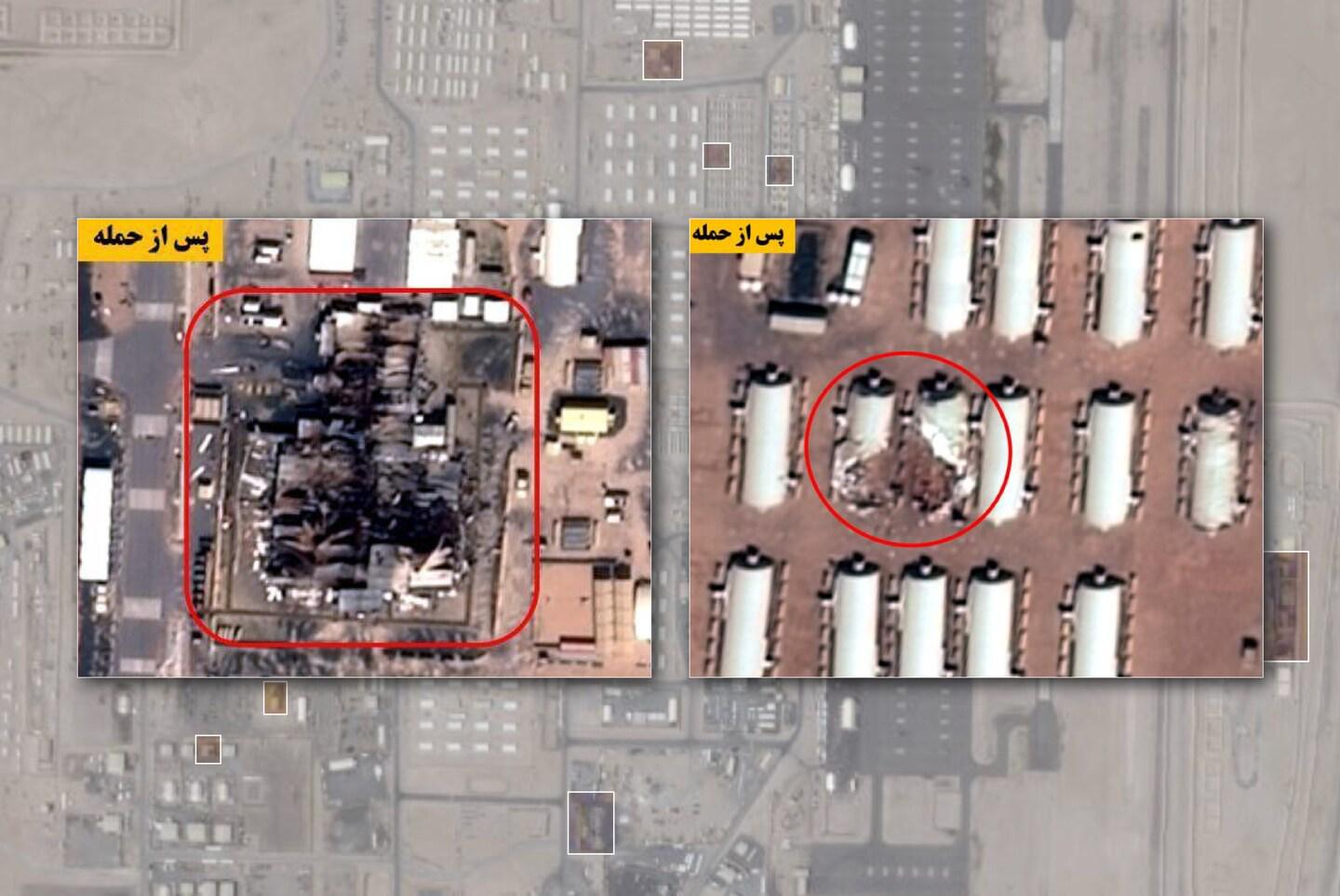
Iranian airstrikes have damaged or destroyed at least 228 structures or pieces of equipment at U.S. military sites across the Middle East since the war began, hitting hangars, barracks, fuel depots, aircraft and key radar, communications and air defense equipment, according to a Washington Post analysis of satellite imagery. The amount of destruction is far larger than what has been publicly acknowledged by the U.S. government or previously reported.
The threat of air attacks rendered some of the U.S. bases in the region too dangerous to staff at normal levels, and commanders moved most of the personnel from these sites out of the range of Iranian fire at the start of the war, officials have said.
Since the start of the war on Feb. 28, seven service members have died in strikes on U.S. facilities in the region — six in Kuwait and one in Saudi Arabia — and more than 400 troops have suffered injuries as of late April, the U.S. military said. While most of the wounded returned to duty within days, at least 12 suffered injuries that military officials classified as serious, according to U.S. officials who, among others, spoke on the condition of anonymity due to the sensitivity of the issue.
Satellite imagery of the Middle East is unusually difficult to acquire at present. Two of the largest commercial providers, Vantor and Planet, have complied with requests from the U.S. government — their biggest customer — to limit, delay or indefinitely withhold the publication of imagery of the region while the war is ongoing, making it difficult or impossible to assess Iran’s counterstrikes. Those restrictions began less than two weeks into the war.
Iranian state-affiliated news agencies, however, have from the start regularly published high-resolution satellite imagery on their social media accounts that claimed to document damage to U.S. sites.
For this examination — one of the first comprehensive public accounts of the damage to U.S. facilities in the region — The Post reviewed more than 100 high-resolution Iranian-released satellite images. The Post verified the authenticity of 109 of the those images by comparing them with lower-resolution imagery from the European Union’s satellite system, Copernicus, as well as high-resolution images from Planet where available. The Post excluded 19 Iranian images from the damage analysis because comparisons with the Copernicus imagery were inconclusive. No Iranian imagery was found to have been manipulated.
In a separate search of Planet imagery, Post reporters found 10 damaged or destroyed structures that were not documented in the imagery released by Iran. In all, The Post found 217 structures and 11 pieces of equipment that were damaged or destroyed at 15 U.S. military sites in the region.
Experts who reviewed The Post’s analysis said the damage at the sites suggested that the U.S. military had underestimated Iran’s targeting abilities, not adapted sufficiently to modern drone warfare and left some bases under-protected.
“The Iranian attacks were precise. There are no random craters indicating misses,” said Mark Cancian, a senior adviser with the Center for Strategic and International Studies and a retired Marine Corps colonel, who reviewed the Iranian images at The Post’s request. The Post previously revealed how Russia provided Iran with intelligence to target U.S. forces.
Some of the damage may have occurred after U.S. troops already left the bases, making protection of the structures less vital. Cancian and other experts said they do not believe the attacks have significantly limited the U.S. military’s ability to conduct its bombing campaign in Iran.
U.S. Central Command, which has responsibility for the Middle East, declined to address a detailed summary of findings from The Post. A military spokesperson disputed the characterization of base damage by experts as extensive or evidence of failures, saying assessments of destruction are complex and can be misleading in some cases, but declined to provide specifics. Military leaders will be able to provide fuller context for the Iranian attacks after the conflict ends, the spokesperson said.
In the first weeks of the war, several news outlets published reviews of damage, including the New York Times, which found strikes at 14 U.S. military sites or air defense installations. In late April, NBC News reported that an Iranian jet bombed a U.S. base in Kuwait, the first time in years that an enemy fighter plane has hit a U.S. base, and cited research it said showed 100 targets had been struck by Iran across 11 bases. CNN reported last week that 16 U.S. installations had been damaged.
But the review by The Post — based on images dating from the war’s start through April 14 — reveals that scores of additional targets were struck at the sites, which are predominantly used by the U.S. military but shared with the host nations’ military forces and allies.
The images show that airstrikes damaged or destroyed what appear to be numerous barracks, hangars or warehouses at more than half of the U.S. bases that The Post reviewed.
“The Iranians have deliberately targeted accommodation buildings across multiple sites with the intent to inflict mass casualties,” said William Goodhind, an investigator with the open-access research project Contested Ground who reviewed the imagery. “It is not just equipment, fuel storage and air base infrastructure under fire, but also soft targets, such as gyms, food halls and accommodation.”
The Post also found that the attacks hit a satellite communications site at al-Udeid Air Base in Qatar, Patriot missile defense equipment at Riffa and Isa air bases in Bahrain and Ali al-Salem Air Base in Kuwait, a satellite dish at the Naval Support Activity Bahrain — which serves as the headquarters of the U.S. 5th Fleet — a power plant at Camp Buehring in Kuwait and five fuel storage bladder sites across three bases.
The Iranian imagery also documented previously reported damage or destruction of radomes at Camp Arifjan and Ali al-Salem Air Base in Kuwait, and at the 5th Fleet headquarters; Terminal High Altitude Area Defense (THAAD) missile defense radars and equipment at Muwaffaq Salti Air Base in Jordan and two sites in the United Arab Emirates; a second satellite communications site at al-Udeid Air Base, and an E-3 Sentry command and control aircraft and a refueling tanker at Prince Sultan Air Base in Saudi Arabia.
More than half of the damage reviewed by The Post occurred at the 5th Fleet headquarters, and the three bases in Kuwait — Ali al-Salem Air Base, Camp Arifjan and Camp Buehring. Camp Arifjan is the U.S. Army’s regional headquarters.
Some Persian Gulf nations have refused to allow the U.S. military to conduct offensive operations out of their bases. A U.S. official said bases in Bahrain and Kuwait were two of the hardest hit, possibly because they permitted attacks from their territory, including the use of High Mobility Artillery Rocket Systems (HIMARS) that can fire missiles at ranges exceeding 310 miles.
The Post’s review represents only a partial count of the damage based on available satellite imagery.
Some of the damage could have been the result of U.S. choices or deception, Cancian said. To help preserve valuable interceptors, U.S. forces can choose to allow an incoming missile to strike if it seems likely to hit an unimportant target, he said, and it’s also possible commanders sought to deceive Iranian forces by making emptied base locations appear occupied.
Experts said the vulnerability of the military sites to Iran’s attacks was likely the consequence of numerous factors.
Chief among them, experts said, is that Iranian forces have been more resilient than the Trump administration may have anticipated. Kelly Grieco, a senior fellow at the Stimson Center, a think tank, said plans to destroy Iran’s missile and drone forces fast enough to prevent them from inflicting serious damage underestimated “the depth of Iran’s pre-positioned targeting intelligence on fixed U.S. infrastructure.”
Grieco said the strategy also failed to account for the degree to which U.S. and Israeli air defenses had been used up during the 12-day conflict in June between Iran, Israel and the United States.
According to an estimate from the Center for Strategic and International Studies, the military used at least 190 THAAD interceptors and 1,060 Patriot interceptors between Feb. 28 and April 8, representing 53 percent and 43 percent of their prewar inventories, respectively.
Justin Bronk, senior research fellow for airpower and technology at the Royal United Services Institute based in London, said U.S. and allied air defenses had done an impressive job intercepting attacks, but “at an enormous cost in terms of surface-to-air missile interceptors and air-to-air missiles.”
In addition, experts said the U.S. military had not adequately adapted to the use of one-way attack drones, something they said planners should have learned from observing the war in Ukraine.
“While [drones] have small payloads — some of these did not do that much damage — they are more difficult to intercept and much more accurate, making them a much bigger threat to U.S. forces,” said Decker Eveleth, an associate research analyst at the Center for Naval Analyses.
They also pointed to structural challenges, including a shortfall of fortified shelters that could protect troops and equipment at key positions and likely targets.
For example, the tactical operation center in Kuwait, where six U.S. service members were killed by an Iranian drone attack in early March, offered little overhead protection or concealment, one of several issues being examined by Democratic lawmakers probing the fatalities.
In one case, it appeared that the E-3 Sentry command and control aircraft at Prince Sultan Air Base in Saudi Arabia was destroyed after being repeatedly parked in the same location on an unprotected taxiway, satellite imagery shows.
U.S. Central Command declined to address questions on experts’ analysis of the damage.
The strikes on U.S. bases in the region have left military planners considering new trade-offs, said Maximilian Bremer, a nonresident fellow at the Stimson Center and a retired Air Force officer: Pull troops back to safer locations and limit their ability to fight or maintain the bases as they were and accept the potential of future casualties.
A U.S. official said that damage at the Naval Support Activity is “extensive” and that the headquarters there relocated to MacDill Air Force Base in Tampa, Florida, the home of U.S. Central Command. It is unlikely that troops, contractors or civilian employees will return to the base “anytime soon,” the official said.
Two other officials said U.S. forces may never return to regional bases in large numbers, though no final decision has been made.
“We have moved from an age of stealth to one where the entire battlespace is translucent and increasingly transparent,” said Bremer. “It feels like we should be on offense, but we are definitely playing defense around these bases.”
Posted by John3262005