
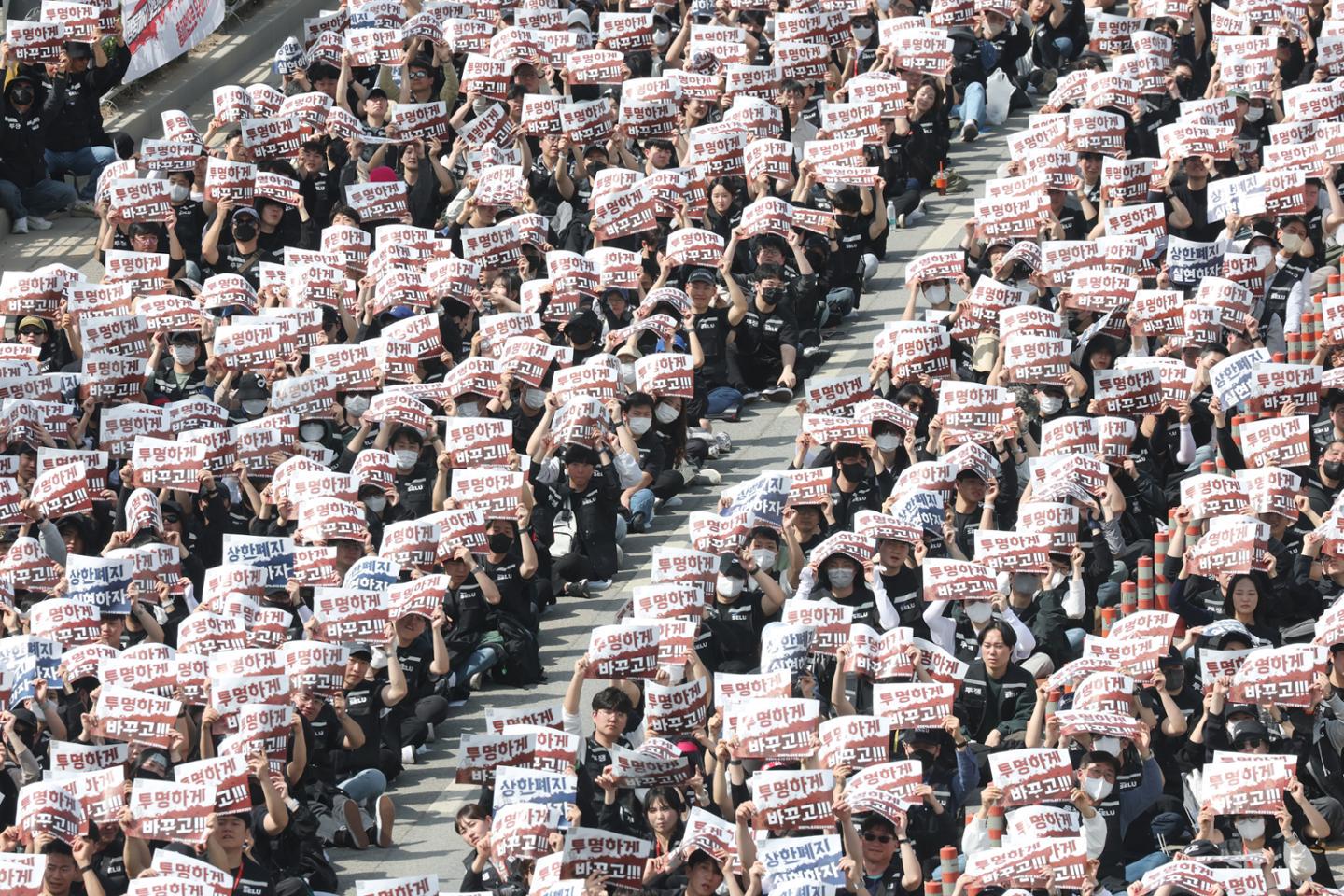
Amid record-breaking earnings, debate is growing over the actions of Samsung Electronics’ union, which has announced plans for a general strike while demanding higher performance bonuses. In particular, critics argue that the demand to allocate 15% of this year’s estimated operating profit — 300 trillion won, or about 45 trillion won — to performance bonuses for the semiconductor division is excessive.
The labor community’s view of the situation is complicated. Since collective action, including strikes, to demand higher pay is a basic right of workers, and since the Samsung Electronics union has also secured procedural legitimacy for a strike, many find it difficult to simply condemn the union. However, they also judge that the union’s poor strategy and miscalculation have touched a nerve with the public, turning this into an unwinnable fight. Union officials and labor experts point out that “Samsung Electronics union’s strategy lacks three major things.”
1. Lack of solidarity: “Protecting only our own rice bowl”
“Even though the Hyundai Motor union is attacked as militant, they have consistently made efforts at solidarity, such as helping organize subcontractor unions and demanding better treatment for them. That is where they differ from the Samsung Electronics union.”
A person identified as A, who has long been active at the national labor federation level, criticized the union, saying, “The lifeblood of a union comes from solidarity, but Samsung Electronics union’s demands contain no such agenda.” The criticism is that, unlike existing unions that, while asserting their own interests, also mentioned more vulnerable groups such as irregular workers and subcontractors, the Samsung Electronics union gives the impression that it is interested only in realizing its own interests. The lack of solidarity narrows the union’s base of support.
Some also compare it with the SK hynix union, whose members received enormous performance bonuses during the semiconductor boom. A labor official identified as B said, “In the case of SK hynix, subcontractors that have worked with the company since its days as Hyundai Electronics also share in the results and receive performance bonuses amounting to around 75–85% of what the primary contractor’s employees receive. Samsung Electronics has not accumulated that kind of thought or history.”
Some point to “the limits of an enterprise-level union without an upper-level federation” as the reason for the Samsung Electronics union’s lack of solidarity. The Samsung Electronics branch of the Samsung Group Super-Enterprise Union, which is leading the strike phase as the majority union within Samsung Electronics, is not affiliated with an upper-level federation such as the Federation of Korean Trade Unions or the Korean Confederation of Trade Unions. B said, “There seems to be a sense of superiority among the Samsung Electronics union leadership, as if they think, ‘We belong to the No. 1 company, so why do we need solidarity?’ If you choose to remain an enterprise-level union without belonging to an upper-level organization, solidarity with the outside is virtually impossible. It seems they had the perception that they did not need solidarity beyond Samsung Group.”
There is also criticism that, while the Samsung Electronics union describes itself as a super-enterprise union, its actual operation runs contrary to that idea. Normally, a super-enterprise union tries to increase bargaining power by bringing together workers from multiple companies within a specific industry. For example, if a super-enterprise union were formed in the semiconductor industry, the typical form would include not only Samsung Electronics and SK hynix, but also subcontracting semiconductor firms, all participating in joint bargaining. However, Samsung Electronics’ super-enterprise union consists only of Samsung Group affiliates. Park Ji-soon, professor at Korea University Law School, criticized the union, saying, “Samsung Electronics union has weakened the distinctive union value of solidarity and has become a pure interest group. It is worrying because it shows an extremely individualized appearance,” adding, “It seems to have an attitude of ‘we have no tomorrow.’”
2. Lack of strategy: focusing only on semiconductors led to internal division
There is also criticism that the union leadership made a strategic misjudgment and failed to achieve internal unity. The criticism is that, while preparing for labor-management negotiations, the union did not first agree internally on how much performance bonus each division should demand, and instead only played the card of demanding performance bonuses for the semiconductor division, causing internal division.
Kim Jong-jin, director of the Working Citizens Research Institute, said, “Demanding bonuses centered on the semiconductor division without first deciding the internal rule for distribution shows the union’s immaturity. Before demanding performance bonuses from the company, there should have been agreement between members in the semiconductor division and those in non-semiconductor divisions.”
In particular, critics say it is problematic that, although the semiconductor division performed well this year because of the semiconductor supercycle, the union ignored the fact that in recent years, when semiconductors were weak, the mobile and home appliance divisions supported Samsung Electronics. Because of this mistake, the Companion Union, which is centered on non-semiconductor union members, eventually withdrew from the joint struggle headquarters.
There is also criticism that the union failed to prepare a sophisticated argument against management, which is skilled at public opinion campaigns. A said, “There was no particular logic beyond saying, ‘Give us more money because we produced results.’ To ordinary citizens, that is why it looks like semiconductor regular workers’ union members are trying to monopolize results that were created not only by regular workers but also by subcontracted workers.”
3. Lack of experience: the union chair went on vacation and attacked another company’s union
Another problem cited is that the Samsung Electronics union has repeatedly made mistakes that disappointed public opinion, revealing its lack of experience. The Samsung Group Super-Enterprise Union was formed in 2024.
Choi Seung-ho, chair of the Samsung Electronics branch of the Samsung Group Super-Enterprise Union, came under controversy after taking a week-long trip to Southeast Asia last month. Many criticized it as inappropriate for the head of a union preparing for a large-scale collective action such as a general strike.
In addition, after President Lee Jae-myung criticized “excessive demands by some organized workers” on the 30th of last month, Choi said, “That was about LG Uplus, not Samsung. They asked for 30%. They should have kept it to a reasonable level like us, 15%.” This remark also drew criticism. A expressed frustration, saying, “It is the first time I have seen someone respond to a presidential criticism not by giving their own opinion, but by redirecting the blame toward another company’s union that was staying quiet.” Kim Sung-hee, professor at Korea University Graduate School of Labor Studies, assessed, “Their organizational capacity does not appear sufficient, and there does not seem to be leadership capable of resolving internal conflicts of interest.”
Another problem cited is that the Samsung Electronics union has repeatedly made mistakes that disappointed public opinion, revealing its lack of experience. The Samsung Group Super-Enterprise Union was formed in 2024.
Choi Seung-ho, chair of the Samsung Electronics branch of the Samsung Group Super-Enterprise Union, came under controversy after taking a week-long trip to Southeast Asia last month. Many criticized it as inappropriate for the head of a union preparing for a large-scale collective action such as a general strike.
In addition, after President Lee Jae-myung criticized “excessive demands by some organized workers” on the 30th of last month, Choi said, “That was about LG Uplus, not Samsung. They asked for 30%. They should have kept it to a reasonable level like us, 15%.” This remark also drew criticism. A expressed frustration, saying, “It is the first time I have seen someone respond to a presidential criticism not by giving their own opinion, but by redirecting the blame toward another company’s union that was staying quiet.” Kim Sung-hee, professor at Korea University Graduate School of Labor Studies, assessed, “Their organizational capacity does not appear sufficient, and there does not seem to be leadership capable of resolving internal conflicts of interest.”
Posted by Freewhale98
1 Comment
1. Summary
Samsung strike is losing steam as Korea’s umbrella labor unions turn against them. Samsung labor union is an independent union not affiliated to larger umbrella unions such as KCTU and FKTU. Only Samsung subcontractor are affiliated to these larger unions. It is reported that Samsung labor union was so prideful that they snubbed the workers of subcontractors and insulted other labor unions while the leader went on a vacation in the middle of ongoing labor strike. Korea’s more established unions are quite upset the behavior of this relatively new union established in 2024.
2. How is this related to the sub
(1) Organized Labor: Samsung union found to be quite incompetent in how they handled the labor dispute.
3. My opinion
The behavior of Samsung union is quite…weird. In this kind of strikes, the labor unions gang up on the main company, with the union in main company promising workers of subcontractors a slice of the “loot” if they triumph over employers. Also, they use pre-existing network of FKTU and KCTU to justify their struggle.
But this one is doing none of it. They are trying to monopolize the profit without giving anything to subcontractors and insult other unions. They feel almost like Trump’s Iran War.