
Republicans have been throwing everything they can at the 2026 midterms: aggressive mid-decade gerrymanders, talk of ICE at polling places, executive orders and litigation aimed at state election administration. Most of these will come to naught as I recently wrote in a piece here at The UnPopulist, “Worry, Don’t Panic, About Trump’s Efforts to Subvert the Elections.” Our electoral system is remarkably fire-proofed against tampering and too decentralized to be rigged from above. Moreover, Trump is extremely unpopular, and Democrats are well ahead in the polls and romping in special elections. So whatever slight advantage these electoral shenanigans hand Republicans is likely to be overwhelmed by voter discontent.
But there is an option. I had rated this as a lower-risk concern. I believe it is now worth taking more seriously in light of the Supreme Court’s ruling last week in Louisiana v. Callais. It’s not certain, perhaps not even likely. But given the dangerous downward spiral currently underway toward norm breaking, it’s worth considering in detail.
The move would be, in essence, a rehash of the attempted objections to electoral votes on Jan. 6, 2021. The basic shape of the gambit is straightforward. If Republicans cannot stop a Democratic majority from emerging on election night in November, they might still try to prevent it from taking power in January, by blocking enough Democratic members-elect from being seated to leave Republicans in the majority.
This danger has been given a boost by the 6-3 party-line Callais decision. Several Republicans, in both Congress and the administration, are now claiming that deliberately drawn majority-minority districts are constitutionally banned. Several states will conduct elections this November using such districts which were, until now, often required under the Voting Rights Act, the landmark civil rights law gutted by the Supreme Court.
On Jan. 3, 2027, when the new House convenes, Republicans could object to the seating of Democratic members, alleging their elections were unconstitutional. The goal would be for a rump House to then have a Republican majority, elect a Republican speaker, and decline to seat the challenged members. On this theory, the seats of rejected members would be vacant, allowing a Republican-controlled House to proceed to business even with fewer than all 435 representatives. The Constitution defines a quorum as a simple majority of the House’s members, and past practice has been to not count vacancies toward that number. In other words, an outright purge of the House.
To be clear, my fear is not that any of this would necessarily work. Such objections would fail if played out under the rules as they stand. The members-elect targeted would still be entitled to vote on the matter, and could simply vote to reject the objections and thwart the entire scheme. But that’s if Republicans play by the minimal rules.
As with the attempt to overturn the 2020 presidential election, the concern is using the alleged unconstitutionality of blue state election rules to provide a justification for even more extreme and lawless actions. Duly elected representatives ejected from the chamber. Trump refusing to accept the legitimacy of the House, at least rhetorically, or possibly even ordering interference by force. The danger is in providing a plausible-seeming pseudo-legal pretense for such measures.
The result would be a legitimacy crisis without precedent in American history. An attempt to install what would be, morally as well as constitutionally, a fake Congress. But in a world where they have already tried the same thing in a presidential election, the risk can’t be dismissed.
Out with the Old, In with the New
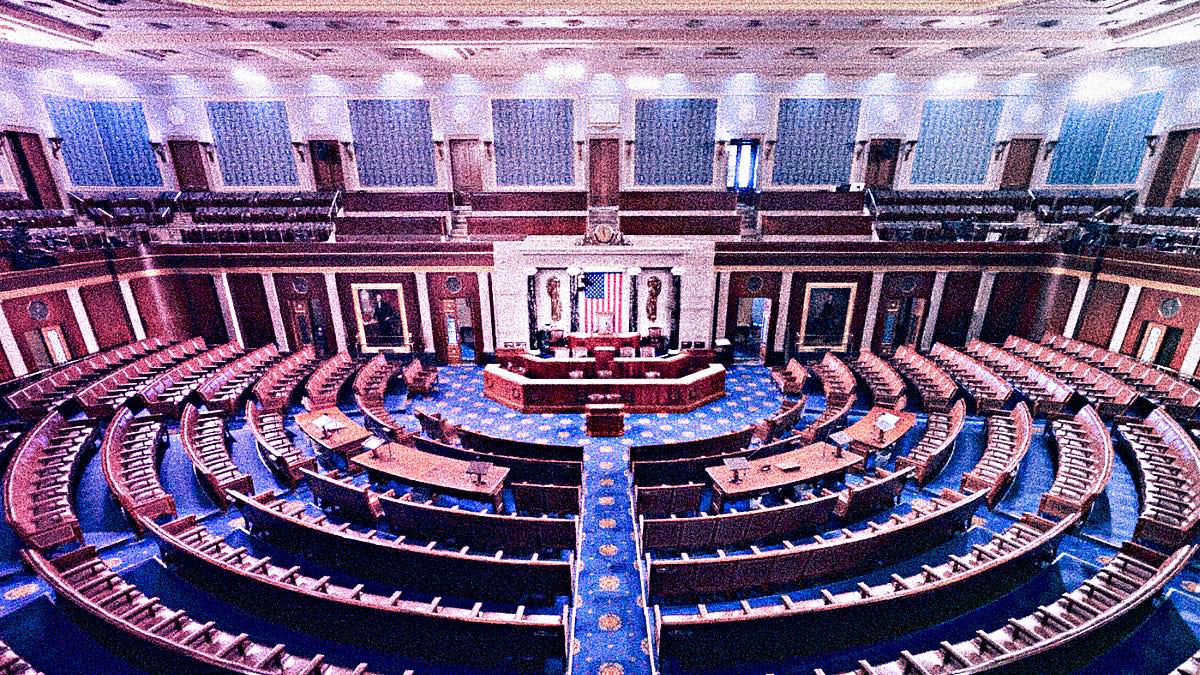
The House faces a peculiar problem every two years. The body has to bootstrap itself into existence when the newly elected members gather on Jan. 3, the date set by the 20th Amendment. The old House’s term has expired. There is no speaker yet, no rules, no committees. Nobody has yet taken the oath and been seated. There are only representatives-elect, a House-to-be in a state of limbo.
What gets the House started is a thin scaffolding inherited from the previous Congress. Federal law requires the clerk of the House to prepare a roll of representatives-elect from the credentials sent by the states. The clerk also gavels the chamber to order and presides until a speaker is chosen. Once a speaker is elected (which can take a while), the speaker is sworn in, then administers the oath to everyone else, and the House becomes a House and lawmaking can commence. The process normally goes without any hiccups.
The roll the clerk prepares is the essential starting point. The clerk is required to include those whose credentials show they have been certified as the election winners by their respective states. If any election results have been litigated, the final outcome will be the winner who gets this crucial piece of paper confirming his or her certification. The clerk’s only job is to check whether a state has sent a facially proper certificate of election. The clerk does not adjudicate the underlying election. It is a purely ministerial job with no discretion.
Here is where things get complicated. A member-elect may, after the roll is read out, object to the seating of another member. By custom, in more normal cases, the challenged member voluntarily stands aside while the rest of the House is sworn in. The chamber then disposes of the objection, either seating the member or not, and, if necessary referring the dispute to committee.
This custom of a challenged member standing aside is exactly that: a custom, a bit of voluntary deference out of respect for the House. It is not in the rules and cannot be compelled. It is only a matter of comity and norms, which go out the window if the procedure is being abused.
The Constitution provides that “Each House shall be the Judge of the Elections, Returns and Qualifications of its own Members, and a Majority of each shall constitute a Quorum to do Business.” The House judges the elections of its members. The House that does the judging is composed of all the members-elect on the clerk’s roll, unless any of them voluntarily abstain.
This is, in short, how the House is born. (All of this is much simpler in the Senate because two thirds of its members are still in place; it is a continuous body with staggered terms.)
“In recent years things have mostly gone smoothly, but there is a deep history of organizing the House going haywire due to partisan disputes,” notes Kacper Surdy, an expert on congressional procedure. In 1839, the House was deadlocked for weeks over which set of credentials to accept from New Jersey, a fight known as the “broad seal war.” In 1863, the House clerk tried to unilaterally reject several Republicans while including on the roll disputed members more sympathetic to the Confederacy. As recently as 2021, Rep. Chip Roy, a Texas Republican, objected to members from several states to highlight the contradiction of Republicans rejecting Biden’s victory in an election conducted on the same ballots as their own elections.
A Dangerous Gambit
Callais struck down Louisiana’s congressional map, creating a second majority-Black district, as an alleged “racial gerrymander,” upending the framework that has governed Voting Rights Act cases for decades.
Now, Southern states are rushing to abolish districts which had previously guaranteed Black voters real representation in Congress because that’ll give them an electoral advantage. But many states will run their 2026 elections on maps with the existing majority-minority districts they were required to draw, either by court order or the state’s voluntary compliance, before Callais. It is virtually guaranteed all such “VRA districts” will elect Democrats. Most will be from large, predominantly Democratic states such as Illinois, New York, and California.
Republicans are already hinting at questioning these districts, even though Callais only directly affected Louisiana. Sen. Eric Schmitt of Missouri, who chairs the Senate Judiciary Subcommittee on the Constitution, has called Callais a “redistricting earthquake” and declared that “each district drawn that used race is now unconstitutional.” He is particularly keen to target California, which just engaged in its own counter-gerrymander, and is the biggest basket of blue districts. Assistant Attorney General Harmeet Dhillon reposted Schmitt’s call and reiterated the call to “review all race-based districts,” suggesting the DOJ might file suits against these states. Never mind that it is already absurdly late in the cycle, with filing deadlines and some primaries already passed, for states to be redrawing their congressional districts. As a practical matter, it’s infeasible for any newly launched litigation to be resolved in time for November.
These same arguments, spurious as they may be, could be deployed on the House floor.
The argument would run something like this: members were chosen from states with congressional maps the Court has now deemed defective, so the Constitution entitles the new House to ignore basic parliamentary rules to refuse their election returns. It is a bad argument. Voters cast ballots in districts that federal courts had in many cases ordered, and candidates campaigned on those lines. A Supreme Court ruling that comes down mid-cycle does not cancel elections already underway under the rules then in force. Any future litigation based on Callais, in states other than Louisiana, has yet to play out.
The argument does not have to be sound to be useful. It only has to be plausible enough to give wavering Republicans cover, no doubt amplified by unhinged Trump demands posted on Truth Social. Stop the Steal 2.0—once again targeting Black voters in particular for disenfranchisement.
This Callais-based argument is the most credible threat, insofar as it offers some fig leaf of a legal argument to ignore existing rules. The end goal is straightforward, and abhorrent. If enough Democratic members-elect are blocked, such as the entire delegation from California, the rump House left on the floor could vote to refuse to seat them, elect a Republican speaker, and proceed as if this sham body is a legitimate House of Representatives.
The counter-strategy must be firmly settled in advance. Democratic members-elect who face such an objection should refuse to stand aside. They should remain in their seats, take the oath with their colleagues, and vote on any resolution disposing of the objection. They are on the clerk’s roll. They hold regular certificates of election. They are part of the House that is judging, not bystanders.
Democratic leadership should make this position public well before January, to avoid any confusion. The fact that challenged members have sometimes stood aside in the past cannot be treated as an obligatory rule that they must, a distinction Republicans might try to elide with those superficially plausible precedents. Some of this work appears to be underway: Rep. Joe Morelle, a New York Democrat and a ranking member on the House Administration Committee, told Talking Points Memo last month that his task force has been war-gaming scenarios.
If All Else Fails
The procedural defense may not be sufficient. The objection strategy depends on the clerk’s roll being honest, and that roll is prepared by the clerk of the previous House. This gives the outgoing lame-duck House a potential opportunity to install a rogue clerk, willing to play the part Mike Pence refused to play on Jan. 6. A clerk who is willing to openly break the law.
The House Rules allow the speaker to unilaterally remove the incumbent clerk and appoint an acting clerk, without even a full vote of the House needed. The current clerk, Kevin McCumber, is widely respected as a nonpartisan institutionalist. But Johnson could potentially replace him with somebody more willing to go along with a crazy scheme.
At this point, Democrats may have to resort to emergency litigation to compel the clerk to follow the law, maybe even to gain admittance to the House chamber. We would be tipping over into a direct physical fight for control over the room.
Under no circumstances should any Democratic members (or sensible and upright Republicans, for that matter) remain to participate in an illegitimate rump House. To do so would concede the point. They should assert their right to participate and ultimately, if it comes to this, be prepared to walk out. They would still be a majority of the elected representatives, they alone could constitute a valid quorum. If forced to do it elsewhere than at the Capitol, they should do so.
They should leave the chamber, find somewhere else to meet, achieve a quorum, elect a speaker, and assert that they are the real House. The constitutional crisis would be extreme, Congress itself in dispute between dueling claims. But if push comes to shove, that will be the fight we must have.
This gambit, whether in an extreme version or as a more half-hearted performance, would be an attack on the basic premise that elections settle who governs. It would be the same impulse behind Jan. 6, once again driven by Trump’s position that elections don’t count if he dislikes the outcome, and this time aimed at Article I rather than Article II.
To be clear, it’s far from certain Republicans will try this. The point is not alarmism, or even worse, defeatist doomerism. Hopefully, there won’t be anything of the sort, and none of this will matter. But we need to be prepared, given that it’s not hard to see more extreme members and Trump himself pushing something like this between November and January if the election doesn’t go their way. We should be clear: it’s not one neat trick, a procedural technicality, an actual loophole they can use. It would be a coup d’état, an attempt to overthrow constitutional government altogether.
Posted by TheUnPopulist
1 Comment
What about Powell v. McCormack?