
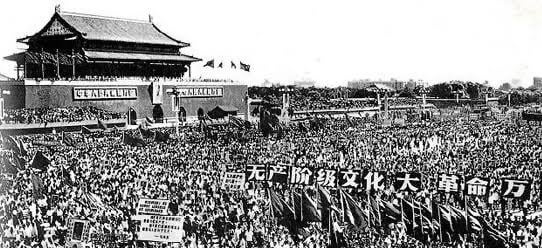
May 16, 2026 marked the 60th anniversary of China’s Cultural Revolution(文革). On this day in 1966, the Political Bureau of the Central Committee of the Communist Party of China issued the “May 16 Notification” (五一六通知) nationwide, and Mao Zedong (毛泽东) announced the launch of the “Great Proletarian Cultural Revolution” (无产阶级文化大革命). During the following ten years, violent political campaigns and armed factional struggles broke out across China. Millions died unnatural deaths, even more people suffered public denunciation and persecution, large amounts of cultural relics were destroyed, schools were closed, production stagnated, and social order fell into chaos. It was not until 1976, when Mao Zedong died and the “Gang of Four” (四人帮) was arrested, that the Cultural Revolution came to an end.
After Reform and Opening Up, the authorities officially defined the Cultural Revolution as a “serious mistake,” rehabilitated many victims of the Cultural Revolution, and implemented policies to rectify past mistakes and restore order. Subsequent generations of Communist Party leadership continued this official assessment. However, regarding the detailed history of the Cultural Revolution — such as its causes, process, and specific victims — the authorities maintained a long-term low-profile approach, with little reflection or commemoration, disproportionate to the event’s significance and enormous impact.
Especially during the past decade, the authorities have almost entirely avoided mentioning the Cultural Revolution and have also suppressed civil commemorations of it. For example, in 2016, the only Cultural Revolution museum in China, located in Shantou, was closed. On the occasion of the 60th anniversary of the Cultural Revolution, official Chinese public opinion channels and major domestic media carried no related reports, reflection, or commemoration.
Among the public, however, there are two sharply contrasting attitudes toward the Cultural Revolution. One, represented by liberal intellectuals, views the Cultural Revolution as an extremely disastrous national catastrophe, blaming it and its initiators for causing immense suffering and severe damage to many individuals and to the entire nation and society. They also connect many contemporary social problems with the Cultural Revolution and warn against another “Cultural Revolution” occurring. People within the system and vested-interest groups likewise do not wish to see the Cultural Revolution reappear, lest their own privileged status and interests suffer.
Another perspective comes from the far-left supporters and worshippers of Mao Zedong (Maoists), as well as some other frustrated and strongly dissatisfied individuals. Such people often praise the Cultural Revolution, regarding it as a means to oppose bureaucrats, overthrow bad people, and realize “mass democracy.” These people are also dissatisfied with today’s reality. Rather than placing their hopes on achieving democracy and improving the rule of law, they instead hope for another “Cultural Revolution” to “sweep away all ‘monsters and demons’” (a political label for enemies).
In addition, some foreign leftists also hold romanticized fantasies about the Cultural Revolution, believing that it was a great revolution against oppression and for liberation. This is far removed from historical reality. On the contrary, the Cultural Revolution intensified the persecution of vulnerable groups, strengthened the constraints imposed on the oppressed, and did not eliminate privilege. Some foreigners who visited China at the time, such as Italian director Antonio Antonioni (安东尼奥尼), witnessed aspects of its darker reality. Yet even today, some foreigners still do not understand the true nature of the Cultural Revolution.
The authorities’ low-profile approach toward the Cultural Revolution, the mixed praise and criticism among the public, and differing views held by different people all arise from their respective positions, perceptions, and purposes. They also reflect today’s social contradictions and China’s complex reality.
Simply put, the ruling Communist Party of China cares deeply about maintaining political legitimacy and institutional continuity as well as current social stability. It wishes both to defend Reform and Opening Up and to avoid excessively emphasizing the errors and tragedies of the Mao era, thereby preventing further dissatisfaction and instability. Intellectual elites and liberals, especially Cultural Revolution victims and their descendants, strongly detest the Cultural Revolution because of traumatic experiences and value systems.
Some marginalized people at the bottom of society, however, envy the Cultural Revolution’s destruction of existing order and hope for another political movement through which they could “rebel” and rise up and overturn their status. Many ordinary people also know little about the Cultural Revolution or remain indifferent, and may be influenced by the above narratives,
developing only a partial understanding and wavering attitudes.
First of all, the Cultural Revolution was indeed a disaster. At that time, China was engulfed in political violence and turmoil. Law and order disappeared, many innocent people were publicly denounced and imprisoned, and large numbers of innocent people were killed or driven to suicide. This included former Nationalist Party members, intellectuals, industrialists and merchants, those labeled as “landlords, rich peasants, counterrevolutionaries, bad elements, and rightists,” Communist Party cadres, and ordinary people from all walks of life. Among those persecuted to death were Communist Party leaders Liu Shaoqi (刘少奇) and Peng Dehuai (彭德怀), former Nationalist generals who had surrendered such as Huang Shaohong (黄绍竑) and Chen Changjie (陈长捷), scholars Chen Yinke (陈寅恪) and Lao She (老舍), and scientists Yao Tongbin (姚桐斌) and Zhao Jiuzhang (赵九章).
Under the turmoil and the principle of “taking class struggle as the key link” during the Cultural Revolution, national economic and technological development was also severely disrupted, causing China to fall behind most countries in the world. At that time, China’s per capita GDP was not only far lower than that of Europe, the United States, Japan, and the Soviet Union, but was also below that of most developing countries in Asia, Africa, and Latin America. Most people, especially peasants, lived in extreme poverty, and even basic food and clothing needs remained unresolved. Informing and reporting on others were encouraged during the Cultural Revolution, with relatives and friends reporting one another and everyone living in fear. Anti-intellectualism, personality cults, and extremism also flourished, leaving deep scars on people, casting shadows over society, and continuing to cause harm today.
If the causes and consequences of the Cultural Revolution disaster cannot be honestly confronted, discussed, and reflected upon, it would not only fail those who suffered at the time, but would also plant the seeds for the tragedy of the Cultural Revolution to reappear in various forms. For example, several years ago during COVID-19, various extreme “Zero-COVID(清零)” measures caused livelihood crises — especially restrictions on travel, shopping, and medical treatment, nucleic-acid testing for goods, and large-scale compulsory quarantine. Such epidemic-control measures, which violated scientific principles and infringed upon citizens’ rights, bear similarities in both motivation and consequences to the anti-intellectual policies under the principle of “politics in command” during the Cultural Revolution.
Another tragedy of the Cultural Revolution lay in personality cults and a system where one voice dominates all decisions, the absence of democracy and the rule of law, and the inability to constrain power. The accumulation of social problems and the difficulty of protecting civil rights in today’s China are similarly related to insufficient democracy and rule of law.
At the same time, those who praise the Cultural Revolution and even hope for its return should also be understood with sympathy. This too is a necessary requirement for honestly confronting history and reality. The causes of the Cultural Revolution were complex. It was not simply the result of Mao Zedong’s temporary impulse, but was also related to severe social contradictions, rigid bureaucratic systems, and estrangement and conflict between elites and the masses.
According to the views of Peking University scholar Qian Liqun (钱理群) and others, antagonism between officials and the public before the Cultural Revolution was already very serious. The masses were dissatisfied with the Party and government, and society resembled a pressure cooker. Mao’s issuance of the “May 16 Notification” merely lit the fuse that ignited these contradictions.
China in recent years has become politically rigid and conservative, with widening wealth gaps and increasing social stratification, while vested-interest groups monopolize resources. At the same time, reform has stagnated and public discourse has tightened. Coupled with economic decline, social contradictions have intensified significantly. Many lower- and middle-class people, educated but unemployed individuals, and marginalized groups live in poverty, see no hope, and lack proper channels for expression. Driven by resentment and their limited understanding of the Cultural Revolution, they long for another violent political movement that would overthrow those they hate and enable themselves to become masters of their own fate.
For example, many university students and young teachers resent the monopolization of resources and exploitation by academic oligarchs and hope to use methods like the “copper-buckled belt” (铜头皮带), a tool used for beating people during the Cultural Revolution, to publicly denounce teachers and academic oligarchs;
Workers exploited by sweatshops hope to overthrow capitalists and redistribute wealth equally;
Citizens who believe they have suffered unjust imprisonment, facing the power and indifference of Party and government institutions — especially the police, procuratorate, and courts — find considerable resonance in the Cultural Revolution slogan “Smash the Public Security, Procuratorate, and Courts” (砸烂公检法);
The poor struggling at the bottom of society wish to smash the existing order and vent their frustrations like the “rebel factions” (造反派) during the Cultural Revolution…
Such psychological paths and motivations can be understood and sympathized with. However, whether viewed from the perspective of society as a whole or most individuals, political movements like the Cultural Revolution are disastrous. To some extent, they did attack certain problems in ordinary society and damage some bad actors, but they simultaneously brought even greater consequences. Under social disorder, human-rights violations became more widespread and severe, and many innocent people lost their families and lives. The Cultural Revolution also destroyed trust between people and damaged social morality, worsening interpersonal relationships and social conditions. Even political opportunists who benefited temporarily often ended up suffering consequences themselves.
Nor was the Cultural Revolution truly equal. Cadres, workers, and rebel factions possessed privileges, whereas peasants and those categorized among the “Five Black Categories” (黑五类) were treated as social inferiors in both status and rights.
Although the early-stage “rebellion” of the Cultural Revolution did indeed challenge privileged cadres, its targets gradually shifted toward vulnerable groups such as the “Five Black Categories” while radical rebels and anti-privilege activists among the masses were also suppressed. Those who openly opposed Mao Zedong and criticized the Communist Party, such as Lin Zhao (林昭), Zhang Zhixin (张志新), Yu Luoke (遇罗克), and Huang Lizhong (黄立众), faced severe repression and were executed. Meanwhile, some senior Communist Party leaders were overthrown primarily due to the needs of power struggles rather than anti-privilege objectives, and this did not fundamentally change the unfair and unjust ruling system or social structure.
However, some disillusioned Chinese people embrace a mentality resembling, “If these days must perish, let you and me perish together,” seeking mutual destruction. Even knowing that the Cultural Revolution was destructive, they still attempt to overthrow the current order through radical means and vent dissatisfaction.
The rise of global populism in recent years has likewise been driven by public dissatisfaction with existing systems and hatred toward elite vested interests. The Cultural Revolution itself was also China’s manifestation of the global wave of left-wing populism several decades ago.
Although today’s China appears relatively calm on the streets under strict political control, it cannot remain untouched amid rising global populism and has accumulated even greater dissatisfaction and hidden dangers. Frequently occurring incidents involving class, ethnicity, gender, and other tensions are manifestations of populism bubbling beneath a political pressure cooker. Frequent tragedies involving indiscriminate attacks causing casualties, along with large amounts of extreme online rhetoric praising the Cultural Revolution and fascism, are also signs of worsening social contradictions and warnings of national crisis.
Most people do not understand the full picture of the Cultural Revolution and its historical background. Instead, they often possess selective understandings resembling the blind men and the elephant phenomenon, projecting their own circumstances and intentions onto the era of the Cultural Revolution, and then using people and events from that period to reflect and influence today’s realities.
Therefore, many people’s views of the Cultural Revolution are one-sided. Official suppression of commemoration and reflection prevents a more complex and realistic picture of the Cultural Revolution from being shown. Its cruelty has not been sufficiently exposed, resulting in even greater misunderstanding and distortion. Whether people praise or oppose the Cultural Revolution, they ultimately struggle to truly learn lessons from it and prevent the return of tragedy.
Therefore, whether regarding the history of the Cultural Revolution or China’s realities today, one cannot avoid them through a self-deceptive approach of “covering one’s ears while stealing a bell,” but instead must confront and sincerely understand their origins and development. Those in power and those at higher levels should also listen to the people’s demands and understand public difficulties, rather than remaining arrogant and indifferent or simply blaming the public’s ignorance and enemy manipulation.
Only by reforming institutions and distribution systems, promoting democracy and the rule of law, relaxing controls on public discourse, and allowing controversies to be openly debated can social contradictions be alleviated, harmony increased, and hostility reduced. Building an inclusive order, maintaining social fairness and justice, and eliminating motivations for social destruction are the fundamental ways to prevent another Cultural Revolution from reoccurring.
(The author of this article is Wang Qingmin(王庆民), a Chinese writer living in Europe and a researcher of international politics.)
Posted by Slow-Property5895
1 Comment
Rather like MAGA cult.