
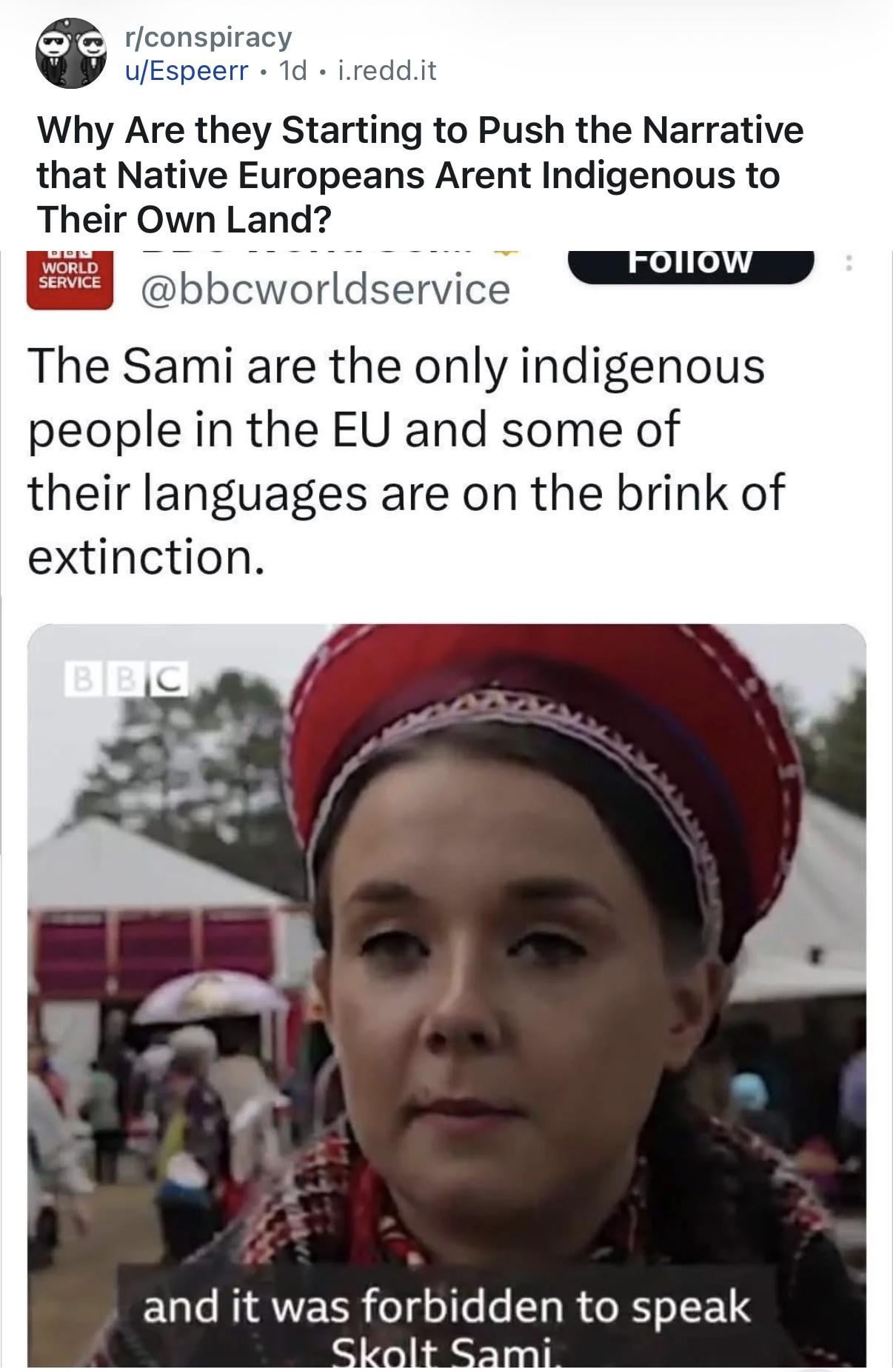
I’ve seen multiple people under the comments of this post getting lost in translation because of the word indigenous, saying for example that Germans are indigenous cause they are native. And it’s exactly the opposite, in anthropology, native means native, indigenous specifically means non native to the land.
I’ll elaborate.
I am French, the BBC is British, most of you are Americans.
The word « Indigenous » comes from the Latin word « indigena », which means « from the country ». This is what the word meant most of history.
In French this word would be « Indigène », coming from Latin, meaning the same as in Latin. However there was a shift in definition in English, specifically American English, because of the misuse of the term.
If I to translate the English word « Indigenous » in French you’d expect the one I gave above but not, you’d get « Autochtone », from Ancient Greek, which has no real equivalent in English.
The definition of this world would be as follows: « The descendants of those who lived in a country or geographical region at the time when population groups of different cultures or ethnic origins arrived there and subsequently became predominant, through conquest, occupation, colonization, or other means »
While this is not the commonly used definition of indigenous in English, it is the main definition in anthropology, for lack of a better equivalent word.
The confusion probably came from the USA calling the (previously) called Indians, « Native Americans », and « Indigenous », when they are in fact not Indigenous, following the original Latin definition; they come from Asia, and follow the longer definition I’ve given above, of the Greek word "Autochtone".
However, that doesn’t mean the BBC is right either.
They are right only if we follow the UN definition of indigenous, which includes a form of marginalization in society, present or past, something that is not relevant at all in anthropology, the real field of study of human populations. The UN recognize the Sami as the only indigenous people of Europe.
And, the global majority of Anthropologists agree on the existence of those indigenous groups in Europe:
– Karelians, between Finland and Russia
– Moldovans
– Touteiches (Slavic people from Polesia)
– Balkans
– Sardis, in Italy
– Romanches, in Switzerland
The smaller majority would add :
– 4 types of Balkans, The Albaneses, Greeks, Morlacs, and Valacs)
– The Basques
And following recent modifications, at least in France, we would add those French populations:
– The Britanny people (Breizh, in France)
– The Alsacians
– The Normands
– The Occitans
– The people from Gascogne
– The people from Limousin
– The people from Auvergne
– And the people from Corsica.
This is justified by extreme cultural differences in those groups, which I can confirm from experience. I was raised in Normandy, and now that I live near Paris, I struggle socially, but when I went to Denmark and then Norway, absolutely no social struggle at all, same humor, same social styles. But in France I also don’t struggle with people from Britanny, France.
This is also where the UN definition becomes even more incoherent, they mentioned that an indigenous groups is an "autochtone" group who has been or is marginalized.
Well, well, well, it turns out I went to school in France, and I’ve specifically learned about the people of Britanny, and how they were oppressed in the past, very, very severely. They are white, they look just like me, and like most white people in Europe, I even have a bit of Britanny/Normandy genetic heritage.
(I would like to add that we have pretty different definitions of what is a white person or black person in France. For example a lot of Greek people have very dark skin, and we consider them white. My partner comes from Vendée in France, and during the summer, I assure you that he’s darker than Kamala Harris, a (despicable, like everyone Republican and Democrat to be honest (sorry as a Libertarian if I don’t mention I’m one I die or something)) individual most people would consider black in the USA; which is the craziest thing I’ve heard.
Kamala Harris fits into "African American" anthropologically, and her skin color is white. She fits into "African American" because she has the facial features of Middle and South African Heritage.
And surprisingly this would also be the case if Barack Obama. In France people called him black because he was presented as such by the media, however if we met him in real life we wouldn’t call him black either.
He would be what we called "métissé" or "chocolate", or "bronzé (tanned)". This is for example the case of the child of my cousin, he’s approximately the same skin color as Barack Obama, but not a single person would ever consider him Black in France, and he would never face any racism because of his skin color. (He is French and from The Reunion, a French island with a Black non-African indigenous population).
I myself am, primarily from Basque heritage. I wouldn’t however consider myself as indigenous and basque, I was not raised in the basque region, I don’t speak basque, I don’t know basque culture (I mean, I like their ham), my culture is the one from Normandy and I consider myself Normand.
Just wanted to do this long post to clarify, hope it can help anyone.
Posted by tespacepoint
1 Comment
And this is why anthropology is less of a science and more of an argument.