
The data 'highlights a real and growing gap between the federal government’s legal needs and its in-house capacity,' says Gregory Harlow, president of the Association of Justice Counsel.
The federal government’s expenditures on outsourced legal work have more than doubled since 2015, despite hundreds of vacant in-house counsel positions staying open over the last decade, new government data reveals.
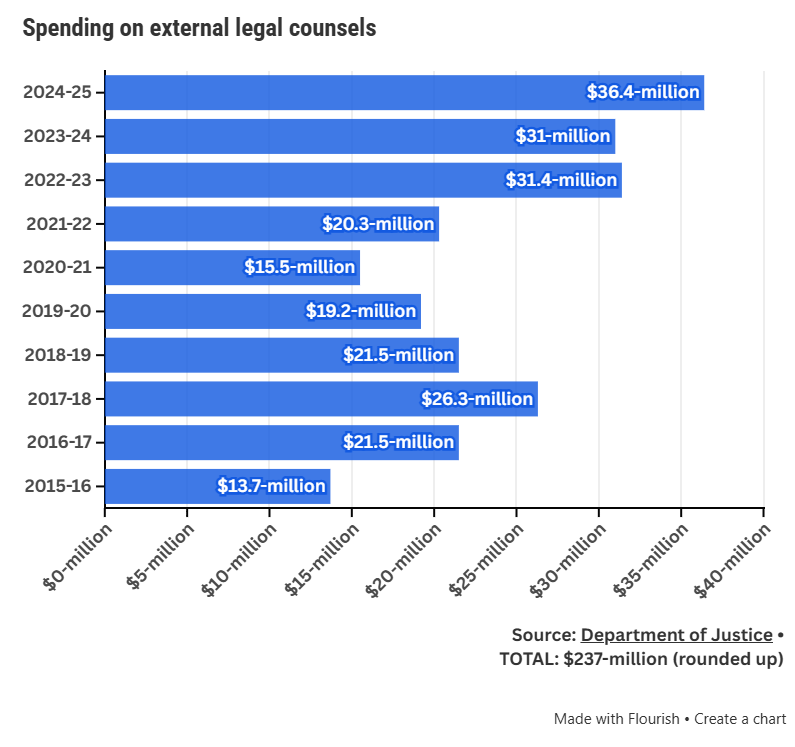
A Hill Times analysis of data disclosed by the Department of Justice shows that its spending on contracts for legal services from external counsels or “legal agents” increased from $13.8-million in 2015-16 to $36.4-million in 2024-25, more than doubling over a decade. “Legal agents” are private-sector law practitioners who enter into a contract under the authority of the minister of justice and attorney general to provide defined legal services to the Crown, as described by the department.
Gregory Harlow, president of the Association of Justice Counsel union representing more than 3,500 federal Crown prosecutors and legal counsels employed by the government, told The Hill Times that “the data highlights a real and growing gap between the federal government’s legal needs and its in-house capacity.”
According to the data, spending on outsourcing was about $36.4-million in 2024-25, an increase from 2023-24 when $31-million went to external counsels. In 2022-23, spending on outsourcing was about $31.4-million, while in 2021-22, outsourcing spending was at $20.3-million. In 2020-21, outsourcing spending was about $15.5-million.
The Justice Department led by Minister Sean Fraser (Central Nova, N.S.) did not disclose the figures for 2025-26, telling The Hill Times in an email that this information will be released on June 30 and that “until the data is finalized and posted, it would be premature to make the material public.”
The total amount spent on outsourced legal services over the last decade is more than $237-million. The breakdown of law firms and total amounts paid to them does not provide any details on the exact work done, but refers to them only as “legal services.” The department did not respond to further questions from The Hill Times, but said in a May 22 email that the data shows “a variance in costs from year to year.”
Government data also shows that the spending on in-house lawyers—which includes an annual total of salaries and benefits—nearly doubled from $368-million spent in 2015-16 to $674-million in 2025-26. According to the data, the total spending on in-house work since 2015 totals approximately $5.3-billion.
Vacant positions for in-house counsels in the government have also increased during the same period. According to the data, there were 1,342 positions vacant in 2025-26 for an average of 207.56 days. In the 2015-16 fiscal year, the number of vacant in-house counsel positions was 1,008, with the average duration of vacancy clocking in at 225.28 days. While these numbers fluctuate each year, records show that there have been more than 950 vacant positions each year over the last decade.
The data release on the number of in-house counsels employed by the department as well as an annual total of their salaries and benefits stems from a May 8 response to a March 23 Order Paper question submitted by Conservative MP Larry Brock (Brantford–Brant South–Six Nations, Ont.). Brock, his party’s justice critic, did not respond to The Hill Times‘ questions. The government did not provide a full set of data as requested by Brock, who asked for details such as the breakdown of data by province, legal area, and number of active legal agents.
Harlow explained that when it comes to routine legal work of the government, “it becomes cheaper for in-house counsel to handle those matters, partially because they become more efficient at it, as opposed to hiring firms to do one-off work, and generally, quite frankly, the hourly rate for in-house counsel is, as a general rule, much cheaper than that of external counsel.”
“External counsel can play a role in highly specialized matters, but they are no substitute for a strong, stable legal workforce within the public service. Federal government lawyers are not a discretionary expense,” Harlow said.
Harlow said that many public sector lawyers are working “significant and often absurd amounts of unpaid overtime to ensure their professional, ethical and legal obligations are met.”
“They are accountability and oversight and often the first line of defence for Canada in the forums where significant battles are won or lost, the outcomes of which have significant and lasting impacts on Canadians.”
Between 2015-16 and 2025-26, the total number of full-time equivalents (FTE) for in-house counsel employed by the department in each fiscal year have also gradually increased by more than 26 per cent. In 2025-26, there were 2,820 FTEs compared to 2,227 in 2015-16.
The department said the numbers provided in response to Brock’s question included all positions without permanent employees, some of which may be filled temporarily including with a term employee.
“Positions that are vacant cannot necessarily be staffed as funding may not be available in a given year for all positions. Positions that remain vacant from one year to the next are counted in each fiscal year,” reads a statement from Justice spokesperson Ian McLeod.
A third and “adjusted” dataset, provided to The Hill Times by the Justice Department in a May 22 email shows that 1,405 people were employed by the department in 2025-26, 919 of whom were permanent employees. In 2024-25, there were 1,027 employees, 648 of whom were permanent; and in 2023-24, 794 out of 1,156 employees were permanent.
In its response to Brock, the department said it does not have any specific targets or thresholds for the proportion of legal work to be handled in-house.
“When legal services are required, the Justice manager responsible decides, in consultation with the client department or agency, whether to assign work to in-house counsel or to recommend that the work be outsourced to a private sector law practitioner,” reads the response.
The department said the criteria used to determine whether a matter is assigned to in-house counsel or to a legal agent is outlined in the Agent Affairs Program, which includes considerations like urgency of the work, availability of counsels and resources, and geographic and security reasons.
Department has always used mix of in-house and outside support: Wernick
While it is not clear from the aggregate numbers “what may be going on,” former Privy Council clerk Michael Wernick said the Justice Department is “the government’s law firm,” and they have always used a mix of in-house staff and contractors.
“The contractors tend to be used to provide legal advice on particular issues but not to represent the Crown in court. Lawyers are not generic and interchangeable so one would want to know more about shifts in the kind of legal work,” Wernick said.
“There are big clusters of trade lawyers, tax lawyers, Indigenous law specialists, intellectual property lawyers, lawyers who draw up contracts and deals, lawyers who handle human resource issues, and so on,” he explained, adding that there may be sub-disciplines where it is harder to recruit or retain lawyers, or areas where the volume of work has grown faster than the government’s ability to recruit.
“I would assume there is a geographic distribution issue as well. The clients, the lawyers, and the courts aren’t all in the same place, and while there must have been a shift of some of the work to online platforms, it is still a challenge for the department to manage,” Wernick said.
Harlow argued that the vacancies point to recruitment and retention challenges that need to be addressed, and said the budget cuts under the Comprehensive Expenditure Review are going to continue to impact recruitment and retention. Under the review, department has to reduce its operational spending by 15 per cent over three years, which means cuts of $22.8-million in 2026–27, $30.9-million in 2027–28, and $43.5-million in 2028–29. It is anticipated that these spending reductions will involve a decrease of approximately 234 FTEs by 2028-29, according to the department’s plan.
“If this government truly values accountability, fairness, and justice, and wants to ensure Canadians legal interests are defended, it must invest in the people who uphold those values and advance Canadians legal interests every day by filling these positions and addressing the root causes of vacancies and retention problems,” Harlow said.
According to the government records, the top five law firms to which the government contracted out work in the 2024-25 fiscal year were the United States-based Blank Rome LLP, which received approximately $7.5-million; multinational law firm Dentons, which was paid $3.6-million; Canadian law firm Fasken Martineau Dumoulin LLP, which made about $2.6-million; American multinational Jones Day, which was paid $2.6-million; and Canadian law firm Torys LLP earned $2-million.
Blank Rome, Dentons, Fasken, and Torys have appeared on the list of suppliers consistently over the last decade, as well as other law firms including British-American multinational law firm Norton Rose Fulbright, Canadian firms Spiteri & Ursulak LLP and Kowarsky Ritson, and American firm McDermott Will & Emery.
When asked about the trend of certain firms repeatedly getting contracts with the government, some of which now employ former politicians, Harlow said, “I don’t think it’s an accident that many former federal politicians, particularly high-profile cabinet ministers and sometimes former prime ministers, end up with positions at major law firms, and I don’t think that they’re hired to provide legal advice. I think they are hired in their capacity of networking. Law firms do that for a reason, and that reason is to bring in business. So, do I think that there’s an overly cozy relationship? Yes, I do.”
Posted by IHateTrains123