
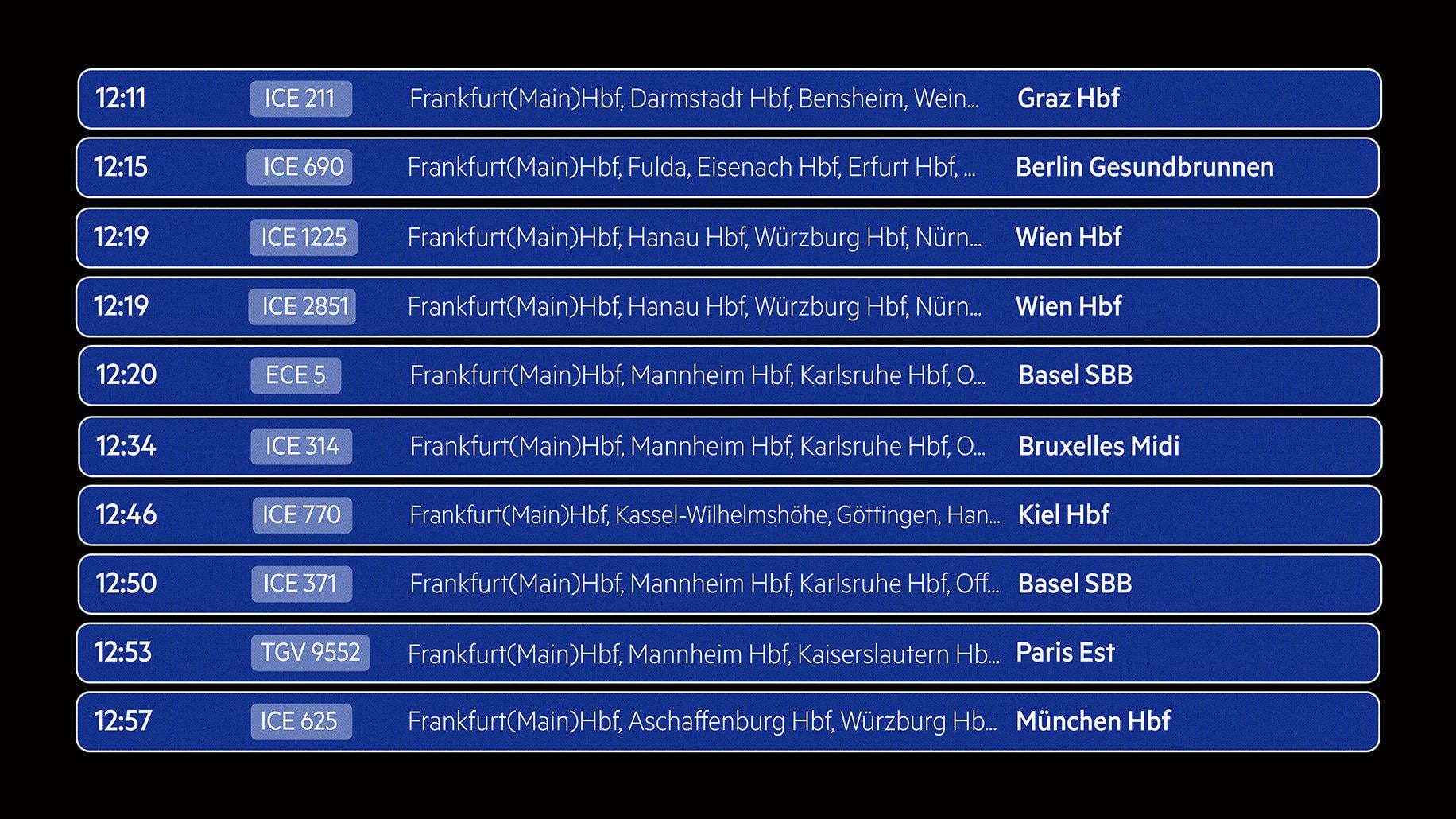
The country’s railway renewal is the first test of whether Europe’s largest economy can reverse years of decline
On a hot May afternoon near Wuppertal, a colossal track-renewal train nicknamed Mammoth inches along one of Germany’s oldest railway lines, ripping out old sleepers, ballast and rails before replacing them with new ones.
Nearly 200 years after the first commercial train ran in Germany, the work is part of a historic effort to rebuild the country’s network and a major priority in the government’s landmark €1tn debt-funded spending plans.
German railways have become so unreliable that transport minister Patrick Schnieder warned in March that they risk undermining democracy if citizens lose faith in the state’s ability to deliver basic services.
Just 60 per cent of long-distance German trains arrive on time, down from 84 per cent two decades ago. Last year, an FT analysis found that state-owned railway company Deutsche Bahn was underperforming even the most unreliable British train operator.
Following years of under-investment, time is tight, both for workers on the ground and for chancellor Friedrich Merz. Germany’s economy is in its fourth year of stagnation and a third of voters support populist parties on the right and left. Productivity growth lags behind most peers, the country’s export-reliant industrial sector is losing global market share and unemployment is on a slow but steady rise.
Perennially unreliable trains have “become a political and social symbol” for a perceived wider malaise, says André Schwämmlein, co-founder and chief executive of train operator Flix. “Many people judge how well the country functions based on the performance of the rail system.”
In Wuppertal, Mammoth is labouring to correct such sentiment. Operated by a team of 15 workers, it is rebuilding two kilometres of track per shift, more than four times what can be achieved using conventional methods.
Mammoth’s deployment is part of a much wider spending spree. In a break from decades of fiscal restraint, Berlin last year worked around a constitutional obligation to balance the budget, allowing the government to borrow €500bn to revamp its ailing infrastructure over 12 years, with a priority on trains, and to spend the same amount on the military.
“Money is no longer the main constraint,” says Jens Südekum, professor of economics and personal adviser to finance minister Lars Klingbeil. “The real challenge now is the speed of project delivery.”
Germany’s railway renewal has become the first real test of whether the state can transform a surge in borrowing into future growth, reversing years of drift and decline in Europe’s largest economy.
Berlin’s broader fiscal push has had a patchy start. In 2025, only €24bn of the €37bn earmarked for additional infrastructure investment was spent. Deutsche Bahn, which emptied the bulk of its budget, was a notable exception.
“The transport sector, and rail in particular, has been one of the areas where the infrastructure fund has got off to the strongest start,” says Südekum. “Many railway projects had been sitting in drawers for years and can now finally be financed.”
Much rests on Deutsche Bahn, which was created in 1994 through the merger of the state-owned railways of East and West Germany after reunification.
Mere months after taking office in 2025, the Merz government fired Deutsche Bahn CEO Richard Lutz, who had become the face of the rail group’s problems. His replacement, Evelyn Palla, has vowed to axe red tape and streamline a bloated organisation.
“Our ambition can be nothing less than to become the best railway company in Europe,” she told journalists in May in Berlin, adding that the journey “is still long and will also be a rocky one”.
On paper, the train journey from Hamburg to Düsseldorf is a matter of four hours and a few minutes. But on a Monday afternoon in late May, it turned into a 23-hour test of patience for Nicolas Krämer.
After hours of waiting, his train was cancelled. Alternatives were overcrowded and the eventual replacement the next morning arrived with another 100 minutes of delay.
“Deutsche Bahn’s crisis management was poor, and its internal workflows seem utterly ineffective,” Krämer says.
For the growing number of Germans complaining that nothing in their country functions as it should, the state-owned company is an easy target. The group’s infrastructure arm, DB InfraGo, owns and maintains the country’s rail network, acts as lessor to the various operators and is legally mandated to serve in the public’s interest.
But Deutsche Bahn is no longer the only train in town. A 1991 edict from Brussels opened the main lines to competition. Now there are hundreds of private operators. Most are specialised in cargo and local trains, where Deutsche Bahn’s market share has fallen below 40 per cent and 59 per cent respectively.
In long-distance travel, however, the government-owned group still controls 94 per cent of the market, with rivals like Flix, Eurostar and ÖBB making up the rest.
Krämer, a 52-year-old chief executive of healthcare consultancy HC&S, relies on Deutsche Bahn for most of his 58,000 kilometres of annual rail travel for work, often to remote hospitals.
Krämer says that “gallows humour” is the best response to delays. Earlier this year frustrated railway users created a mock betting platform to bet on real-time train delays.
He copes by careful planning. “For important meetings, I factor in three to three-and-a-half hours of time buffer,” he says. He also always carries a spare set of clothes and a toothbrush.
Over the coming years, German passengers, who took 1.93bn journeys last year, will get plenty of opportunities to hone similar rituals.
The number of construction sites on the network has shot up by a third since 2024 to 28,000 in 2026, causing additional travel chaos. Deutsche Bahn’s punctuality target has been revised down to 70 per cent and pushed back by two years to 2029.
The track works visited by the FT in Wuppertal highlight the dilemma. The line connects Cologne to the eastern Ruhr Valley, one of Germany’s most densely populated and heavily industrialised areas. Normally, up to 280 trains per day are run on this line which was opened between 1841 and 1848.
From February to July, the crucial artery will be closed down. Long-distance trains are being rerouted elsewhere, resulting in longer journey times and even more pressure on an already congested network. Some 55,000 commuters have to rely on more than 200 rail replacement buses, which are often stuck in traffic.
“Railway users face a pretty tough time for five months,” says Philipp Nagl, chief executive of DB InfraGo, Deutsche Bahn’s infrastructure arm. “But afterwards, things really will be much better.”
Between Cologne and Hagen, workers are feverishly renewing 81 kilometres of track, replacing 50 switches and renovating 12 stations. “It’s a massive task,” says Arno Jaeger, a Deutsche Bahn veteran in charge of the €800mn project, from his temporary office in a container on a disused goods station in Wuppertal.
Outside, hundreds of old sleepers are piling up next to a mountain of new ballast. Workers repeatedly uncover forgotten cables, pipelines and even roads beneath the tracks.
“We are working ourselves through the industrial history of the greater Ruhr region,” says Jaeger. With one month left until the planned reopening of the line in mid-July, he is confident the work will be completed on time: “We’ll manage thanks to a terrific team effort.”
Closing key lines for months to rebuild them from scratch is a radical departure from Deutsche Bahn tradition.
In the past, lines were kept open and renovated piece by piece. “That would just take us forever,” says Nagl. Two such closures have been completed and three are ongoing, and the company plans 35 more by 2036. “In a few months, we’re getting more work done than in previous years combined,” he adds.
Nagl, a 44-year-old railway enthusiast who holds a PhD in transport economics and logistics, inherited Europe’s largest railway network in a moment of acute crisis. Two months before his start in 2022, five people died in a train crash caused by dilapidated sleepers that should have been replaced long before.
The tragedy brought attention to a badly degraded network. Sixteen per cent of the rail network’s assets are graded as “poor” or “inadequate” and in need of urgent replacement, including bridges from the era of Emperor Wilhelm II and signal boxes from the 1960s. Eighty per cent of all train delays are caused by the worn-out infrastructure.
The problems date back to a series of ill-fated decisions taken more than two decades ago when Germany was struggling with high unemployment, low growth and rising budget deficits.
At the start of the new millennium, privatising Deutsche Bahn and listing it on the stock exchange was mooted as a way to reduce costs for taxpayers. Though it never happened, the idea had far-reaching effects. To improve profits ahead of the hypothetical listing, maintenance was skimped on. Priority was given to large-scale projects, such as Stuttgart’s controversial underground station, which ran into years of delays, cost overruns and fraud allegations by whistleblowers.
Adjusted for inflation, the annual budget for the railways network between 2005 and 2010 was around 20 per cent lower than in the mid-1990s, FT calculations show.
After the heavy borrowing to bail out banks during the global financial crisis, Germany in 2009 enshrined its controversial “debt brake” into its constitution, forcing the government to bring annual outlays in line with tax revenues.
“Under the old fiscal framework of the balanced-budget policy and the debt brake, investment had to compete with social spending for the same tax revenues,” says Südekum, the economics professor. As a result, future-orientated investment was often disadvantaged by the political process.
When Nagl arrived at DB InfraGo in 2022, one of his first moves was to implement the close-to-rebuild strategy.
Not everything worked out right away. While the first pilot, a line between Frankfurt and Mannheim, was reopened as planned after five months, real improvements in punctuality only happened a year later. The rollout of a digital train control and signalling system was delayed by more than a year. “We tried to do too much at the same time,” says Nagl.
The work on the crucial line between Hamburg and Berlin, which has been closed since August 2025, suffered an even bigger setback. Due to bad weather, the May reopening was postponed by six weeks. And for the first few weeks, the journey time will be five minutes longer than before.
Jonas Mog, owner of ahead burghotel Lenzen in Brandenburg, says that the delay in the reopening of the 278km line between Hamburg and Berlin has been a “real shock” for him. Bookings at his hotel halfway between the two big cities fell by 15 to 20 per cent during the closure.
Located in a listed castle, “we actively promote travelling here by train,” says Mog, adding that for guests from the capital, the train normally is quicker than driving. During the closure, the trip “can take four hours or more” by rail replacement, says Mog. “Guests simply do not accept that.” Mog now hopes to make up for the shortfall during the summer season. “Otherwise things can become dire.”
Elsewhere in Brandenburg, Torsten Völker, chief revenue officer at railways construction group Spitzke, faces a different challenge: not accepting more orders than the company with 3,000 employees can hope to execute. Annual revenue surged by 19 per cent to €688mn in 2025, and for this year another double-digit increase is anticipated.
After the government outlined its investment programme, Spitzke invested massively in the heavy engineering machinery needed in railway construction work. “The long-term commitment is crucial,” says Völker, adding that “we now have the confidence to act and to invest.”
On the line between Neumarkt and Regensburg, Spitzke is using helicopters to put in place new pylons for overhead wires. “That’s a bit more expensive but much quicker,” Völker adds.
Despite what Nagl calls “the biggest railway investment programme since postwar reconstruction”, current spending commitments of €107bn between 2025 and 2029 still fall short of the €130bn he says is needed to make up for years of under-investment.
Each year, more infrastructure assets reach their end of life. Over half of this year’s €23bn budget is needed to stop the maintenance backlog from getting worse, Nagl says.
While passengers are still frustrated, industry experts and economists are optimistic about the medium-term benefits. “A great deal of money is currently flowing into the most heavily used parts of the network. That will have a large effect,” says Flix CEO Schwämmlein.
Last year was a landmark of sorts. For the first time in years, the overall state of the railways network did not deteriorate further, according to DB InfraGo’s annual assessment.
By the end of 2026, Deutsche Bahn will have rebuilt 900 kilometres of train lines since 2024, close to a quarter of its 2036 target. That is equivalent to half of the roughly 1,900 kilometres of new lines built after 1945.
Flix, which started as a coach operator but also runs long-distance trains, has earmarked €2.4bn for up to 65 new high-speed trains that it plans to roll out from 2028. Italian high-speed train operator Italo also has ambitions for Germany, promising up to €3.6bn of investment in new trains if it gets multiyear access to the network.
Both rivals are eyeing 2028 for their big attacks on Deutsche Bahn’s near monopoly on long-distance journeys. By then, the current investment splurge is expected to have made meaningful improvements.
Enhanced competition could eventually spell good news for passengers. In Italy, average ticket prices fell by 41 per cent while passenger numbers doubled in the first five years after Italo started to compete with state-owned group Trenitalia in 2012.
“We believe that tens of millions of additional passengers can be brought on to the railways,” says Flix’s Schwämmlein, expressing the hope of many of the insurgent operators. “In Germany, we are too often trapped in the present and lose sight of what is being built for the future.”
Posted by IHateTrains123
1 Comment
!ping Germany&Transit