
- Khashoggi gave us the template—the intelligence-linked fixer with a yacht and a little black book, overlapping with Trump and Epstein.
- Drexel and its Milken-Black-Burkle-Deckoff connections show how the financing of the 1980s created the capital bases for today’s private equity and celebrity venture empires, and how its alumni went on to own both the financial (Black) and physical (Deckoff) remnants of Epstein’s world.
- Trump’s pardon of Milken closes the political loop.
- Kutcher’s Thorn and Burkle’s Palantir investment tie the same crew directly into the state surveillance apparatus—both tools ostensibly built to protect children, both connected to men who partied and profited in a system that trafficked them.
- Apollo’s loan to Diddy and Burkle’s A-Grade partnership with Kutcher pull the Hollywood world into the same intelligence-finance network.
- The informant speculation around Burkle and Clive Davis points to the same pattern: a small group of people who appeared to float above the law, many connected—directly or one step removed—to intelligence, law enforcement, and political protection.
Adnan Khashoggi is the starting point. He was the Saudi arms dealer and fixer who personified the 1980s intersection of intelligence, finance, and celebrity. His superyacht, the Nabila, was sold to the Sultan of Brunei and then bought by Donald Trump in 1988. Trump renamed it the Trump Princess, and he and Khashoggi ran in the same high-roller casino and party circles. Khashoggi also appears in Jeffrey Epstein’s private address books. He moved through the same world of private jets, kompromat, and intelligence connections that Epstein later mastered. Khashoggi was a known CIA asset and a central figure in Iran-Contra—the covert arms-for-hostages scandal that relied on layers of fixers, shell companies, and state-adjacent criminals.
From that 1980s milieu came Drexel Burnham Lambert, the junk-bond powerhouse. Drexel was the engine that funded a generation of leveraged buyouts and hostile takeovers. The key names for this web are Michael Milken (the junk bond king) and Leon Black (head of M&A). Drexel’s junk bonds also financed the early supermarket acquisitions of Ron Burkle, making Yucaipa Companies a Drexel client. Trump himself had financial ties to Milken and Drexel in the 1980s. Decades later, President Trump pardoned Michael Milken in 2020—a direct act of absolution for the man who ran the junk bond machine that helped seed multiple fortunes in this story.
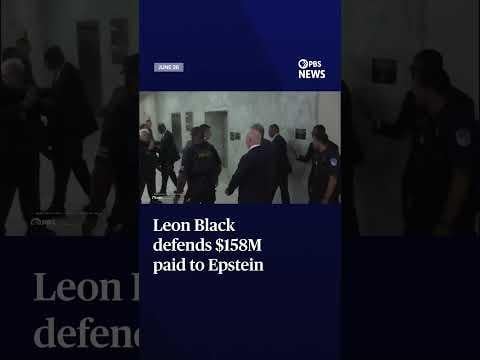
After Drexel collapsed, Leon Black co-founded Apollo Global Management, bringing along many Drexel alumni. Black spent decades as Epstein’s single biggest financial patron, paying him $158 million for tax and estate advice long after Epstein’s 2008 conviction. Black’s relationship with Epstein was so deep that it ultimately forced him out of Apollo.
Another Drexel alum, Stephen Deckoff, takes the Epstein connection in a physically literal direction. Deckoff started his career at Drexel Burnham Lambert in the 1980s, later co-founding private equity firm Black Diamond Capital Management. In 2023, he purchased Epstein’s two private Caribbean islands, Little St. James and Great St. James, for roughly $60 million, with plans to turn them into a luxury resort. So not only did Drexel spawn the financial patron who paid Epstein $158 million; a different Drexel graduate now owns the very islands where Epstein committed many of his crimes. The Drexel-to-Epstein pipeline isn’t just abstract capital flows—it’s physical real estate.
Meanwhile, Ron Burkle—the supermarket consolidator built with Drexel money—became a major Democratic donor, a close Clinton family friend, and a figure whose name shows up in Epstein’s flight logs. Burkle flew on Epstein’s plane, socialized in the same orbit, and hosted Bill Clinton fundraisers.
Burkle then co-founded the venture firm A-Grade Investments alongside Ashton Kutcher and Guy Oseary. That’s the bridge from 1980s junk-bond finance to celebrity tech investing. Kutcher was also a longtime friend and party companion of Sean “Diddy” Combs. The two ran in the same Hollywood nightlife scene, and Kutcher has publicly joked about the wildness of Diddy’s parties. At the same time, Kutcher co-founded Thorn, a nonprofit that builds digital tools used by law enforcement to identify and locate child sex trafficking victims. Thorn’s software is deployed in police departments and by Homeland Security, meaning Kutcher sits at a strange junction: he parties with a man now accused of sex trafficking, he invests with a man linked to Epstein’s flight logs and the Palantir surveillance network, and he simultaneously supplies the very police technology used to investigate those same hidden worlds. Diddy’s own financial story then directly intersects: in 2023, Apollo Global Management (the firm Black built from the ashes of Drexel) provided a roughly $200 million music-catalog-backed loan to Diddy.
That links Diddy, through Apollo, back to the Drexel/Epstein network. And it loops Kutcher into the picture both through Burkle’s A-Grade, his personal friendship with Diddy, and his role as a supplier of surveillance tools to the state.
Now the surveillance angle deepens. Ron Burkle’s Yucaipa Companies was an early investor in Palantir Technologies, the data-mining and intelligence software firm co-founded by Peter Thiel with seed funding from the CIA’s venture arm, In-Q-Tel. Palantir builds the platforms that allow military and spy agencies to fuse and analyze vast troves of personal data—the very kind of capability that turns private information into intelligence. That puts Burkle, and by proximity his A-Grade co-founder Kutcher, directly in the financial orbit of the surveillance state. The same money that was built on Drexel junk bonds and circulated in Epstein’s social scene also helped fund the tools of mass digital espionage.
Then there’s the FBI informant layer. Burkle has long been dogged by unproven rumors that he has acted as an informant, particularly in the Epstein investigation and related financial and entertainment industry circles. Diddy’s longtime music industry mentor, Clive Davis, has faced similar rumors—made more intriguing by the fact that Davis’s adopted son, an attorney, represented Diddy and was caught on video, with Davis in the room, discussing industry secrets in unusually candid terms. Neither Burkle nor Davis has been confirmed as an informant, but the rumors persist and echo the central question of Epstein’s infamous 2008 sweetheart plea deal: was the leniency because he and others in his circle provided intelligence, allowing a network of connected criminals and fixers to operate with impunity for years?
I bring this up in light of the new Leon Black revelations:
- https://youtube.com/shorts/jXyWqAl7D3A?si=lJcgFwZHUiYACnRW
- https://youtu.be/lmAgyt50cuM?si=2yVly7gZPWl0uGSW
I've previously dug into Ashton, and it's odd he has two dead ex-girlfriends, another ex who kissed a small boy on film and co-founded THORN (and wears the red string on her arm), and kissed his wife when she was 14 on TV….. and the two of them left THORN after saying Danny Masterson was a great guy during his rap*per trial. Friends with McCain and the infamous clip of the wife saying they all knew what Epstein was doing but everyone was afraid to go after him. The money trail leads straight to Ashton, there is no denying it. Oh yea and he is involved with a bunch of Israelis now per his wife. There's that real men don't buy girls commercial with trump in it as well, https://web.archive.org/web/20110410215919/https:/rmc.demiandashton.org/donald-trump, So full circle again.
Posted by CoC_Axis_of_Evil
2 Comments
SS: Kutcher is the most guilty person I’ve ever seen, like more guilty than trump in a golden shower.
Didn’t Kutcher donate his time and money to put traffickers away.