
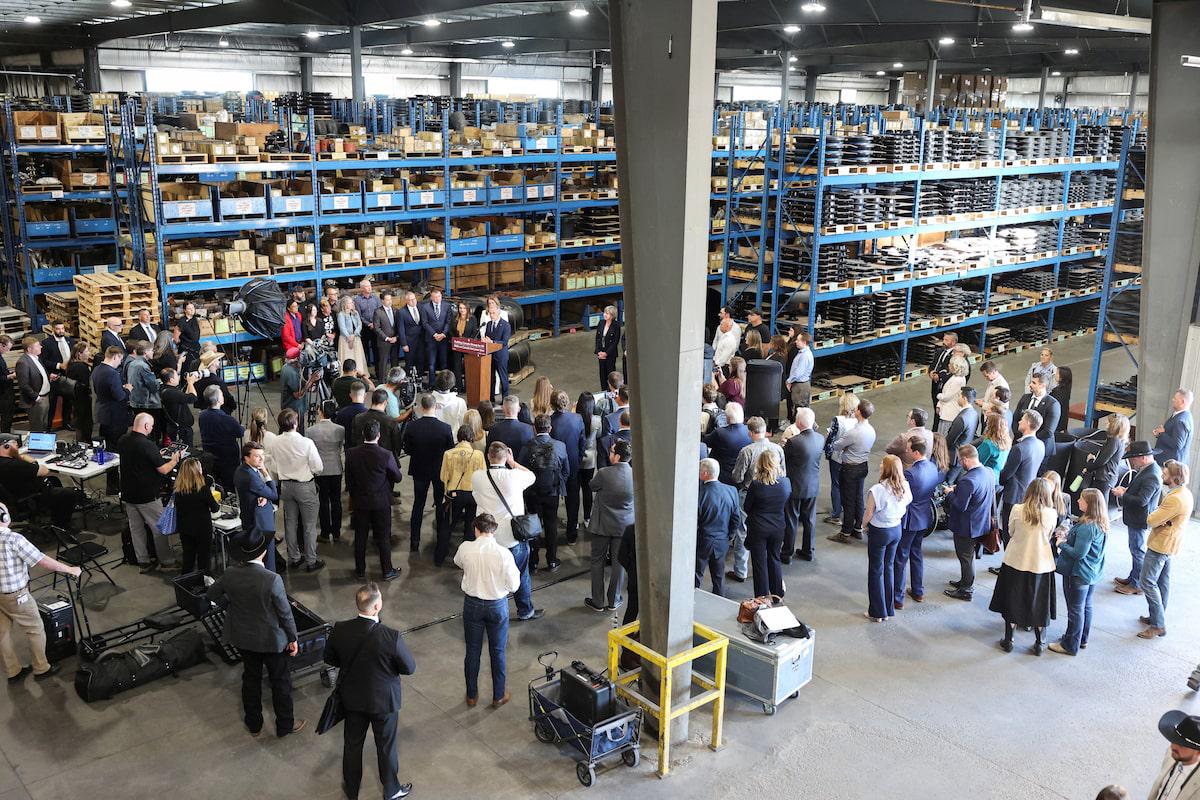
Surrounded by racks of pipe supplies at a warehouse in southeast Calgary on Thursday evening, Prime Minister Mark Carney and Alberta Premier Danielle Smith spoke in glowing terms about the economic potential of a new oil pipeline from Alberta to the West Coast.
Mr. Carney said the 1,200-kilometre conduit would “catalyze” more than $200-billion in investments and added that was a “lowball figure.” Ms. Smith said the profits from the project would generate billions more in revenues for the federal and provincial governments, as well as Indigenous nations over several decades.
The West Coast oil pipeline project, filed Thursday with Ottawa’s Major Projects Office, is the culmination of the memorandum of understanding signed last year by the two leaders, aimed at breaking regulatory logjams that Alberta’s energy sector has long cited for its refusal to invest major capital in new oil export pipelines.
So with that federal-provincial support, what’s most striking is the absence of a private-sector proponent to lead what is being touted as a nation-building project.
It is being spearheaded by Trans Mountain Corp., the Crown-owned pipeline company that completed TMX project, which nearly tripled the capacity of the existing Trans Mountain line at a cost to the federal purse of $34-billion. The new line would follow the TMX right-of-way to southern B.C. The Alberta Petroleum Marketing Commission, also a government entity, will be an equity owner.
The only private-sector player is Pembina Pipeline Corp.
PPL-T which said it would have a 10 per cent stake during construction and the option for another 10 per cent later under a non-binding agreement. First Nations will be offered opportunities to gain interests.
Last October, when Alberta kicked off a process to get a proposal ready, Ms. Smith said: “To be clear, Alberta taxpayers will not be on the hook to build this pipeline.”
But on Thursday, Ms. Smith blamed the lack of private-sector enthusiasm on past failed attempts by pipeline companies to get infrastructure built. She cited the costly failures of Enbridge Inc.’s Northern Gateway pipeline to northwestern B.C., as well as TC Energy Corp.’s Energy East and Keystone XL pipelines.
“That’s the environment we’re finding ourselves in, and so it does take some work, I think, to make sure that the private-sector proponents understand that this is a real process,” Ms. Smith said. “This is a real commitment on the part of all three parties – myself, as well as the Premier of British Columbia, as well as the Prime Minister – to get this project to the finish line.”
Asked how much taxpayer money would be spent on the project, Ms. Smith said that is still to be negotiated. Mr. Carney, speaking in French, highlighted the revenue potential, calling the project not an expense but an investment to benefit all of Canada.
Now, the MPO will assess the pipeline to list it as a project of national importance by October, and if it is listed, that would mean regulatory approvals will be fast-tracked. The line is still contingent on oil sands producers building a major carbon-capture project, though Mr. Carney said they have reached an agreement on it.
The carbon-capture project, known as Pathways, is a venture that will generate no revenue, and oil producers are being asked to put money alongside taxpayer dollars to make it happen. That’s on top of the billions of dollars they will spend to vastly increase production, said Martha Hall Findlay, director of the University of Calgary’s School of Public Policy.
She said most Canadians would rather the pipeline be funded by private capital.
Indeed, polls suggest Canadians are not broadly in favour of using tax dollars for a pipeline. In January, Abacus Data surveyed pubilc opinion on a new pipeline and found Canadians generally supportive of the idea, with 62 per cent either supporting or strongly in support. But that support dipped to 40 per cent when people were asked how they’d feel if the project was publicly funded.
However, according to Ms. Hall Findlay, the pipeline had little chance of being funded by pipeline companies until they were confident that the oil producers would produce enough new oil to pay the transport tolls to support the cost of building the line.
Former environment minister Steven Guilbeault – who quit his cabinet job as Canadian identity and culture minister on the day the original Ottawa-Alberta MOU was announced – raised concerns on Friday about the price tag.
“Bad news: after promising in the MOU that if a pipeline was to be built, it would have to be financed and operated by the private sector, we’ve learned that ‘Canada and Alberta will be equal partners. . .,’” he wrote on social media.
“Another project will be funded by taxpayers, even as oil companies are expected to earn $60-billion in profits this year.”
The federal Conservatives also offered a mixed response. Conservative infrastructure critic and Alberta MP Shannon Stubbs said taxpayers shouldn’t be on the hook.
“Those pipelines should be planned and funded by private sector proponents that will invest and build on their more efficient time and on their own dime if the federal government would just get itself out of the way and fix the fundamentals to give confidence and certainty to all companies to plan and build,” she said in a statement.
Adam Fremeth, an associate professor in business, economics and public policy at the Ivey Business School at Western University, said that the way the pipeline proposal has been presented could be seen as a first step, and that the private sector may eventually be willing to play a larger role.
“I think everyone is waiting to see another shoe drop in what policy changes may come on impact assessment, on environmental regs, on other things that are standing in the way of these projects happening,” he said in an interview.
“So I’d imagine Pembina has probably lined up to do a lot more if the government’s willing to make the changes to make this more straightforward.”
Posted by IHateTrains123