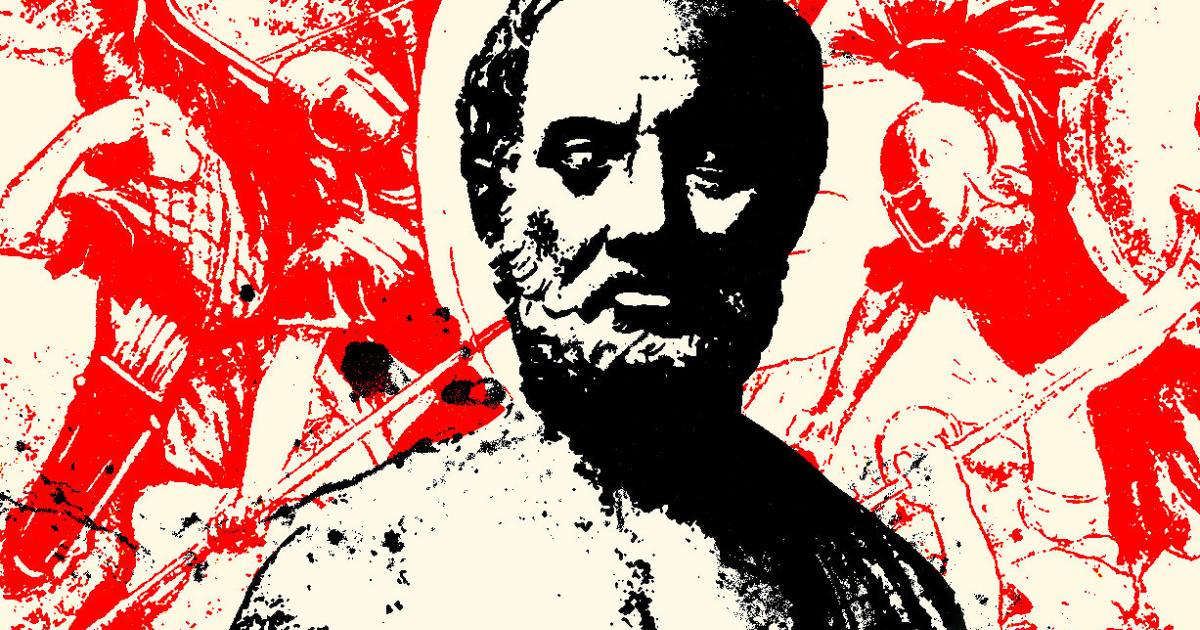
>It seems to many these days that the world is a jungle beholden only to one law. Since returning to office in 2025, U.S. President Donald Trump has not only made a spectacle of American power—by striking alleged drug smugglers in the Caribbean, kidnapping Venezuelan President Nicolás Maduro, bombing Iran, and even threatening the sovereignty of allies—he has also made a principle out of it. Trump described Maduro’s capture as a vindication of the “iron laws that have always determined global power.” In a similar vein, White House Deputy Chief of Staff Stephen Miller asserted in January that the world is “governed by force” and “governed by power” and that “these are the iron laws of the world since the beginning of time.” Observers heard in these blunt statements echoes of Thucydides, the ancient Athenian aristocrat often considered the first proponent of the cold-blooded doctrine of realism. *The Peloponnesian War*, his magisterial opus on Athens’ doomed decades-long conflict with Sparta in the fifth century BC, includes the famous line, “The strong do what they can and the weak suffer what they must.”
>That well-known line comes from an important section of the text known as the Melian Dialogue, in which representatives of Athens browbeat emissaries from the island of Melos. After the Athenians fail to persuade the Melians to accept unconditional surrender, they kill all the island’s men and enslave its women and children. Thucydides’s Melos passage has long been cited as proof that little governs the world beyond strength and its exercise—and as evidence that the brilliant Athenian general, historian, and philosopher himself believed that. Generations of students of international relations have been assigned these decontextualized snippets from his vast work and instructed that this was indeed Thucydides’s lesson. Today, a cottage industry of commentators now celebrate (or bemoan) what is described as a Thucydidean turn in American foreign policy. In “How Trump Won Davos,” an essay published in January, the historian Niall Ferguson explicitly invoked the Melian Dialogue to tout the triumph of Trump as a realist in the mode of Thucydides and asserted that, at Melos, “the realists won an emphatic victory.”
>But that understanding of both the dialogue and its author gets his meaning fundamentally backward. Thucydides repeatedly refers to, but never endorses, the idea that the strong have the freedom to do what they want: to the contrary, a careful reading of *The Peloponnesian War* suggests a rather different view. Among the principal lessons to learn from Thucydides is that the ambition of the strong can lead to their own undoing. Right after Thucydides reports the fateful words of the Athenian envoys and the subsequent destruction of Melos, he describes at great length the disastrous campaign Athens pursued in Sicily—an effort that eventually led to Athenian defeat and Spartan victory. In this light, the Melian Dialogue is not proof of the great virtue of strength in international relations but an illustration of pride before the fall.
>The political scientist Graham Allison famously coined the term “Thucydides trap” to refer to the dynamic inherent in *The Peloponnesian War*, of how the tensions between a rising power and an existing power will invariably bubble over into conflict. The real Thucydides trap, however, is different. The crucial lesson of the book is not to sketch how Athens and Sparta found themselves sleepwalking into a war that neither side wanted or understood. As Thucydides elaborately elucidates, both went into the conflict with eyes wide open. Moreover, in his view, the start of that war was hardly a trap. Thucydides supported the commencement of hostilities and the careful strategy of Pericles, the Athenian leader who rallied the public behind his demand for war with Sparta. The true catastrophe, and the real trap, occurred many years later, when Athens abandoned Pericles’s prudence and became recklessly ambitious, most grimly demonstrated by the misguided bid to conquer Sicily.
>The central tragedy of *The Peloponnesian War* is the story of growing Athenian arrogance and hubris and its fateful consequences. Modern-day Athenians, trumpeting the virtue of strength, would do well to heed Thucydides’s warnings if they don’t want to court their own disasters.
>TRUTH IN THE TALE
>The Melian Dialogue indeed offers vital lessons, but only if it is understood in the context of *The Peloponnesian War* as the book was written. That requires familiarity not with a few selected sentences but with the content of the entire work—and with Thucydides’s brilliant, precise, and overarching method. In his estimation, the 27-year conflict (431–404 BC) between Athens and Sparta unfolded in three distinct phases: an initial ten years of direct conflict, an uneasy seven-year interregnum of constant skirmishes and jockeying for position, and then another ten years of war before Athens’s unconditional surrender. Thucydides lived long enough to see the end of the war, but not, it seems, to complete his narrative, which ends abruptly in 411.
>Thucydides intuited that the Peloponnesian War would be of enormous consequence, and, with time on his hands (he was relieved of his command and exiled in 424, as punishment for a military setback under his authority), set out to record its details as “a possession for all time.” He went to heroic lengths to achieve accuracy and objectivity—qualities that can of course be strived for but never fully achieved. He had to adjudicate, at times, between competing accounts of events he did not witness and explains about the book’s many speeches that “some I heard myself, others I got from various quarters; it was in all cases difficult to carry them word for word in one’s memory, so my habit has been to make the speakers say what was in my opinion demanded of them by the various occasions, of course adhering as closely as possible to the general sense of what they really said.”
>It seems safe to say that objectivity was Thucydides’s sincere aspiration. But he inescapably had a point of view—and lessons he wished to convey. He elaborated those points not by massaging the facts but by choosing to tell the story in particular ways. As his first great English translator Thomas Hobbes put it, although Thucydides never stops “to read a lecture, moral or political, upon his own text,” nevertheless, “the narration itself doth secretly instruct the reader.” Modern students of Thucydides share this view. As the French classicist Jacqueline de Romilly explained, Thucydides “strives so impressively for perfect scholarly objectivity,” but he is “constantly making choices” and his “intervention is most profound.”
>Thucydides also puts his finger on the scale by simply withholding information. Readers must attend to the places where he opts to expand or contract the narrative. One full year of fighting is sometimes compressed into a few paragraphs, yet other events, even those of little direct strategic consequence to the course of the war, are elaborated in considerable detail. Thucydides deploys the tactic of what one scholar has called “extreme narrative deceleration” to instill greater meaning into certain events, and in so doing, subtly crafts the lessons that he wants to impart.
>THE MELIAN MYSTERY
>The Melian Dialogue is a dramatic example of Thucydides’s extreme narrative deceleration. Although it is incessantly quoted, its most distinct—and rarely acknowledged—characteristic is that there is absolutely no obvious reason why the author dwells on this event. In the 16th year of the war (during that unstable interregnum when Athens and Sparta were technically at peace), the Athenians returned to this modest island in the Aegean and demanded that it surrender or be obliterated. Technically a Spartan ally but not much involved in the fighting, Melos wanted to be left alone, and its representatives pleaded with the Athenians to let them remain quietly neutral.
>Thucydides then stops his narrative in its tracks and follows the deliberations among a handful of Athenians and Melians. That debate takes the form of a dialogue, in which each side takes a turn making or rebutting an argument. It is the only such dialogue in the entire work and goes on for several pages, during which the Melians warn that the Athenians might regret destroying them and the Athenians insist on complete submission. The Athenians are imperious and swaggering and show little concern that any act of barbarism they commit might come back to haunt them. They urge the island’s inhabitants to surrender and be spared, surviving as vassals; the Melians, at least those in the closed-door negotiations, choose resistance. After a while (Melos turned out to be less of a pushover than imagined), the Athenians conquer the island. “The Melians surrendered at discretion to the Athenians, who put to death all the grown men whom they took, and sold the women and children for slaves, and subsequently sent out five hundred colonists and settled the place themselves.”
>The episode’s denouement offers a compelling and characteristically vivid parable. But it is also not obvious at all why Thucydides gives Melos the attention that he does. The Melian campaign had no bearing whatsoever on the course and outcome of the war.
>Nor does Melos provide a unique example of how “the strong do what they can and the weak suffer what they must.” Numerous classicists have observed that this notion appears frequently in the work. Sixteen years earlier, in a speech before the Spartans, the Athenians defended their behavior by invoking it: “It has always been the law that the weaker should be subject to the stronger.”
GogurtFiend on
Few people who quote Thucydides have actually read him
Standard_Ad7704 on
SS: Relevant since Thucydides has been quoted a lot recently, it would be instructive to clarify popular misconceptions about beliefs and thought.
* Trump administration officials, who ostensibly abide by the realist school of international relations as well as commentators like Niall Ferguson, have invoked Thucydides’s famous Melian Dialogue line, “the strong do what they can, and the weak suffer what they must”, as vindication for a raw power-politics approach to foreign policy.
* This actually gets Thucydides backward. He never endorses that maxim in his own voice; instead, he places the massacre of Melos immediately before Athens’s catastrophic Sicilian expedition, using this sequence to show that imperial arrogance leads to self-destruction rather than triumph.
* Rather than moralizing directly, Thucydides instructs through narrative craft, such as compressing some events into a single sentence while dramatically slowing down (extreme narrative deceleration) on others to signal what he considers most important.
* The Melian dialogue stands out as the only full dialogue in the entire work (The Peloponnesian War), and receives vastly more attention than the nearly identical, and comparably brutal, destruction of Scione years earlier, which is conveyed in one line. This is a deliberate clue to its significance. Reading the Melian Dialogue in context alongside the more merciful Mytilene debate and the ruinous Sicilian campaign that follows, the episode shows how war corrupted Athenian conduct over time. Thucydides’ central warning isn’t that might makes right, but that unchecked arrogance and hubris are what ultimately destroy great powers.
* Ultimately, the true “Thucydides trap” is a cautionary tale for modern superpowers like the United States: relying solely on brute force and boundless self-regard while dismissing moral restraints courts catastrophe.
TF_dia on
The Trump Admin quoting Thucydides is funny because the Peloponessian war famously ended with the Athenians eating shit, with the start of their misfortunes being a naval invasion started on shoddy pretenses that lead to their entire invasion forced getting killed or enslaved. Theonly thing they got from Melia was a genocide that only led to misery.

4 Comments
>It seems to many these days that the world is a jungle beholden only to one law. Since returning to office in 2025, U.S. President Donald Trump has not only made a spectacle of American power—by striking alleged drug smugglers in the Caribbean, kidnapping Venezuelan President Nicolás Maduro, bombing Iran, and even threatening the sovereignty of allies—he has also made a principle out of it. Trump described Maduro’s capture as a vindication of the “iron laws that have always determined global power.” In a similar vein, White House Deputy Chief of Staff Stephen Miller asserted in January that the world is “governed by force” and “governed by power” and that “these are the iron laws of the world since the beginning of time.” Observers heard in these blunt statements echoes of Thucydides, the ancient Athenian aristocrat often considered the first proponent of the cold-blooded doctrine of realism. *The Peloponnesian War*, his magisterial opus on Athens’ doomed decades-long conflict with Sparta in the fifth century BC, includes the famous line, “The strong do what they can and the weak suffer what they must.”
>That well-known line comes from an important section of the text known as the Melian Dialogue, in which representatives of Athens browbeat emissaries from the island of Melos. After the Athenians fail to persuade the Melians to accept unconditional surrender, they kill all the island’s men and enslave its women and children. Thucydides’s Melos passage has long been cited as proof that little governs the world beyond strength and its exercise—and as evidence that the brilliant Athenian general, historian, and philosopher himself believed that. Generations of students of international relations have been assigned these decontextualized snippets from his vast work and instructed that this was indeed Thucydides’s lesson. Today, a cottage industry of commentators now celebrate (or bemoan) what is described as a Thucydidean turn in American foreign policy. In “How Trump Won Davos,” an essay published in January, the historian Niall Ferguson explicitly invoked the Melian Dialogue to tout the triumph of Trump as a realist in the mode of Thucydides and asserted that, at Melos, “the realists won an emphatic victory.”
>But that understanding of both the dialogue and its author gets his meaning fundamentally backward. Thucydides repeatedly refers to, but never endorses, the idea that the strong have the freedom to do what they want: to the contrary, a careful reading of *The Peloponnesian War* suggests a rather different view. Among the principal lessons to learn from Thucydides is that the ambition of the strong can lead to their own undoing. Right after Thucydides reports the fateful words of the Athenian envoys and the subsequent destruction of Melos, he describes at great length the disastrous campaign Athens pursued in Sicily—an effort that eventually led to Athenian defeat and Spartan victory. In this light, the Melian Dialogue is not proof of the great virtue of strength in international relations but an illustration of pride before the fall.
>The political scientist Graham Allison famously coined the term “Thucydides trap” to refer to the dynamic inherent in *The Peloponnesian War*, of how the tensions between a rising power and an existing power will invariably bubble over into conflict. The real Thucydides trap, however, is different. The crucial lesson of the book is not to sketch how Athens and Sparta found themselves sleepwalking into a war that neither side wanted or understood. As Thucydides elaborately elucidates, both went into the conflict with eyes wide open. Moreover, in his view, the start of that war was hardly a trap. Thucydides supported the commencement of hostilities and the careful strategy of Pericles, the Athenian leader who rallied the public behind his demand for war with Sparta. The true catastrophe, and the real trap, occurred many years later, when Athens abandoned Pericles’s prudence and became recklessly ambitious, most grimly demonstrated by the misguided bid to conquer Sicily.
>The central tragedy of *The Peloponnesian War* is the story of growing Athenian arrogance and hubris and its fateful consequences. Modern-day Athenians, trumpeting the virtue of strength, would do well to heed Thucydides’s warnings if they don’t want to court their own disasters.
>TRUTH IN THE TALE
>The Melian Dialogue indeed offers vital lessons, but only if it is understood in the context of *The Peloponnesian War* as the book was written. That requires familiarity not with a few selected sentences but with the content of the entire work—and with Thucydides’s brilliant, precise, and overarching method. In his estimation, the 27-year conflict (431–404 BC) between Athens and Sparta unfolded in three distinct phases: an initial ten years of direct conflict, an uneasy seven-year interregnum of constant skirmishes and jockeying for position, and then another ten years of war before Athens’s unconditional surrender. Thucydides lived long enough to see the end of the war, but not, it seems, to complete his narrative, which ends abruptly in 411.
>Thucydides intuited that the Peloponnesian War would be of enormous consequence, and, with time on his hands (he was relieved of his command and exiled in 424, as punishment for a military setback under his authority), set out to record its details as “a possession for all time.” He went to heroic lengths to achieve accuracy and objectivity—qualities that can of course be strived for but never fully achieved. He had to adjudicate, at times, between competing accounts of events he did not witness and explains about the book’s many speeches that “some I heard myself, others I got from various quarters; it was in all cases difficult to carry them word for word in one’s memory, so my habit has been to make the speakers say what was in my opinion demanded of them by the various occasions, of course adhering as closely as possible to the general sense of what they really said.”
>It seems safe to say that objectivity was Thucydides’s sincere aspiration. But he inescapably had a point of view—and lessons he wished to convey. He elaborated those points not by massaging the facts but by choosing to tell the story in particular ways. As his first great English translator Thomas Hobbes put it, although Thucydides never stops “to read a lecture, moral or political, upon his own text,” nevertheless, “the narration itself doth secretly instruct the reader.” Modern students of Thucydides share this view. As the French classicist Jacqueline de Romilly explained, Thucydides “strives so impressively for perfect scholarly objectivity,” but he is “constantly making choices” and his “intervention is most profound.”
>Thucydides also puts his finger on the scale by simply withholding information. Readers must attend to the places where he opts to expand or contract the narrative. One full year of fighting is sometimes compressed into a few paragraphs, yet other events, even those of little direct strategic consequence to the course of the war, are elaborated in considerable detail. Thucydides deploys the tactic of what one scholar has called “extreme narrative deceleration” to instill greater meaning into certain events, and in so doing, subtly crafts the lessons that he wants to impart.
>THE MELIAN MYSTERY
>The Melian Dialogue is a dramatic example of Thucydides’s extreme narrative deceleration. Although it is incessantly quoted, its most distinct—and rarely acknowledged—characteristic is that there is absolutely no obvious reason why the author dwells on this event. In the 16th year of the war (during that unstable interregnum when Athens and Sparta were technically at peace), the Athenians returned to this modest island in the Aegean and demanded that it surrender or be obliterated. Technically a Spartan ally but not much involved in the fighting, Melos wanted to be left alone, and its representatives pleaded with the Athenians to let them remain quietly neutral.
>Thucydides then stops his narrative in its tracks and follows the deliberations among a handful of Athenians and Melians. That debate takes the form of a dialogue, in which each side takes a turn making or rebutting an argument. It is the only such dialogue in the entire work and goes on for several pages, during which the Melians warn that the Athenians might regret destroying them and the Athenians insist on complete submission. The Athenians are imperious and swaggering and show little concern that any act of barbarism they commit might come back to haunt them. They urge the island’s inhabitants to surrender and be spared, surviving as vassals; the Melians, at least those in the closed-door negotiations, choose resistance. After a while (Melos turned out to be less of a pushover than imagined), the Athenians conquer the island. “The Melians surrendered at discretion to the Athenians, who put to death all the grown men whom they took, and sold the women and children for slaves, and subsequently sent out five hundred colonists and settled the place themselves.”
>The episode’s denouement offers a compelling and characteristically vivid parable. But it is also not obvious at all why Thucydides gives Melos the attention that he does. The Melian campaign had no bearing whatsoever on the course and outcome of the war.
>Nor does Melos provide a unique example of how “the strong do what they can and the weak suffer what they must.” Numerous classicists have observed that this notion appears frequently in the work. Sixteen years earlier, in a speech before the Spartans, the Athenians defended their behavior by invoking it: “It has always been the law that the weaker should be subject to the stronger.”
Few people who quote Thucydides have actually read him
SS: Relevant since Thucydides has been quoted a lot recently, it would be instructive to clarify popular misconceptions about beliefs and thought.
* Trump administration officials, who ostensibly abide by the realist school of international relations as well as commentators like Niall Ferguson, have invoked Thucydides’s famous Melian Dialogue line, “the strong do what they can, and the weak suffer what they must”, as vindication for a raw power-politics approach to foreign policy.
* This actually gets Thucydides backward. He never endorses that maxim in his own voice; instead, he places the massacre of Melos immediately before Athens’s catastrophic Sicilian expedition, using this sequence to show that imperial arrogance leads to self-destruction rather than triumph.
* Rather than moralizing directly, Thucydides instructs through narrative craft, such as compressing some events into a single sentence while dramatically slowing down (extreme narrative deceleration) on others to signal what he considers most important.
* The Melian dialogue stands out as the only full dialogue in the entire work (The Peloponnesian War), and receives vastly more attention than the nearly identical, and comparably brutal, destruction of Scione years earlier, which is conveyed in one line. This is a deliberate clue to its significance. Reading the Melian Dialogue in context alongside the more merciful Mytilene debate and the ruinous Sicilian campaign that follows, the episode shows how war corrupted Athenian conduct over time. Thucydides’ central warning isn’t that might makes right, but that unchecked arrogance and hubris are what ultimately destroy great powers.
* Ultimately, the true “Thucydides trap” is a cautionary tale for modern superpowers like the United States: relying solely on brute force and boundless self-regard while dismissing moral restraints courts catastrophe.
The Trump Admin quoting Thucydides is funny because the Peloponessian war famously ended with the Athenians eating shit, with the start of their misfortunes being a naval invasion started on shoddy pretenses that lead to their entire invasion forced getting killed or enslaved. Theonly thing they got from Melia was a genocide that only led to misery.