
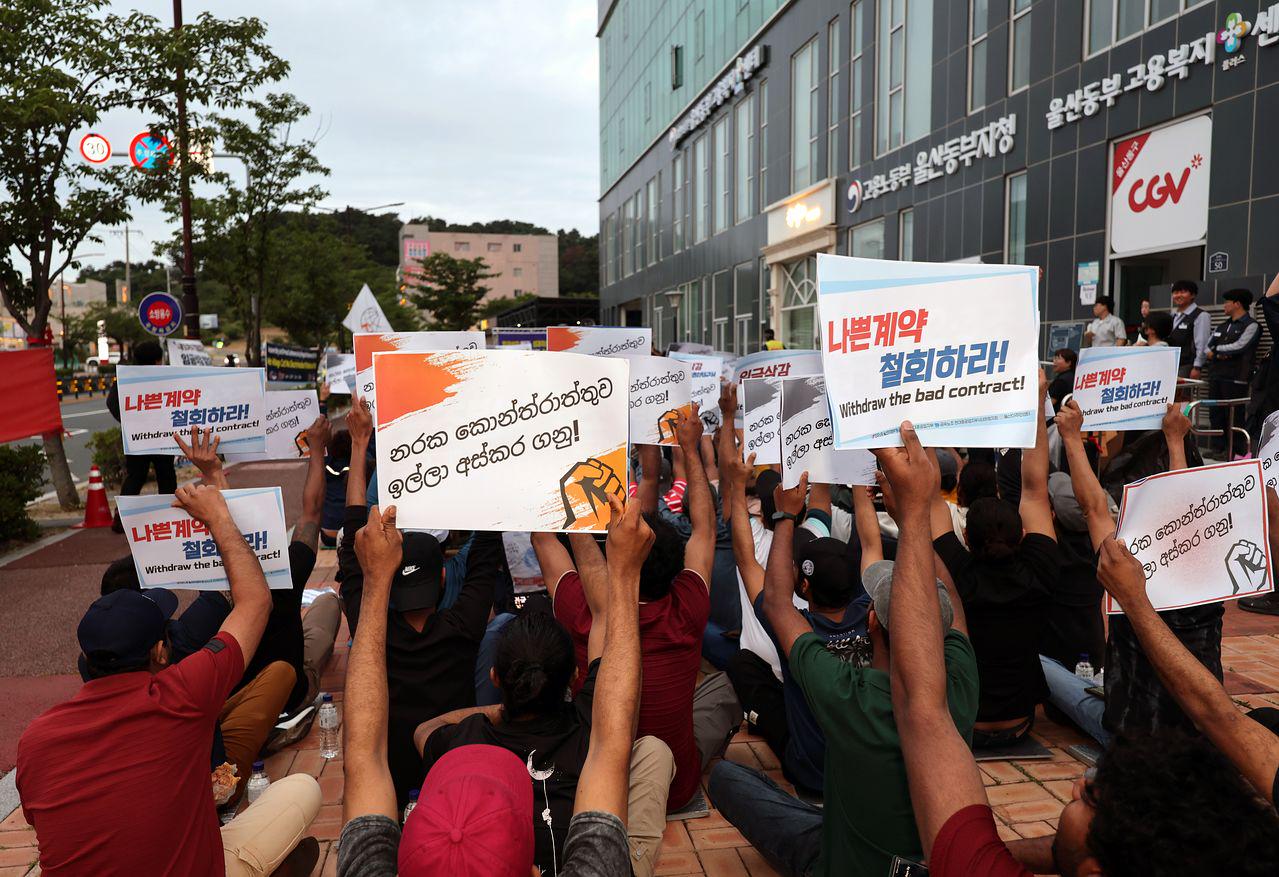
More than 200 directly employed foreign workers at HD Hyundai Heavy Industries’ Ulsan shipyard have joined the Korean Confederation of Trade Unions in a group. The move was triggered by a dispute over a newly revised wage system.
The Korean Confederation of Trade Unions’ Ulsan regional office and the Korean Metal Workers’ Union said on July 15 that more than 200 foreign workers directly employed by HD Hyundai Heavy Industries had recently joined the in-house subcontract workers’ branch of the Hyundai Heavy Industries union. It is considered unusual for shipyard workers from a range of countries, including Sri Lanka, Vietnam, and Nepal, to join a union at the same time.
The immediate cause of the mass enrollment was a new wage system recently introduced by the company. At the end of May, HD Hyundai Heavy Industries offered new employment contracts to approximately 1,600 directly employed foreign workers. Under the proposal, monthly base pay would be reduced by roughly 170,000 to 200,000 won, while a fixed overtime allowance based on 30 hours of overtime per month would be introduced. The company also proposed a performance-based differential wage system under which pay would vary according to individual performance. In addition, meals would be provided free of charge instead of deducting 210,000 won per month from workers’ wages for meal expenses.
However, many foreign workers objected during the contract-renewal process. They were concerned that although meal charges would no longer be deducted, the reduction in base pay could lower their actual earnings. The workers subsequently sought help from the Ulsan Migrant Center, and the Korean Confederation of Trade Unions began providing support, leading to several rallies in central Ulsan.
As the controversy grew, HD Hyundai Heavy Industries announced supplementary measures. From June 30 to July 2, the company held briefing sessions for workers of different nationalities and decided to provide breakfast, lunch, and dinner free of charge to all directly employed foreign workers. It also offered to reimburse meal charges deducted from wages since January 2023 and revised its bonus plan so that performance bonuses would be distributed equally regardless of personnel evaluations. According to the company, the retroactive meal reimbursement would average approximately 7 million won per worker.
A company representative said, “When the abolition of meal deductions, performance bonuses, and other measures are considered together, foreign workers’ total compensation and take-home pay will increase more steadily than under the previous system.” The representative added that a significant number of foreign workers had therefore signed the new employment contracts.
The union, however, maintains that the new contracts should be withdrawn entirely. It argues that some foreign workers signed because they feared that refusing could result in their contracts not being renewed or in their return to their home countries. According to the union, about 320 of the approximately 1,600 directly employed migrant workers signed statements saying that they had agreed to the company’s new contracts against their wishes. The union has called on the Ministry of Employment and Labor to conduct a special labor inspection.
The foreign workers who joined the union are general skilled workers employed directly by HD Hyundai Heavy Industries under E-7-3 visas. They perform core shipbuilding tasks, including welding, painting, and pipefitting.
Posted by Freewhale98
1 Comment
1. Summary
Migrants workers in Korea are unionizing to seek their interests
2. How is this related to the sub
(1) Immigration: Korea’s labor unions have been encouraging migrant workers to unionize for a while and that seems to be producing results.