
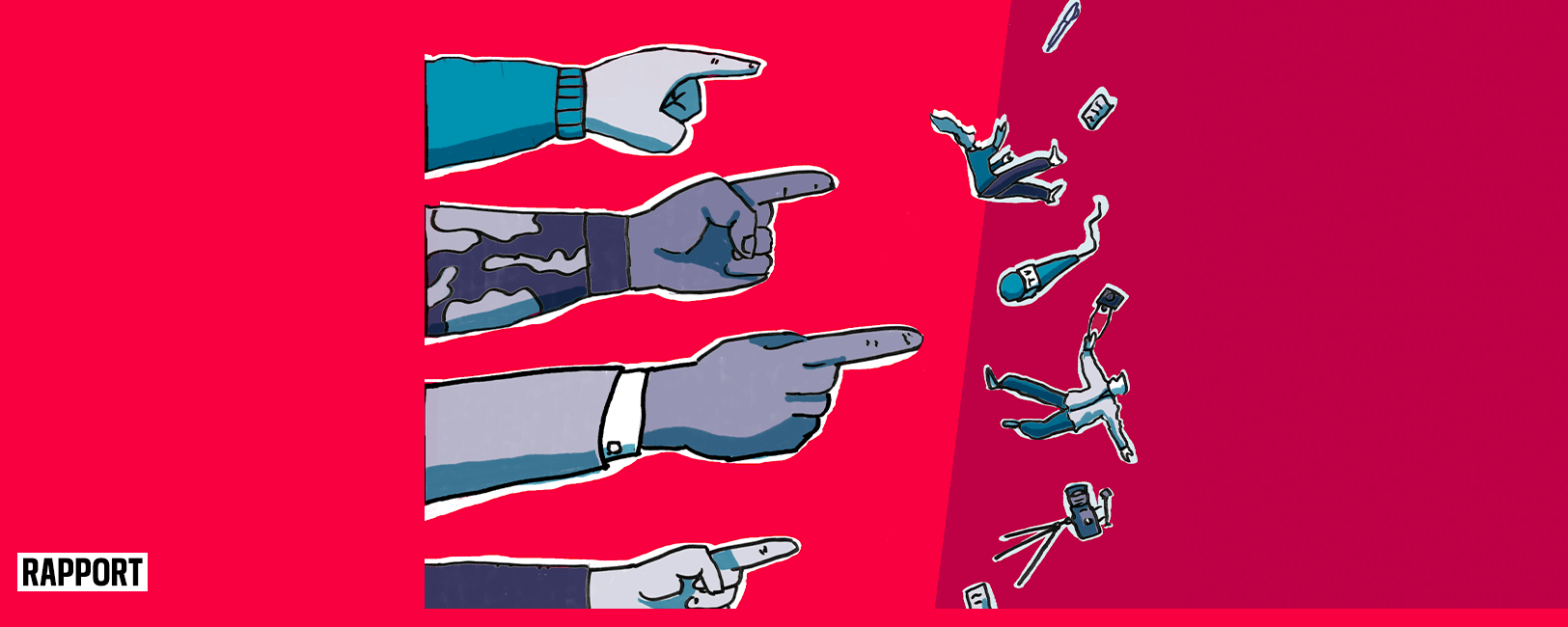
In the name of national security, journalists are being prosecuted, imprisoned, surveilled, forced into exile and even killed. In its new report, “National Security as a Weapon Against Journalism,” Reporters Without Borders (RSF) illustrates how the concept of national security has strayed far beyond its original purpose and become a tool of repression against journalism around the world. The report examines this global drift and sets out ten practical recommendations to ensure the long-term protection of press freedom.
“National security must never become a pretext for governments to silence journalists. Every abusive prosecution, every arbitrary detention and every law misused against the press undermines not only the freedom to report, but also the public’s right to access information. Authoritarian and democratic governments alike are now learning from one another how to deploy the machinery of the national security state to prevent journalists from investigating matters of public interest. Our report shows that this dangerous trend has become global and that it is urgently necessary to reaffirm a fundamental principle: journalism is never a crime against the state – it is a safeguard against arbitrariness.
Anne Bocandé, RSF Editorial Director
What do Saudi journalist Turki al-Jasser, Philippine journalist Frenchie Mae Cumpio and Chinese journalist Zhang Zhan have in common? All were prosecuted in the name of “national security” between 2020 and 2026. Al-Jasser was executed and the other two imprisoned simply for doing their jobs. They are far from isolated cases. From Gaza to Hong Kong, from Moscow to Managua, hundreds of journalists are now being targeted with accusations of terrorism, espionage, treason or harming state interests for providing citizens with reliable news.
The past few weeks alone have provided further evidence of this pattern. In Russia, the independent news outlet Crimean Solidarity was added to the government’s stigmatising list of “foreign agents” for documenting Russian repression in occupied Crimea. In the United States, the Department of Justice issued subpoenas compelling journalists from The Washington Post and The Wall Street Journal to testify before a grand jury investigating national security leaks. On 1 July 2026, just days before the report was published, the Chinese regime brought a new law into force that dangerously expanded the range of activities considered “terrorism”. This legislation can be used to target exiled journalists, notably those from the persecuted Uyghur minority. In Hong Kong, media owner Jimmy Lai has now spent more than 2,000 days in detention on national security charges as the founder of one of the territory’s most prominent independent newspapers, Apple Daily.
On 8 July, the Paris Court of Appeal is due to rule on the case of French investigative journalist Ariane Lavrilleux. She was prosecuted for “compromising national defence secrets” and revealing information likely to identify a “protected agent” after her 2021 investigation revealed that a French intelligence mission had allegedly been diverted by the Egyptian authorities to target civilians. In 2023, the Disclose journalist was held in police custody for 39 hours, her home was searched and she was placed under surveillance. Even though the case against her was dismissed in October 2025 by an investigating judge who found that her reporting clearly served the public interest and contributed to democratic debate, the Public Prosecutor’s Office is now seeking to reopen the investigation and her formal indictment, summon her co-authors to a hearing and impose the removal of the published articles and an accompanying documentary.
Twenty-five years after the US-led “war on terror” heightened security measures around the globe, the 2026 RSF World Press Freedom Index points to the continued overreach of national security legislation as its legal indicator deteriorated in more than 60% of countries between 2025 and 2026. The criminalisation of journalism through the circumvention of press law and the misuse of emergency or ordinary legislation is a global phenomenon.
“I have spent much of my career defending journalists and whistleblowers prosecuted in the name of national security. But when I appeared in court at the beginning of the century for refusing to hand over my sources, I believed I was witnessing an exceptional clash between national security and press freedom. Today, it has become a model of governance. States are learning from one another how best to use the cover of national security to circumvent democratic scrutiny and silence journalists. What this report shows is that we are no longer dealing with a series of isolated cases. We are witnessing the normalisation of a global model in which democracies and authoritarian regimes borrow from one another to shrink the space for press freedom.
Martin Bright, Director of Journalism, University of Essex and Contributing Editor, Index on Censorship
The growing number of armed conflicts and the advance of authoritarianism have fuelled this trend. The report highlights, in particular, how Palestinian journalists in Gaza and the occupied West Bank are being arrested, detained and deprived of their fundamental rights by the Israeli military under the pretext of fighting terrorism and national security. It also examines how the media is being silenced and pressured into disseminating “patriotic news coverage” across the Sahel region of sub-Saharan Africa. More broadly, it documents the international spread of these repressive practices, from “foreign agent” laws inspired by the Russian model to digital surveillance and censorship systems developed by China.
Democracies are not immune to this trend. Increasingly, legal and security precedents are eroding the safeguards that protect press freedom. Examples include the tougher penalties journalists could face for working with whistleblowers under the United Kingdom’s 2023 National Security Act, the conviction of Finnish journalist Juha Mäntylä, the surveillance scandal involving journalist Thanasis Koukakis in Greece, and the prosecution of Julian Assange under the US Espionage Act.
Taken together, these cases reflect a broader trend: the expanding use of national security and state secrecy as the basis for legal action against journalists. Allegations of espionage, terrorism, the dissemination of “false information” and harming state interests are now routinely invoked to justify arrests, arbitrary detention, unlawful surveillance and censorship. Such charges are increasingly brought against journalists simply for covering protests in Iran, reporting on the COVID-19 pandemic in Tanzania, or investigating environmental matters, as illustrated by the cases of Rupesh Kumar Singh in India and Shin Daewe in Myanmar. In Latin America — from Nicaragua to Brazil, from Colombia to Mexico to Chile — abusive national security charges often stem from the legacy of political turmoil caused by “internal enemies” and takes several forms today: accusations of terrorism, treason and propaganda; illegal surveillance; restrictions on access to information; and the use of security-related narratives against journalists investigating security forces, armed groups, organised crime, corruption and environmental issues.
Posted by IHateTrains123