
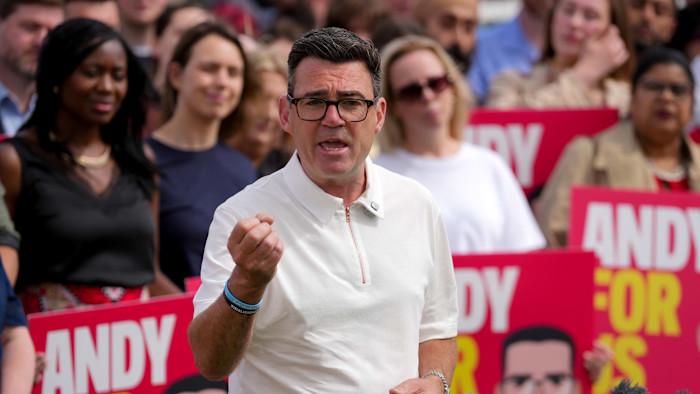
Cost of living, North Sea energy and devolution set to feature in early days and weeks of new premiership
Andy Burnham will next week seek to hit the ground running as UK prime minister with early announcements on the cost of living, North Sea energy, social care and devolution, according to people briefed on his plans.
Burnham will enter Number 10 next Monday lunchtime and immediately start forming his cabinet. His allies say his speech to the nation in Downing Street will set out his core objectives.
Meanwhile, Whitehall insiders say a “nascent grid” of early announcements is taking shape. Burnham’s allies note he will also go on regional visits to highlight his commitment to shifting power outside London.
The MP for Makerfield will begin his transition to head of the government on Friday when he is formally announced as the new leader of the Labour Party at a special conference in central London.
The formal handover as prime minister will take place on Monday when Sir Keir Starmer tenders his resignation to King Charles. Burnham will then travel to Buckingham Palace to formally assume office.
People briefed on Burnham’s plans say his team has been working with Whitehall officials on some early initiatives in his first few days in office. Burnham’s team declined to comment.
This week Burnham told MPs: “My priorities for the country are good growth in every postcode, more power in communities, and putting the cost of living front and centre in the work of the government to provide breathing space for people.”
Miatta Fahnbulleh, a former minister who has drawn up an economic plan for Burnham, has called for a plan to “immediately” put money into voters’ pockets.
Fahnbulleh said this week: “Everyone recognises that people are under pressure, living standards have not risen and we have to grip that.” The former economist singled out the costs of housing, energy and transport.
Meanwhile, Burnham has told Scottish Labour MPs that he will make an early visit to Aberdeen to underline the importance he attaches to the North Sea oil and gas industry.
Gary Smith, leader of the GMB union, and Sharon Graham, leader of Unite the Union, have slammed the Labour government’s policy of ending new exploration licences in the basin on environmental grounds as “economic madness” and “an act of self-harm” respectively.
Burnham has not said that he will change his position on the ban, which was in the 2024 Labour manifesto.
But he is expected to signal other ways in which the government can allow more drilling to take place in the North Sea, including greater use of “tiebacks” that allow further drilling next to existing fields.
Separately, the government must soon decide whether to approve the Jackdaw gasfield and Rosebank oilfield off the coast of Scotland, which were plunged into limbo by a court ruling that their consents were illegal.
Government officials expect Burnham to approve Jackdaw and possibly Rosebank, although he may not be able to move fast because of a live quasi-judicial process.
Burnham has also talked about bringing public services under closer public control. The water industry is braced for him to set out plans to take control of the heavily indebted Thames Water, which this week warned of “material uncertainty” over its long-term future.
Another big announcement planned is a commitment to resolve Britain’s longstanding crisis in social care, an issue the incoming premier began grappling with as Labour health secretary before the 2010 election.
Whitehall officials have started drawing up plans for a free national care service that could cost up to £18bn a year, after Burnham told officials during “access talks” last week that it would be an urgent priority.
Civil servants in the Department of Health and Social Care are fleshing out proposals for a comprehensive free-at-the-point-of-use offer modelled on the NHS.
Burnham said on the campaign trail in Makerfield that he wanted to “look at a care levy” to fund a better system of caring for the elderly, suggesting he stood by a model that he first put forward in the late 2000s.
At the time, funding options included a compulsory insurance contribution from all over-65s or a levy on estates dubbed a “death tax” by the Conservatives.
While campaigning to return to Westminster, Burnham vowed not to “flinch” from radical reform of social care, arguing that “the NHS is almost being overwhelmed by a broken care system” and “there’s a much better way of doing it”.
Lucinda Allen of the Health Foundation think-tank said “most people would think a national care service was like the NHS, free and available to all”, similar to Burnham’s 2010 proposal.
Burnham’s team has also been talking to Whitehall officials about a package to devolve power outside London, according to insiders briefed on the talks, including possible legislation.
The former Greater Manchester mayor is expected to confirm a new Number 10 North operation, which he has said will be a “conduit through which we redistribute power and resources across the UK”.
Cabinet secretary Dame Antonia Romeo will appoint a new director-general — a senior civil servant — for Number 10 North to be in place next week to oversee the new operation, one Whitehall official said.
Burnham may choose to run with some of the policies he introduced while mayor, particularly those around transport, skills, housing and affordability.
Free bus passes for 16- to 18-year-olds were an early mayoral policy nearly a decade ago, intended to connect young people, particularly in struggling households, with opportunities including jobs and college courses.
Burnham may also look to give secondary school pupils a dedicated pathway towards technical education, which he has long said is undervalued in national government.
Meanwhile, fiscal devolution, an area in which chancellor Rachel Reeves has become increasingly enthusiastic over the past six months, may also move forward at pace.
Posted by IHateTrains123
3 Comments
!ping UK
I want to give him a chance, let the left get it’s way for a change, but if it all falls apart, they’ll just say it was because he wasn’t left enough.
>My priorities for the country are good growth in every postcode
I love that phrasing, as if the UK had spent the last 15 years having “bad” “unequal” growth, rather than nationwide stagnation.