**Former military chief Gadi Eisenkot is the main opponent to Israel’s divisive prime minister ahead of October election**
In his 30 years at the pinnacle of Israeli politics, Benjamin Netanyahu has vanquished many rivals — but none quite like his current main challenger.
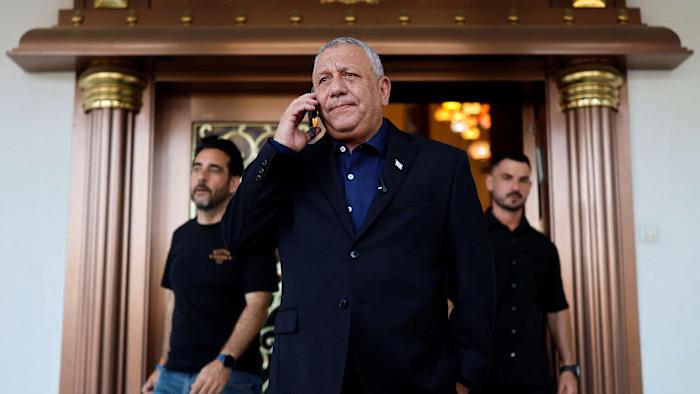
Gadi Eisenkot, a former military chief, speaks halting English. He’s never run a government ministry. And until a few months ago he had never helmed a political party.
The top ranks of Israeli politics used to be dominated by former generals, including prime ministers Yitzhak Rabin, Ehud Barak and Ariel Sharon. It was another former army chief, Benny Gantz, who in 2019 rocketed from political novice to lead the anti-Netanyahu opposition.
Yet, while his path to power is still uncertain, the fact that Eisenkot — referred to by some analysts as the “anti-Netanyahu” — has emerged as the prime minister’s most formidable challenger surprises even those who know him.
“He doesn’t look the part, it’s not overwhelming charisma, and he’s not one to give rousing speeches,” said Amos Harel, the military analyst for Haaretz who has known Eisenkot for more than two decades.
As he has done against political rivals throughout his career, Netanyahu has attempted to paint Eisenkot as an extreme leftwinger who will make common cause with “the Arabs” and endanger Israeli security.
Eisenkot has rejected the portrayal, touting his hawkish credentials. Hailing from a Moroccan immigrant family in the southern city of Eilat, Eisenkot grew up a world away from north Tel Aviv or Jerusalem’s Rehavia neighbourhood, which the Netanyahus called home.
His military career started in the Golani Brigade and ended as chief of the general staff between 2015 and 2019. As a senior officer he formulated a contentious doctrine calling for the use of overwhelming force against Israel’s enemies, including targeting civilian infrastructure.
While Eisenkot didn’t implement the doctrine as army chief — deploying a more targeted strategy — many view it as a precursor to the Israeli military’s devastating tactics in Gaza and Lebanon.
He joined Gantz’s party ahead of the 2022 elections, going on to serve as a minister without portfolio in Netanyahu’s emergency wartime cabinet following Hamas’s October 7 2023 attack — his only senior government post to date.
But it was through the December 2023 death of his reservist son Gal during the war in Gaza — followed shortly thereafter by the deaths in combat of two nephews — that many Israelis formed an attachment to him.
Gal’s funeral, which drew the country’s senior leadership, was aired live on Israeli television, with the stoic Eisenkot giving a tearful eulogy in which he vowed to make Israel worthy of his son’s sacrifice.
He later fell out with Netanyahu over wartime strategy, including what he saw as the sabotage of deals to halt the war in return for the release of Israeli hostages held by Hamas.
He left the cabinet in 2024 “with a heavy heart . . . once I understood that Netanyahu’s own interests were no longer vital national security interests”, he told a conference this month.
Dahlia Scheindlin, a pollster and political analyst, said Eisenkot’s personal loss and background in the military — still the most trusted institution among Jewish Israelis — helped drive his growing popularity.
“He paid the ultimate price for this war, and it draws a sharp contrast with the current government,” she said. Netanyahu has spent months trying to pass legislation exempting the ultra-Orthodox from mandatory army service, a demand of his coalition partners that is hugely unpopular with the public. Critics also point out that the prime minister’s two sons have not mobilised for reserve duty in the wars that followed October 7.
Eisenkot’s new centrist party Yashar (“Straight”), which he formed last year after splitting with Gantz and quitting parliament, has in recent surveys often pipped Netanyahu’s ruling Likud as the largest party in the next parliament, or Knesset.
A poll from public broadcaster Kan showed Yashar inching ahead of Likud by one seat — 24 to 23 — in the 120-seat chamber, and Eisenkot himself consistently leads Netanyahu when respondents are asked who would make a better prime minister.
Other potential challengers have faded for now, including former premiers Naftali Bennett and Yair Lapid. Analysts say their high-profile merger in late April put off many voters, helping Eisenkot become the opposition’s standard-bearer.
“The anti-Netanyahu camp has always had a ‘candidate of the moment’ that they coalesce around, not because they necessarily loved them, but because they think he has the highest chance to defeat Netanyahu,” said Roni Rimon, a political strategist and owner of a PR firm who ran Netanyahu’s 2009 election campaign.
“The central thing about Eisenkot is that he’s the only politician in Israel whose disadvantage is an advantage: he has no charisma,” Rimon added.
Given the tumult and trauma of the past four years under the divisive, highly polished Netanyahu, “this is exactly what Israelis are looking for. We just want someone we can believe.”
That appears to be the main thrust of Eisenkot’s campaign: not a sweeping vision or specific changes on policy towards, say, Gaza or Iran, but a pitch to “repair” the damage of the Netanyahu years and “unite” a fractured nation.
Many Israelis are alarmed by the prospect of another term for Netanyahu, whose far-right coalition has sought to undermine the judiciary and other legal bodies, neutralise the free press, and evade any accountability for the security failures around October 7. The prime minister is also facing a long-running corruption trial.
“Netanyahu’s biggest problem is leadership,” Eisenkot said in a recent interview to Israel’s Channel 12. “He doesn’t understand the word responsibility . . . and does not believe in [setting a] personal example.”
Eisenkot “has to be prime minister, to save this country”, one person close to him said.
Largely consensus issues such as drafting the ultra-Orthodox, setting up a commission of inquiry into the October 7 attack, and a return to *mamlachtiut —* a Hebrew word connoting statesmanship — are the issues Eisenkot touts most often.
Such caution is deliberate, according to analysts, as his campaign attempts to appeal to disaffected Likud supporters and other “soft rightwing” voters. Like Eisenkot, they are often Mizrahi Jewish — with roots in north Africa and the Arab world — rather than Ashkenazi communities of European descent.
It is this voting bloc that will make or break the election for either side, said Rimon, the political strategist.
Despite his growing popularity, Eisenkot’s path to form the next coalition government is not yet clear.
Polls suggest the combined slate of anti-Netanyahu Jewish opposition parties could still fall a few seats short of attaining the Knesset’s absolute 61-seat majority.
Several of those opposition leaders have ruled out joining forces with Arab-Israeli political parties, who are expected to win about 10 seats in total.
Eisenkot has remained non-committal, saying he would only ally with parties who recognise Israel as a Jewish, democratic state, and accept the principle of mandatory military or national service — a potential opening for one Arab faction.
Netanyahu has attempted to portray Eisenkot — alongside other recent generals — as defeatists who pushed to cut short recent wars before Israel could secure its “many victories” on the battlefield.
Eisenkot’s party Yashar “is not straight”, went one typical Likud advertisement. “It’s left.”
In the face of such attacks and the lingering public mood after October 7, Eisenkot has sought to deflect any such suggestion.
“I have never in all my 66 years said the words ‘Palestinian state’,” he declared in the Channel 12 interview this month.
Yet in another interview the same night, he argued for “separation” from the Palestinians, against the annexation of the occupied West Bank and advocated placing certain conditions on settlement construction in the territory.
“A reality in which we annex 2.8mn Palestinians [in the West Bank] to Israel will be a severe threat to the Zionist project,” Eisenkot said.
While still untested politically, especially in an election campaign, Eisenkot has improved as a candidate, according to analysts and those who know him — becoming sharper in interviews, more confident and growing into the role of a potential prime minister.
“It doesn’t come naturally to him, but he’s getting the hang of it,” said Harel, the military analyst. Eisenkot “understands that he’s been tasked with this job. He’s not exactly eager for it, but he’s aware of the historic role he needs to play.”
WAGRAMWAGRAM on
Likud has already reached campaign gaffes level of trouble

3 Comments
Archived version: [https://archive.fo/HmUqn](https://archive.fo/HmUqn).
**Former military chief Gadi Eisenkot is the main opponent to Israel’s divisive prime minister ahead of October election**
In his 30 years at the pinnacle of Israeli politics, Benjamin Netanyahu has vanquished many rivals — but none quite like his current main challenger.
Gadi Eisenkot, a former military chief, speaks halting English. He’s never run a government ministry. And until a few months ago he had never helmed a political party.
Yet the 66-year-old is now leading [Netanyahu](https://archive.fo/o/HmUqn/https://www.ft.com/stream/8a275086-5f00-4666-b3d8-bbdbcbb62c93) in several polls, in the process becoming many Israelis’ best hope of unseating the veteran incumbent in the general election on October 27.
The top ranks of Israeli politics used to be dominated by former generals, including prime ministers Yitzhak Rabin, Ehud Barak and Ariel Sharon. It was another former army chief, Benny Gantz, who in 2019 rocketed from political novice to lead the anti-Netanyahu opposition.
Yet, while his path to power is still uncertain, the fact that Eisenkot — referred to by some analysts as the “anti-Netanyahu” — has emerged as the prime minister’s most formidable challenger surprises even those who know him.
“He doesn’t look the part, it’s not overwhelming charisma, and he’s not one to give rousing speeches,” said Amos Harel, the military analyst for Haaretz who has known Eisenkot for more than two decades.
As he has done against political rivals throughout his career, Netanyahu has attempted to paint Eisenkot as an extreme leftwinger who will make common cause with “the Arabs” and endanger Israeli security.
Eisenkot has rejected the portrayal, touting his hawkish credentials. Hailing from a Moroccan immigrant family in the southern city of Eilat, Eisenkot grew up a world away from north Tel Aviv or Jerusalem’s Rehavia neighbourhood, which the Netanyahus called home.
His military career started in the Golani Brigade and ended as chief of the general staff between 2015 and 2019. As a senior officer he formulated a contentious doctrine calling for the use of overwhelming force against Israel’s enemies, including targeting civilian infrastructure.
While Eisenkot didn’t implement the doctrine as army chief — deploying a more targeted strategy — many view it as a precursor to the Israeli military’s devastating tactics in Gaza and Lebanon.
He joined Gantz’s party ahead of the 2022 elections, going on to serve as a minister without portfolio in Netanyahu’s emergency wartime cabinet following Hamas’s October 7 2023 attack — his only senior government post to date.
But it was through the December 2023 death of his reservist son Gal during the war in Gaza — followed shortly thereafter by the deaths in combat of two nephews — that many Israelis formed an attachment to him.
Gal’s funeral, which drew the country’s senior leadership, was aired live on Israeli television, with the stoic Eisenkot giving a tearful eulogy in which he vowed to make Israel worthy of his son’s sacrifice.
He later fell out with Netanyahu over wartime strategy, including what he saw as the sabotage of deals to halt the war in return for the release of Israeli hostages held by Hamas.
He left the cabinet in 2024 “with a heavy heart . . . once I understood that Netanyahu’s own interests were no longer vital national security interests”, he told a conference this month.
Dahlia Scheindlin, a pollster and political analyst, said Eisenkot’s personal loss and background in the military — still the most trusted institution among Jewish Israelis — helped drive his growing popularity.
“He paid the ultimate price for this war, and it draws a sharp contrast with the current government,” she said. Netanyahu has spent months trying to pass legislation exempting the ultra-Orthodox from mandatory army service, a demand of his coalition partners that is hugely unpopular with the public. Critics also point out that the prime minister’s two sons have not mobilised for reserve duty in the wars that followed October 7.
Eisenkot’s new centrist party Yashar (“Straight”), which he formed last year after splitting with Gantz and quitting parliament, has in recent surveys often pipped Netanyahu’s ruling Likud as the largest party in the next parliament, or Knesset.
A poll from public broadcaster Kan showed Yashar inching ahead of Likud by one seat — 24 to 23 — in the 120-seat chamber, and Eisenkot himself consistently leads Netanyahu when respondents are asked who would make a better prime minister.
Other potential challengers have faded for now, including former premiers Naftali Bennett and Yair Lapid. Analysts say their high-profile merger in late April put off many voters, helping Eisenkot become the opposition’s standard-bearer.
“The anti-Netanyahu camp has always had a ‘candidate of the moment’ that they coalesce around, not because they necessarily loved them, but because they think he has the highest chance to defeat Netanyahu,” said Roni Rimon, a political strategist and owner of a PR firm who ran Netanyahu’s 2009 election campaign.
“The central thing about Eisenkot is that he’s the only politician in Israel whose disadvantage is an advantage: he has no charisma,” Rimon added.
Given the tumult and trauma of the past four years under the divisive, highly polished Netanyahu, “this is exactly what Israelis are looking for. We just want someone we can believe.”
That appears to be the main thrust of Eisenkot’s campaign: not a sweeping vision or specific changes on policy towards, say, Gaza or Iran, but a pitch to “repair” the damage of the Netanyahu years and “unite” a fractured nation.
Many Israelis are alarmed by the prospect of another term for Netanyahu, whose far-right coalition has sought to undermine the judiciary and other legal bodies, neutralise the free press, and evade any accountability for the security failures around October 7. The prime minister is also facing a long-running corruption trial.
“Netanyahu’s biggest problem is leadership,” Eisenkot said in a recent interview to Israel’s Channel 12. “He doesn’t understand the word responsibility . . . and does not believe in [setting a] personal example.”
Eisenkot “has to be prime minister, to save this country”, one person close to him said.
Largely consensus issues such as drafting the ultra-Orthodox, setting up a commission of inquiry into the October 7 attack, and a return to *mamlachtiut —* a Hebrew word connoting statesmanship — are the issues Eisenkot touts most often.
Such caution is deliberate, according to analysts, as his campaign attempts to appeal to disaffected Likud supporters and other “soft rightwing” voters. Like Eisenkot, they are often Mizrahi Jewish — with roots in north Africa and the Arab world — rather than Ashkenazi communities of European descent.
It is this voting bloc that will make or break the election for either side, said Rimon, the political strategist.
Despite his growing popularity, Eisenkot’s path to form the next coalition government is not yet clear.
Polls suggest the combined slate of anti-Netanyahu Jewish opposition parties could still fall a few seats short of attaining the Knesset’s absolute 61-seat majority.
Several of those opposition leaders have ruled out joining forces with Arab-Israeli political parties, who are expected to win about 10 seats in total.
Eisenkot has remained non-committal, saying he would only ally with parties who recognise Israel as a Jewish, democratic state, and accept the principle of mandatory military or national service — a potential opening for one Arab faction.
Netanyahu has attempted to portray Eisenkot — alongside other recent generals — as defeatists who pushed to cut short recent wars before Israel could secure its “many victories” on the battlefield.
Eisenkot’s party Yashar “is not straight”, went one typical Likud advertisement. “It’s left.”
In the face of such attacks and the lingering public mood after October 7, Eisenkot has sought to deflect any such suggestion.
“I have never in all my 66 years said the words ‘Palestinian state’,” he declared in the Channel 12 interview this month.
Yet in another interview the same night, he argued for “separation” from the Palestinians, against the annexation of the occupied West Bank and advocated placing certain conditions on settlement construction in the territory.
“A reality in which we annex 2.8mn Palestinians [in the West Bank] to Israel will be a severe threat to the Zionist project,” Eisenkot said.
While still untested politically, especially in an election campaign, Eisenkot has improved as a candidate, according to analysts and those who know him — becoming sharper in interviews, more confident and growing into the role of a potential prime minister.
“It doesn’t come naturally to him, but he’s getting the hang of it,” said Harel, the military analyst. Eisenkot “understands that he’s been tasked with this job. He’s not exactly eager for it, but he’s aware of the historic role he needs to play.”
Likud has already reached campaign gaffes level of trouble
https://preview.redd.it/y7ahahk54neh1.png?width=1097&format=png&auto=webp&s=b9f4d257e503d0944e0e2dca0a458b790f1f09ee
It’s me