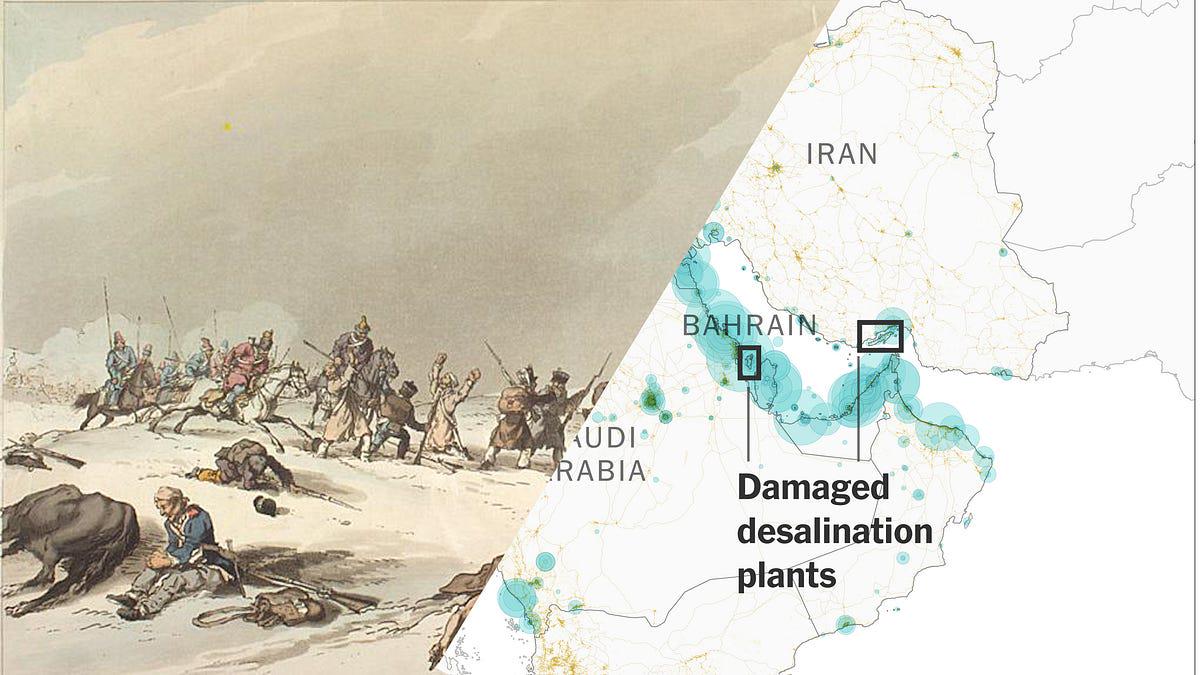
In light of the war with Iran escalating to targeting desalination plants, [I’ve chosen to look at](https://www.deadcarl.com/p/barbarity-and-civilization-explaining) what Clausewitz wrote on the distinction (or lack thereof) between wars of civilized peoples and those of the “uncivilized.”
“If we find that civilized nations don’t put their captives to death, don’t destroy city and countryside, it is so because the intellect is more mixed into their practice of war and has taught them more potent means of applying violence than these raw expressions of instinct.” (my own translation)
Yet, we see that very advanced civilizations are nonetheless capable of remarkable savagery, and Clausewitz states this directly: “but this difference does not lie in the essence of barbarity and civilization themselves, but rather in the accompanying circumstances, institutions, etc. This difference is therefore not necessary in every case, but rather it only governs in the vast majority of cases. In a word: the most civilized nations can also be fervently enflamed against one another.”
In this article, I look at what these circumstances are and how barbarous acts can occur even in cases in which “civilized” nations do not have passionate hatred to drive them.
P.S. it was a pleasure meeting some of you at NLAS and LibCon—if we haven’t already connected, please message me here or on bluesky.

1 Comment
In light of the war with Iran escalating to targeting desalination plants, [I’ve chosen to look at](https://www.deadcarl.com/p/barbarity-and-civilization-explaining) what Clausewitz wrote on the distinction (or lack thereof) between wars of civilized peoples and those of the “uncivilized.”
“If we find that civilized nations don’t put their captives to death, don’t destroy city and countryside, it is so because the intellect is more mixed into their practice of war and has taught them more potent means of applying violence than these raw expressions of instinct.” (my own translation)
Yet, we see that very advanced civilizations are nonetheless capable of remarkable savagery, and Clausewitz states this directly: “but this difference does not lie in the essence of barbarity and civilization themselves, but rather in the accompanying circumstances, institutions, etc. This difference is therefore not necessary in every case, but rather it only governs in the vast majority of cases. In a word: the most civilized nations can also be fervently enflamed against one another.”
In this article, I look at what these circumstances are and how barbarous acts can occur even in cases in which “civilized” nations do not have passionate hatred to drive them.
P.S. it was a pleasure meeting some of you at NLAS and LibCon—if we haven’t already connected, please message me here or on bluesky.
!ping FOREIGN-POLICY&HISTORY