How is China coping with export controls on semiconductor fabricators and AI chips? They’re attempting to work around these limitations through going vertical rather than shrinking transistors.
Below is the roadmap. They’re banking on having a competitor to Nvidia’s Vera Rubin in 2027, albeit with only half the TFLOPs at BF16.
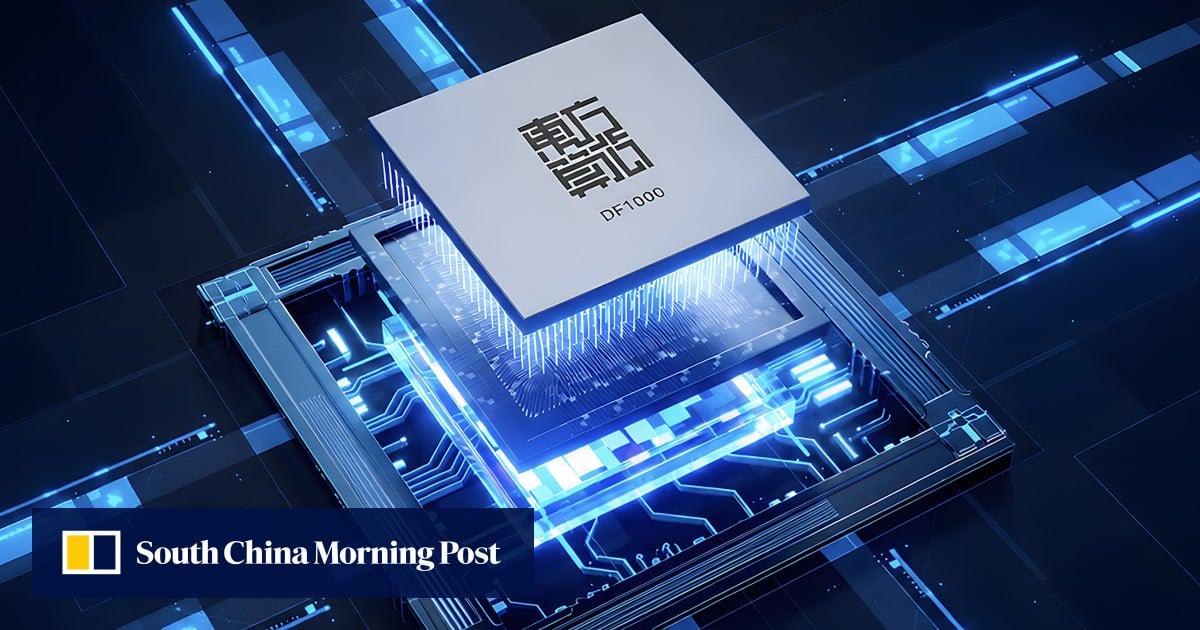
The DF1000, stated for release in late 2026, itself is supposed to have performance approximate to the H200, but with greater memory and less TFLOPs, which makes it a more inference focused chip. What makes it striking is that they’re doing it with a 14nm architecture compared to Nvidia’s usage of TSMC’s 4N (4nm) process. They’re using 3D hybrid bonding to stack the compute and memory wafers in order to shorten the data path between the compute and memory layers, thereby greatly increasing the bandwidth. It should be noted this is a novel innovation – to the best of my knowledge, no other chip designers have attempted to go with full 3D bonding, instead sticking to 2.5D architecture.
The caveat to this 3D architecture is that the complexity of stacking layers degrades yields and requires advanced fabrication nodes. While the yield of producing these chips are in question, Chinese semiconductor companies have implicitly figured out the second problem, given the expected production in late 2026 and the fact that Huawei independently came to a similar 3D architecture that’s also been validated through the EDA tools ([https://chinaxiv.org/abs/202605.00224](https://chinaxiv.org/abs/202605.00224)).
Either way, the implication of this is that there’s still room for scaling even at sub-frontier process nodes. While other semiconductor fabricators will undoubtedly also move in this direction, sanctions have ultimately forced these innovations in China early.
Lighthouse_seek on
China has brilliant chip designers, we saw that with huawei before they were banned. Issue is their manufacturing for high end chips simply does not exist and that’s not changing for 5 years minimum

2 Comments
How is China coping with export controls on semiconductor fabricators and AI chips? They’re attempting to work around these limitations through going vertical rather than shrinking transistors.
Below is the roadmap. They’re banking on having a competitor to Nvidia’s Vera Rubin in 2027, albeit with only half the TFLOPs at BF16.
https://preview.redd.it/sesabu0la7fh1.png?width=2164&format=png&auto=webp&s=9543ca806a09af6b1f87ed4b59392d78f752ae35
The DF1000, stated for release in late 2026, itself is supposed to have performance approximate to the H200, but with greater memory and less TFLOPs, which makes it a more inference focused chip. What makes it striking is that they’re doing it with a 14nm architecture compared to Nvidia’s usage of TSMC’s 4N (4nm) process. They’re using 3D hybrid bonding to stack the compute and memory wafers in order to shorten the data path between the compute and memory layers, thereby greatly increasing the bandwidth. It should be noted this is a novel innovation – to the best of my knowledge, no other chip designers have attempted to go with full 3D bonding, instead sticking to 2.5D architecture.
The caveat to this 3D architecture is that the complexity of stacking layers degrades yields and requires advanced fabrication nodes. While the yield of producing these chips are in question, Chinese semiconductor companies have implicitly figured out the second problem, given the expected production in late 2026 and the fact that Huawei independently came to a similar 3D architecture that’s also been validated through the EDA tools ([https://chinaxiv.org/abs/202605.00224](https://chinaxiv.org/abs/202605.00224)).
Either way, the implication of this is that there’s still room for scaling even at sub-frontier process nodes. While other semiconductor fabricators will undoubtedly also move in this direction, sanctions have ultimately forced these innovations in China early.
China has brilliant chip designers, we saw that with huawei before they were banned. Issue is their manufacturing for high end chips simply does not exist and that’s not changing for 5 years minimum