
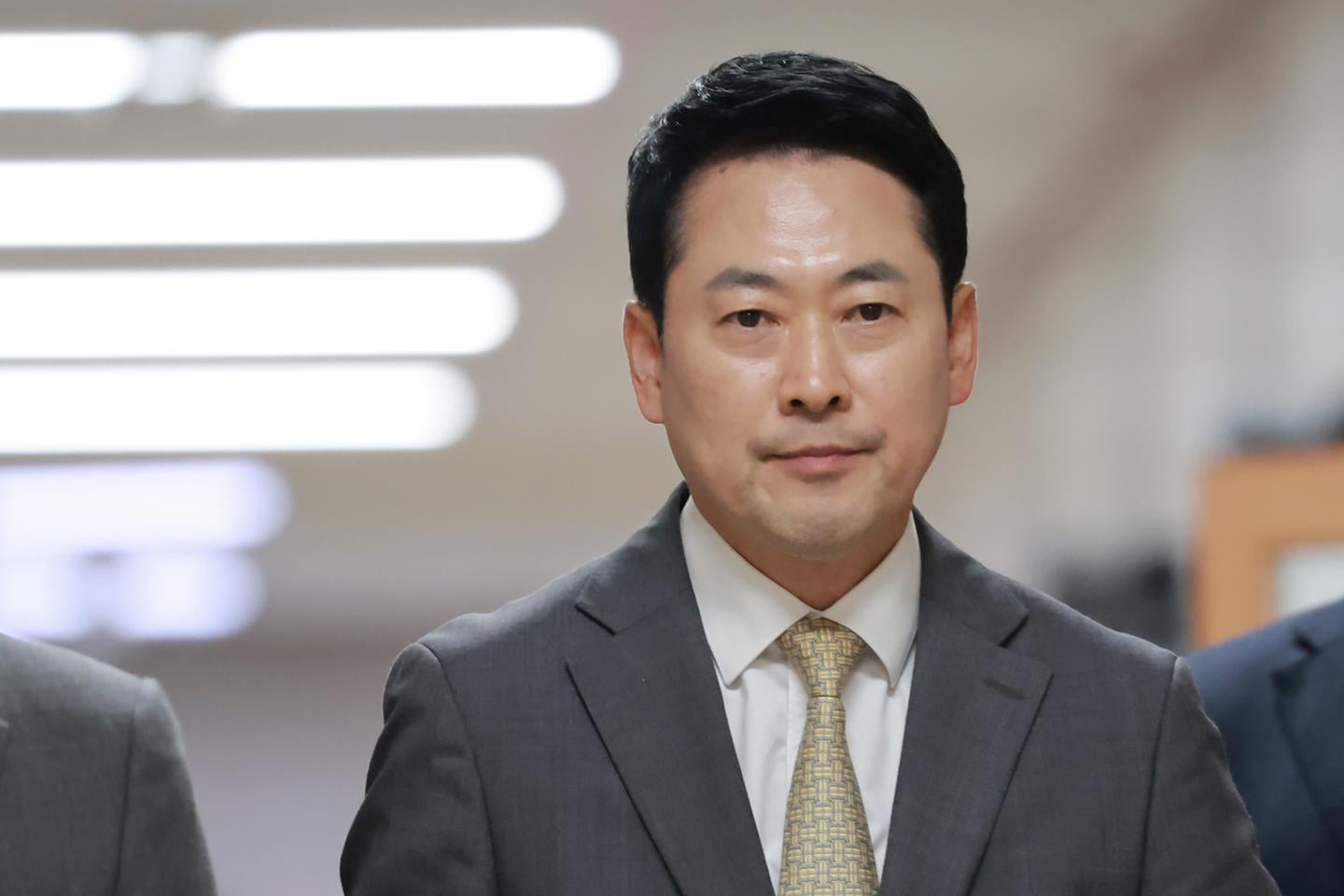
People Power Party leader Jang Dong-hyeok, who has faced a leadership crisis since the June 3 local elections, appears to be expanding his influence amid the political turmoil surrounding the investigation of the National Election Commission. Backed by firm support from hard-line party members, Jang is confronting calls for his resignation head-on while strengthening his control of the party through disciplinary politics, apparently with the aim of retaining authority over nominations for the next general election. As a result, a growing number of lawmakers appear to be aligning themselves with his political line. However, as Jang’s influence expands, moderate voters are leaving the party in large numbers and its approval rating is declining, prompting growing concern both inside and outside the party.
According to reporting on the People Power Party on August 2, the pro-Jang faction has gradually expanded despite continuing uncertainty over Jang’s leadership. When Jang visited the site of a protest blocking a ballot-counting center at Seoul Olympic Park immediately after the National Assembly passed a special counsel bill concerning the National Election Commission on July 30, he was accompanied by 14 incumbent lawmakers: Chung Hee-yong, Park Jun-tae, Kim Tae-gyu, Lee Jin-sook, Park Dae-chul, Lee Jong-wook, Choi Su-jin, Kim Jang-gyeom, Cho Seung-hwan, Kang Myeong-gu, Cho Bae-sook, Park Chung-kwon, Seo Cheon-ho and Joo Jin-woo. The scene stood in stark contrast to only a few days earlier, when it had been difficult to find lawmakers willing to accompany Jang at public events.
The expansion of the pro-Jang faction is widely attributed to the party leadership’s push to reinforce the People Power Party as a “member-centered party.” Anxiety among incumbent lawmakers over nominations for the next general election has reportedly intensified since Jang recently established a task force to reform the evaluation system for elected public officials.
The task force is responsible for establishing evaluation criteria for incumbent lawmakers, metropolitan mayors and provincial governors. Because its work will form the basis for the future operation of the party’s nomination management committee, it is considered a potentially decisive factor in nominations for the 2028 general election. At a ceremony appointing task-force members on July 28, Jang dismissed proposals raised within the party to separate the party leadership from nomination authority.
“The idea of ignoring the wishes of party members and allowing nominations to be decided by someone whom party members did not elect is completely inconsistent with the fundamental principles of party politics,” he said.
Jang is also expected to include measures for realizing a “member-centered party” in a party reform plan to be announced around Liberation Day, which will mark the first anniversary of his inauguration. The plan is understood to reflect his intention to increase the weight given to party members’ preferences in the selection of candidates for public office.
“The views of party members are important in the nomination process,” a party leadership official said.
There is also speculation that Jang, supported by hard-line party members, is beginning preparations to seek another term as party leader. Lawmakers for whom nomination in the next general election is crucial are therefore increasingly placed in a position where they have little choice but to remain attentive to the party leadership.
Coincidentally, while Jang has been rebuilding his leadership, the People Power Party’s approval rating has continued to decline.
In the National Barometer Survey released on July 30 by Embrain Public, KSTAT Research, Korea Research and Hankook Research, the People Power Party recorded an approval rating of 21 percent. This continued a downward trend from 25 percent in the second week of June, immediately after the local elections. Over the same period, support among moderates—a key indicator of the party’s ability to broaden its appeal—plunged by nine percentage points, from 22 percent to 13 percent.
This contrasts with the Democratic Party’s rebound to 40 percent. Although the ruling party is facing numerous political difficulties—including anxiety over a stock market experiencing repeated sharp swings, dubbed the “roller-KOSPI”; growing public opposition over real estate tax reforms such as strengthened property holding taxes; and controversy surrounding the forced abolition of prosecutors’ supplementary investigative authority—the People Power Party has failed to benefit from any corresponding rebound in support.
As the gap between the People Power Party and public sentiment widens, criticism of Jang is also growing within the party. Four-term lawmakers, including Kim Sang-hoon, plan to hold a meeting of senior members this month to discuss Jang’s removal. Three-term lawmakers are also scheduled to meet on August 17 to discuss the direction of party management.
Five-term lawmaker Kwon Young-se publicly called for Jang’s resignation in a CBS radio interview on July 28, saying, “Reform is needed, including the replacement of the party leader.”
Independent lawmaker Han Dong-hoon has also intensified his campaign against Jang. Han has recently made bottom-up nominations a recurring political issue, arguing that “nomination authority should belong not to the party leader but to the people.” His remarks are widely interpreted as targeting Jang, who is seeking to strengthen his nomination authority under the banner of building a member-centered party.
Posted by Freewhale98