
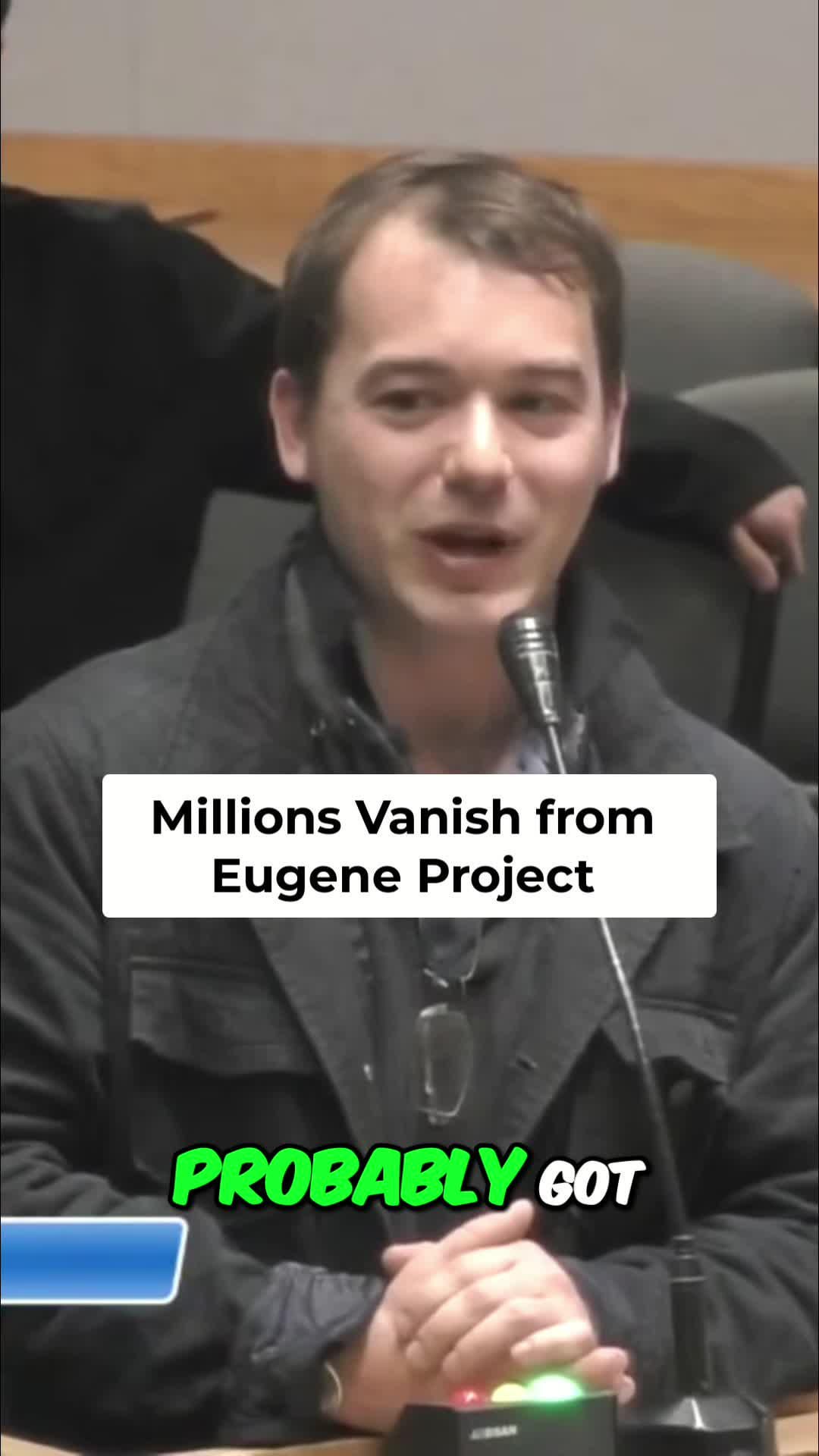
Submission Statement: Conspiracy from Developer to Steal from Local Government
City of Eugene destroyed their City Hall, with no clear plan to rebuild. The developer, Rowell Brokaw, claimed they would recycle 90%+ of materials from the demolished City Hall to build a new one…. instead, they saved no materials, causing cost estimates to skyrocket.
Several blueprints were proposed over 10 years, with none being viable.
Finally, they decided to purchase the headquarters of the City's Chartered Utility Company, which was being abandoned.
The woman who worked for that developer now sits as the "Mayor" of the city, Karen Knudson.
She's been literally been arranging for the City to pay private companies, to take public property, while the City of Eugene is in a $20+ million budget deficit, for the 2nd year running.
What this shows, is a decade+ long conspiracy, to usurp the public trust, abuse government contracts, steal money, and place the thieves in charge of the financial decision processes.
https://www.tiktok.com/@strektubegpt/video/7664992501618740493?is_from_webapp=1&sender_device=pc
https://eugeneweekly.com/2021/03/04/they-put-up-a-parking-lot/
Posted by EUGsk8rBoi42p
1 Comment
Further Evaluation:
# Final Evaluation and Rebuttal of the Compliance Premise
The assertion that Mayor Kaarin Knudson “does not have a financial conflict of interest” because she “permanently left the firm in 2017” is not a statement of fact but an unproven conclusion built on a narrow, colloquial understanding of employment. When tested against the statutory language of Oregon Government Ethics Law (ORS Chapter 244) and the common financial structures of professional service firms, the defense collapses into a series of logical fallacies and evidentiary gaps. The argument conflates departing a job with severing all financial ties, ignores the legal definition of an “associated business,” and treats a lack of public disclosure as proof of innocence.
The following analysis synthesizes the logical contradictions, the statutory framework, and the high-risk timeline of entanglement to demonstrate not only why the defense is insufficient, but precisely how a formal ethics investigation could establish an actionable violation.
# 1. The Statutory Fallacy of “Severed Ties” (ORS 244.020)
The original defensive argument commits a critical error by equating “departure from employment” with the complete dissolution of a business relationship. This is a logical gap that Oregon law does not permit. Under ORS 244.020(2), a “business with which the person is associated” is expansively defined to include any entity from which the official receives income or retains a leadership or ownership role. For a former principal of an architecture firm, a 2017 exit does not automatically mean a 2017 severance of financial interest.
* **The Buyout Loophole:** As a principal, Knudson held an ownership stake. Standard industry practice dictates that a departing partner’s equity is not liquidated overnight. If her separation agreement involved a structured buyout spread over a decade, or if payments are tied to the firm’s ongoing profitability, she remains legally “associated” with Rowell Brokaw. Every municipal contract Eugene awards to the firm directly services that buyout debt, strengthening the firm’s balance sheet and securing her personal payout.
* **Deferred Compensation Nexus:** Profit-sharing plans, unvested retirement assets, or deferred compensation accounts managed by the firm create a direct pipeline between public contracts and her personal net worth. A city contract awarded today can increase the value of those assets tomorrow, constituting a private pecuniary benefit that violates the core prohibition of Chapter 244.
# 2. The Consulting Subcontract Circuit: A Pipeline for Indirect Benefit
The original defense presents the launch of her independent consulting business as proof of a clean break. Mechanically, this introduces a highly probable, and highly problematic, pipeline for indirect financial entanglement. This shifts the conflict from a direct salary to a concealed subcontracting circuit.
* **The Joint-Venture Risk:** In municipal development, large architecture firms routinely subcontract niche components—sustainability consulting, urban planning, or community engagement—to smaller, specialized firms. If Rowell Brokaw bids on City of Eugene projects and utilizes Knudson’s firm, LARCO/KNUDSON, as a subcontractor, public money flows directly from the city coffers, through Rowell Brokaw, and into the Mayor’s private business. This arrangement would be the textbook definition of an indirect financial benefit under a public contract.
* **Shared Developer Ecosystems:** The conflict is further systemic. If her consulting firm shares a book of private developer clients with Rowell Brokaw—clients who require city zoning approvals, permit fast-tracking, or public-private partnership funds—her mayoral actions create a closed-loop conflict. She can systematically favor policies that benefit the exact developers who fund both her former employer and her current consulting practice, while her formal separation from the architecture firm remains technically true in a narrow, W-2 sense.
# 3. Conflating Non-Declaration with Innocence (ORS 244.120)
The compliance argument relies on a circular logic fallacy: *Because there are no active sanctions or public declarations of a conflict, no conflict exists.* This reasoning is dangerously flawed and misinterprets the purpose of the disclosure statute. ORS 244.120 mandates that an official “shall announce publicly the nature of the potential conflict” before taking any official action. An official’s failure to declare a conflict does not prove the conflict is non-existent; it merely proves the entanglement has remained undisclosed. Treating the absence of a public record of a conflict as absolute proof of an ethical “clean break” fails basic critical reasoning and ignores the exact mechanism an Oregon Government Ethics Commission (OGEC) investigation is designed to uncover.
# 4. The Failure of Public Trust Through Systemic Reciprocity
Even if an investigation were to find that all direct financial pipelines were technically clean—a highly unlikely scenario given the gaps identified—the relationship fails the broader standard of public trust due to systemic reciprocity. A mayor wielding executive influence over urban renewal funds, downtown development initiatives, and public works procurement inevitably steers the market.
* When the city council votes on high-density housing mandates or downtown revitalization zones, it directly creates lucrative, multi-million dollar RFP opportunities for which Rowell Brokaw is a dominant, historically favored player.
* The Mayor’s policy agenda therefore inherently enriches her professional network and her former firm, creating an appearance of a closed-loop system where public power is leveraged to advance the interests of a specific, insular architectural and development monopoly. This is the very definition of a structural conflict of interest, which Oregon’s ethics laws are designed to police.