
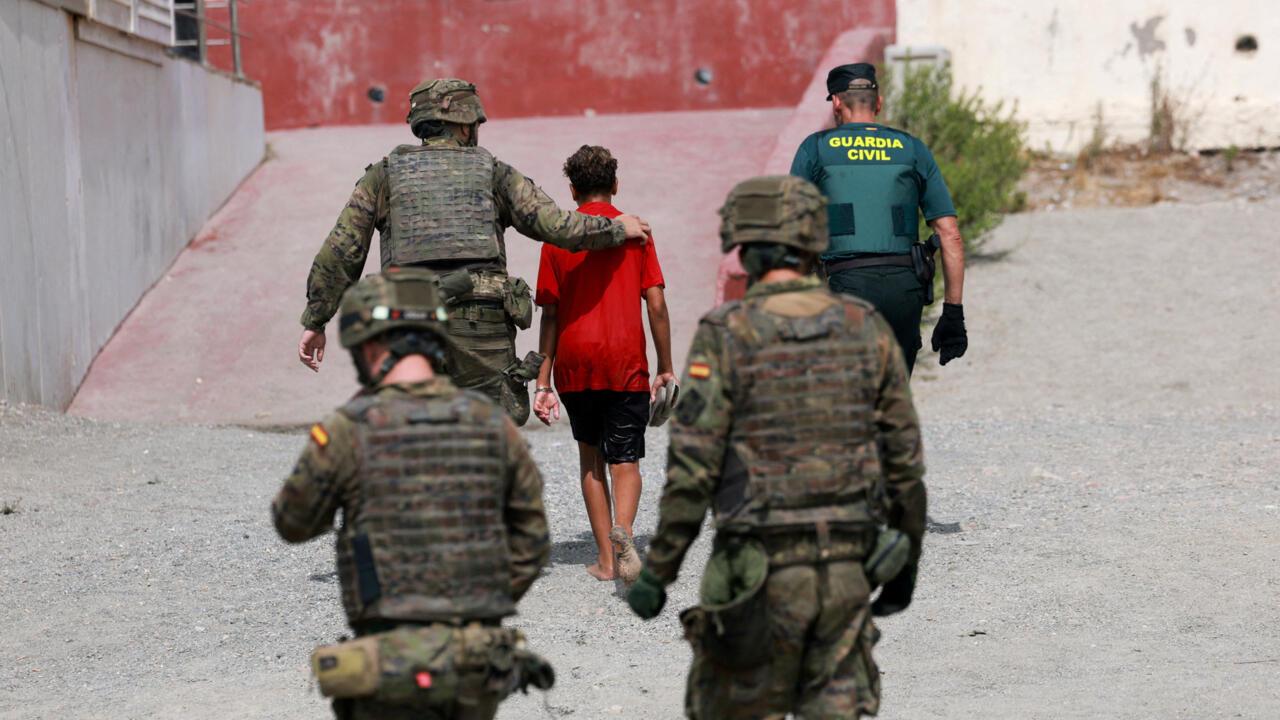
Submission statement: Interview with International Crisis Group's North Africa specialist Riccardo Fabiani over the broader picture painted by last week's migrant surge in Ceuta, the worst border incident involving a EU country in decades, and particularly the tightening relationship between Rabat and Washington.
On July 30, 2026, around 80,000 migrants breached the Moroccan-Spanish border in Ceuta and Melilla, two autonomous Spanish cities located on the northern coast of Africa claimed by Morocco, leading to a severe humanitarian crisis during which ~100 people died. The vast majority of the migrants returned to Morcco within the week, leaving Spain stunned by the scale of the border breach.
In the hours following the incident, footage of thousands of migrants pouring into EU territory inundated social media and provoked heated reactions from anti-immigration activists, up and to the White House, with US President Donald Trump calling the incident a "catastrophe" and an "invasion". Right-wing governments in Europe such as Italy's and Finland's called for a suspension of Spain's Schengen membership, despite neither Ceuta or Melilla being included in the free-movement zone of the EU, further exposing the bloc's divisions over immigration and solidarity with Spain.
Fabiani argues that the incident was not directly engineered by Morocco, but was facilitated and leveraged by Rabat to send a message to Spain, which they consider as still occupying "their" territory, despite Spain's 500-year administration of the territories and the residents' will to remain Spanish.
Nonetheless, Fabiani argues, the crisis in Ceuta should not be analyzed as a mere bilateral territorial dispute between Morocco and Spain, but as part of a broader Moroccan strategy to curtail Washington's favors as they seek to cement their claim over Western Sahara, the territory that has been administered and colonized by Morocco for fifty years despite opposition from the Algeria-backed Polisario Front, who claim to represent the Sahrawi people's aspirations to self-determination. Morocco, with help from US lawmakers like Sens Rick Scott, Tom Cotton and Ted Cruz, has sought to push for the classification of the Polisario Front as part of a network of proxies "backed by Iran, Russia and Hezbollah".
Washington's recognition of the Moroccan claim over Western Sahara was a key gain from Morocco's signature of the Abraham Accords normalizing relations between several Arab countries and Israel, and is part of a broader Moroccan push for international legitimacy on their administration of the territory, which notably saw the "Moroccan plan for autonomy" gain the support of the UK, France and… Spain.
Last month, Morocco officially renamed a new road crossing Western Sahara after Donald Trump to thank Washington for its support. According to Riccardo Fabiani, the rapprochement between Washington and Rabat and the contrasting diplomatic chill between Washington and Madrid over the Spanish position over the wars in Gaza and Iran emboldened Morocco to renew its claim over the Spanish autonomous cities.
While the United States' State Department stressed that it considered Ceuta as a Spanish territory following the crisis, mixed signals are coming from Washington after Mario Díaz-Balart, a prominent Rubio ally in the House of Representatives endorsed the Moroccan claim over the city, contrasting the Morocco-US "250-year alliance" with Spain's refusal to let the US use its bases to refuel on their way to strike Iran.
Personal opinion: while Morocco bears the brunt of the responsibility for the humanitarian disaster that unfolded in Ceuta, we should consider this incident as another wedge between EU and NATO allies exploited by the United States' current government's aggressive strategy against Europe.
Posted by RaidBrimnes
2 Comments
!ping AFRICA&EUROPE&IBERIA
To quote some other sources so neither Mr Fabiani nor myself look like raving lunatics about the American right-wing’s direct involvement in the Ceuta crisis:
[How Trump can punish Spain](https://www.wsj.com/opinion/how-trump-can-punish-spain-fdc2c798) – WSJ (March 2026)
[Here’s how Trump should retaliate against Spain](https://www.aei.org/commentary/heres-how-trump-should-retaliate-against-spain/) – American Enterprise Institute (April 2026) – namely cites backing Morocco’s claims over Ceuta and Melilla
[Did MAGA cause the Ceuta crisis?](https://unherd.com/2026/08/did-maga-create-the-ceuta-crisis/) – UnHerd (August 2026) – also quotes Rep Díaz-Balart’s push to brand Ceuta and Melilla as Moroccan territory
I feel like, even after Trump retires from politics, this will be Republican foreign policy for the foreseeable future.