
As President Vladimir Putin’s full-scale invasion of Ukraine extends for a fifth year, Russian businesses can no longer afford to keep pace with the Kremlin’s war machine in the wage race.
Years of acute labor shortages have pushed salaries well ahead of productivity growth, forcing companies to pay more to produce the same amount of output. In prior years, surging corporate revenues absorbed the pressure. Now, with the wartime economic boom at an end, businesses are shifting into survival mode, slashing costs in ways that may push many out of the race for workers.
Wages have outpaced productivity by about 5 percentage points since the war began in 2022, according to Bloomberg Economics estimates. That’s close to the gap recorded during Russia’s oil-fueled boom in the 2000s and well above the average of about 1 percentage point between 2009 and 2021.
Bloomberg Economics sees the trend as a wartime version of Dutch disease. Instead of oil revenues pulling workers and capital into the energy sector while hollowing out the rest of the economy, massive military spending is drawing them into defense industries, pushing up labor costs and steadily eroding the competitiveness of civilian businesses.
There’s little scope to ease labor pressures with unemployment in Russia at a record-low of just over 2% and the war absorbing huge numbers of men each year.
While wage growth is slowing, it remains in double digits even as Russia’s economic expansion has stalled, production is contracting across many industries and investment is collapsing, Federal Statistics Service data shows.
“The civilian sector can’t operate like this indefinitely,” said Dmitry Polevoy, investment director at Moscow-based Astra Asset Management. “When wages rise faster than productivity, profits inevitably suffer — and that’s exactly what we’re seeing.”
Less efficient businesses that cannot compete on wages with the state sector will lose workers, Polevoy said.
Russia has set a target to sign up 409,000 contract soldiers for the war this year, implying a monthly outflow of as many as 34,000 men from the civilian workforce. That repeats a pattern of previous years as the army seeks to replace huge numbers of troops killed and wounded each month in Ukraine.
Employment in military production has increased by about 510,000 since the end of 2021, to 2.8 million, Oxford Economics estimates.
There’s a shortage of about 200,000 workers in Russia’s construction industry, Deputy Prime Minister Marat Khusnullin told the state-run Tass news service in an interview Thursday. “That’s a lot,” he said.
The labor shortage in construction may intensify as more than 87% of small businesses are failing to improve productivity, Construction and Housing Minister Irek Fayzullin told Tass in March.
Job postings offer another snapshot of how wartime labor shortages are reshaping pay levels across the economy.
State-owned monopoly Russian Railways is offering welders higher salaries than some station managers. It’s raising freight tariffs, passing the burden on to customers across industries.
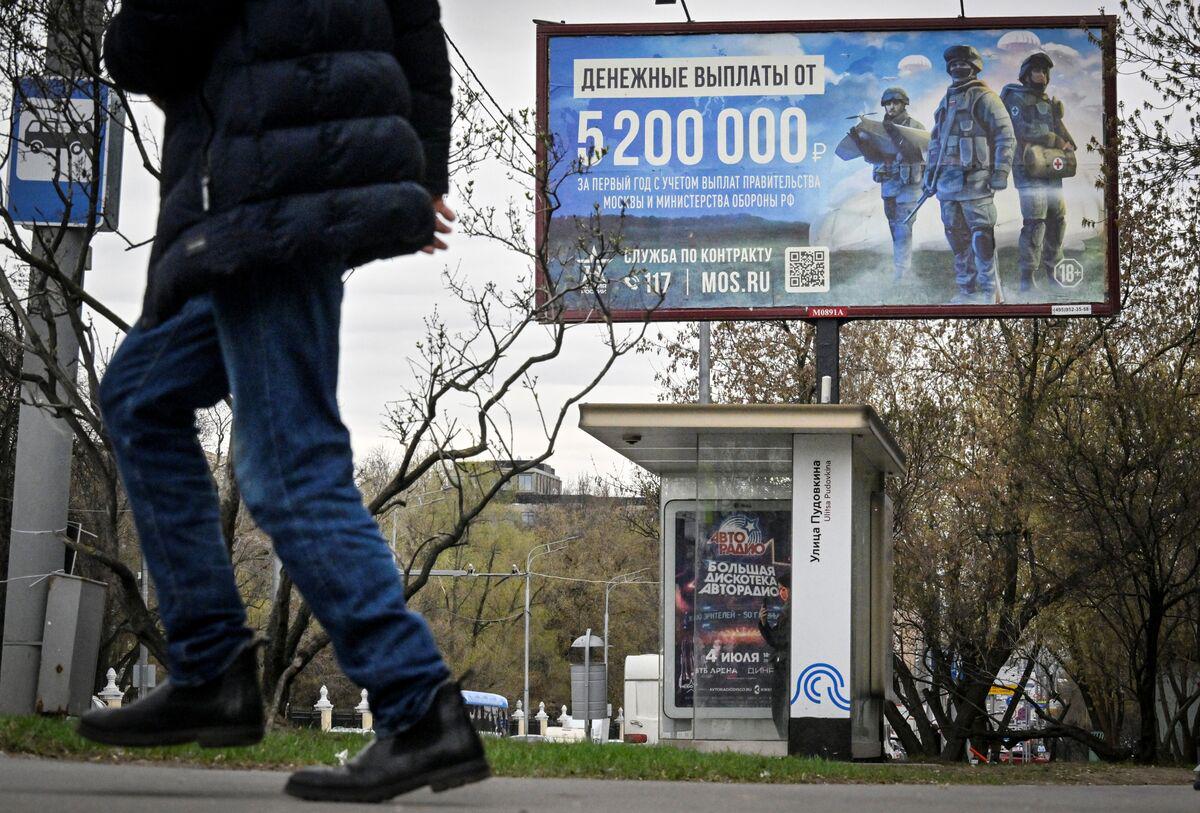
The pressure is also making military recruitment more expensive, as the Kremlin offers high pay and signing bonuses to lure sufficient volunteers into the army and avoid an unpopular mobilization.
A contract soldier’s monthly salary was roughly four times the average Russian wage in 2022 but is now closer to twice the average, Bloomberg Economics estimates. Further increases in recruitment bonuses could force civilian companies to raise wages again and perpetuate the cycle.
What Bloomberg Economics Says…
The wage boom that has helped Vladimir Putin weather the war is becoming one of the biggest constraints on sustaining it.
Larger recruitment packages would force civilian employers to raise wages, narrowing the military-pay premium again. That strengthens the economic case for another compulsory call-up. Any decision will ultimately depend on military and political calculations, given the disruption and public disillusionment another mobilization would cause. — Ekaterina Vlasova, CEE & Russia Economist
Average monthly wages rose to 101,784 rubles ($1,280) in 2025 from 57,244 rubles in 2021, according to the statistics service. On a purchasing-power-parity basis, that puts Russia above Greece, Slovakia and Hungary in the Organization for Economic Co-operation and Development’s latest annual pay rankings — a sign of how far wages have pulled ahead of productivity.
The imbalance has become one of the biggest challenges for the government and the central bank as policy measures have had only limited success. Households continue to receive more money to spend without a corresponding increase in the supply of goods and services, blunting the impact of an extended period of high interest rates.
Bank of Russia Governor Elvira Nabiullina has argued that high interest rates would spur the movement of scarce workers from weaker companies to more productive ones, allowing the economy to keep growing despite labor shortages. Instead, state support for large, inefficient firms appears to be impeding that redistribution.
There’s still “insufficient reallocation of scarce resources to more productive sectors,” hindering progress in slowing price growth and easing financial conditions, Nabiullina said at the latest rate meeting in July.
Tatiana Orlova, an economist at Oxford Economics, described the dynamic as a vicious circle: labor shortages require higher productivity achieved through investment, but high interest rates are constraining that spending, particularly outside state-favored “priority” sectors that benefit from subsidized borrowing.
The wartime distortions are leaving little room to move workers to where they are most productive, she said.
Posted by IHateTrains123
3 Comments
Archived version: [https://archive.fo/XImq0](https://archive.fo/XImq0)
* Russian businesses can no longer afford to keep pace with the Kremlin’s war machine in the wage race due to years of acute labor shortages.
* Wages have outpaced productivity by about 5 percentage points since the war began in 2022, according to Bloomberg Economics estimates.
* The labor shortage is pushing up labor costs and eroding the competitiveness of civilian businesses, with many companies shifting into survival mode and slashing costs.
* [In essence the war economy has become a variation of the Dutch disease, without much oil to compensate.]
Since I cannot edit in the graphs I will post them below:
https://preview.redd.it/6v1yd77f3uhh1.png?width=746&format=png&auto=webp&s=e9145fd56aab693644bd01e78268d4b64652a707
>Bloomberg Economics sees the trend as a wartime version of Dutch disease
I immediately thought of Beaumol’s cost disease but I guess it’s the same mechanism.
Well I know there’s plenty of laborers being freed up from the retail warehouse sector