
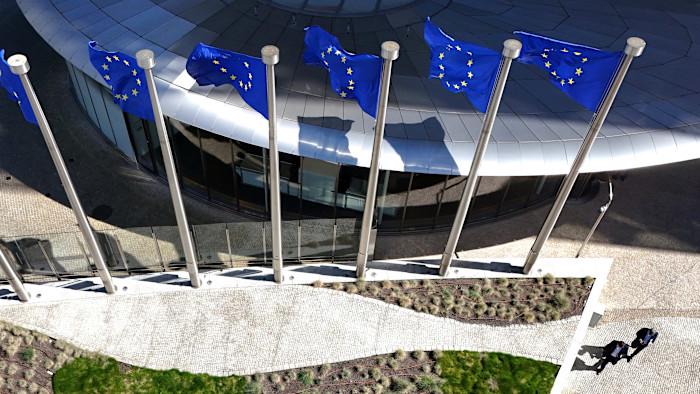
Candidate countries hope for progress after years of inaction, but some in Brussels are still uncertain about enlargement
For 13 years, the club of European Union nations has admitted no new members — and amid geopolitical instability and great-power competition, pressure is growing to open the gates again.
Yet despite its desperation to project a sense of collective security and purpose in the face of Donald Trump’s provocations, Brussels is nonetheless wracked by uncertainty over potential expansion.
As leaders of candidate countries demand faster progress in their membership bids, under pressure from impatient and restless voters, the EU’s existing heads of government fret that the bloc’s structure, and their own sceptical voters, are not able to handle fresh blood.
The signs had looked good. After the shock of Russia’s invasion of Ukraine, enlargement came to be seen as a security policy as well as a political one. Progress accelerated following a moribund decade, raising hopes of a new member in the next couple of years.
Montenegro, at the head of the queue, has finished more than half of the necessary reforms required to enter. EU governments have begun drafting their formal entry legislation, and the Balkan nation has been allocated billions of euros in the draft of the bloc’s next shared budget.
Ukraine and Moldova, both menaced by Moscow, have begun the formal entry requirement negotiations, and Albania has started ticking off items on its reform to-do list. “We have a clear path towards the European Union,” Albania’s prime minister Edi Rama tells the FT. “The country is in the best moment in many ways.”
The geopolitical chaos “created a pressure moment to think seriously about what Europe is, and make a credible beneficial offer to aspiring members”, says Ilir Deda, an analyst at the Institute for Human Sciences in Vienna.
In a bid to stress the EU’s collective will to accept new members, the presidents of the European Commission and Council, representing its administrative and political powers, in June described enlargement as “one of the EU’s greatest success stories.”
“The EU’s offer of peace, stability and opportunity is unmatchable,” said Ursula von der Leyen and António Costa in a joint statement. “Enlargement is a strategic choice.”
Yet would-be entrants are beginning to wonder whether the EU’s leaders are talking up an empty promise.
Brussels is mulling wide-ranging changes to the accession process that would involve more gradual integration as countries progress. Viewed internally as a way to grow responsibly and build up trust, these proposals are seen by some candidates as a path to a tiered membership system that could gum up the process even more.
Many candidate countries are already avoiding unpopular or uncomfortable reforms because they don’t trust Brussels’ promises of rewards, while Brussels berates them for failing to pass necessary legislation.
Aside from Montenegro and Albania, other aspirants in the Western Balkans — Serbia, North Macedonia, Bosnia and Herzegovina and Kosovo — have made little progress in recent years, and in some cases gone backwards.
Some officials worry that there is an unhealthy disconnect between the pro-enlargement rhetoric from von der Leyen and Costa and the reality, given that even Montenegro is still years away from actual membership.
Yet there is a growing sense that the EU needs to show that it is serious about letting in new members. “It’s now or never,” says Deda. A failure to act would have a “catastrophic impact, not only for [candidate countries], but for the EU too. The credibility of the EU will be hurt internally and globally. That scenario must be avoided at all costs.”
The so-called Big Bang expansion of 2004, when 10 new members including Poland and Hungary joined the EU, marked the bloc’s shift from an inward-looking western European core to a post-cold war future of eastern expansion.
Yet in the decade after Croatia’s entry in 2013, membership shrank — with the departure of the UK — rather than grew. The European Commission’s then-president Jean-Claude Juncker in 2014 declared Brussels would “take a break from enlargement” to digest the integration of its newest recruits.
That rhetoric changed with China’s growth as a superpower, then Russia’s invasion of Ukraine and the return to power of Donald Trump and his mercurial attitude to Europe. EU countries realised the geopolitical importance of anchoring so-called greyzone countries under the shared blue-and-yellow-starred flag.
There has been tangible movement in that direction. Since December 2024, candidate countries have together closed 18 chapters in their respective alignment processes. That compares with just four chapters closed in the preceding decade.
Montenegro is more than halfway through the 33 chapters. Ukraine and Moldova opened their first chapters in June, and Albania began closing its first chapters.
Iceland, which applied for membership in 2009 but dropped its bid in 2015, is holding a referendum this month on whether to restart the process. Norway is mulling a third public consultation on a possible membership application.
Marta Kos, the EU’s enlargement commissioner, says adding new members used to be seen as an economic trade-off, with newcomers opening up their markets to existing members in exchange for development investment that rapidly expanded their GDP. Now, there’s a prominent security and defence aspect.
Europe’s security blanket has for generations been provided by Nato, but Trump’s changeable attitude to the alliance has led many capitals to question the transatlantic defence pact. While few believe the EU’s mutual defence clause is analogous to Nato’s Article 5, the bloc is promoting itself as an alternative structure to co-ordinate security policy. Candidate countries Albania, Montenegro, North Macedonia and Turkey are already Nato members.
“Enlargement isn’t just for the candidates to catch up with us . . . today [it is] also a security policy. It is increasingly about how we Europeans can work together in the new realities of the world we live in,” Kos says.
Enlargement is about “reshaping Europe’s political and security architecture to create a Europe capable of competing with other major global powers,” she adds.
Nowhere is that more obvious than in Ukraine, whose armed forces are among Europe’s largest, best-armed and certainly most battle-hardened. EU member states want Kyiv and its formidable military on their team, not angrily sulking on the periphery.
But those benefits come with a colossal flip side. EU officials admit that the scale of concerns over corruption, judicial independence and other fundamental bloc values means the country would not have been granted a formal accession process without Russia’s invasion.
That contradiction, and Kyiv’s demand for a “fast-track” entry next year as part of a possible peace deal with Russia, have forced Brussels to seriously think whether a new approach to enlargement might be necessary to meet the new political realities.
A stated goal of accession by January 1 2027 was a “cry for help”, says a senior EU official involved in the negotiations with Kyiv. “[President Volodymyr] Zelenskyy knew it was impossible. But he needed to send an unambiguous signal to us, and also to Ukrainian citizens, that business as usual on accession would not cut it.”
A senior EU diplomat says Ukraine presents a complex dilemma. “You can’t bring a country of 40mn people that’s at 104 on the global corruption list into the EU. It would make a mockery of the entire project,” the person says. “But you also can’t leave them twisting in the wind. Everyone can see that Ukraine will need something from us to make [a long wait for full membership] easier to swallow.”
For people in the Western Balkans, business as usual is no longer enough when it comes to accession.
In the six countries of the region, the story of EU enlargement is a national cocktail of frustration, resentment and oft-dashed hopes — with a strong element of rivalry.
Brussels officials speak of deep annoyance at the lack of progress towards meeting long-established milestones necessary for membership, particularly in anti-corruption and anti-money laundering safeguards and public procurement rules. Their Balkan counterparts each have a long list of examples where Brussels did not keep up its end of the bargain.
Serbia, the region’s initial frontrunner for membership, saw its bid stall due to concerns over the rule of law and its alignment with Russia — including Belgrade’s refusal to adopt the EU’s sanctions against Moscow. Kosovo and Bosnia are not yet formal candidates; five EU states don’t even recognise the former. Even Albania’s progress over the past five years has been in fits and starts.
But politicians across the EU and the Balkans hope that Montenegro’s momentum towards membership will make clear what is possible, and how to do it.
The Montenegrin prime minister, Milojko Spajić, is bullish. “Enlargement is drawing even closer,” he said in July, after the country concluded chapters on EU competition policy and its customs union. “We are not merely meeting EU standards formally — we are embedding them in our country’s development model.”
Micheál Martin, Ireland’s prime minister, believes Montenegro can close all of its negotiation chapters by the end of the year, under the Irish rotating EU presidency, leaving only ratification by existing members.
“We think we can get them to a stage, more or less, of: ‘Europe, over to you now. Are we going to let Montenegro in or not?’,” Martin tells the FT. “If we could get Montenegro in, it’s a tangible sign to everybody else that this will work . . . It would be a moment in time if that could happen.”
But the region’s history of deep-seated nationalism and rivalry remains a concern in Brussels. An EU border that cuts through the Balkans would sever ethnic lines, hardening and potentially cementing divisions.
“You cannot explain to any single person in Belgrade that Montenegro or Albania is ahead of us. No one would believe in that because people know the situation,” Serbian President Aleksandar Vučić tells the FT, citing his country’s majority share of the region’s GDP, highest exports to the EU and best living standards.
“We are the only relatively well-industrialised country with the biggest potential and capacities. We are the only country that has the real . . . important military capacities and defence industry capacities,” says Vučić.
“We work on a daily basis with Europeans on all these reforms, from all the recommendations to regulatory agency issue to . . . anti-corruption laws and everything else,” says Vučić. “Whether someone in Brussels might say different, it doesn’t change the reality.”
For all the hope and expectation in candidate countries, the underlying question remains: is the EU itself ready for new members, regardless of whether new members are ready for the bloc?
“Ukraine’s biggest impact on the enlargement debate, by far, is making it clear just how unprepared we are for new members,” says the senior EU official. “We need an internal reform commitment, too.”
As enlargement rhetoric has gained momentum, capitals have studied ways to potentially amend the entry process, or even the final outcome.
France and Germany have both circulated initial proposals that would offer a staged, gradual integration model, with membership benefits extended in exchange for reform milestones, rather than the existing system of full membership when the entire process is finished.
“We need to evolve,” says EU commissioner Kos. “We still are using the methodology which is, plus-minus, the same as it was 40 years back when Spain and Portugal joined the EU.”
In light of the French and German proposals, which received broadly lukewarm responses from the rest of the EU, Brussels is set to publish its own proposals on potential enlargement reform, including what Kos describes as a technical assessment of the impact of more members on EU operations and policies, and proposals for gradual integration.
“Enlargement is currently advancing at a speed we have not seen in the last 15 years,” she says. “This needs leadership, and it needs the building of trust with all 27 of our member states.”
In candidate countries, the attitude towards possible halfway-house membership is mixed. Kyiv has broadly rejected anything short of full membership, while Belgrade has signalled openness to the idea.
“Give us open borders, give us [single] market, we need nothing else. And in order to get that, we are ready to align with European politics, but we need to get something as well from Europe,” says Vučić. “Not to be told okay, you have to fulfil everything and then we’ll decide whether to give you something or not.”
For the Balkans, a political decision to enlarge together, rather than a purely merit-based approach, would serve to diminish any cross-border tensions and fulfil the EU’s original vision of uniting the continent in peace. Analysts also suggest that consequential rewards for reforms as they are happening would make the process appear irreversible and help smother arguments that membership is a mirage.
“Citizens have not believed that EU integration is a real possibility, regardless of the talk that Montenegro will join,” says Deda. “This new energy by France and Germany outlining what each country needs to do . . . has enormous benefits.”
“The dynamic in Bosnia, Kosovo, Serbia can change with a new enlargement offer,” he adds. “A sense of belonging . . . People will have no reason to rally around nationalists once they know that it might isolate countries and leave us out of this opportunity.”
But inside the union, there are concerns that anything short of full membership for full legislative alignment could erode the core values of the bloc and its “merit-based” dogma for membership.
“On this argument between the merit-based approach or the more recently emerging ideas around association: We’re going to be very focused on the merit-based, because I think it’s the concrete reality at the moment,” says Ireland’s Martin, citing the lack of “unanimity or consensus” on an alternative approach.
Ireland is willing to “accommodate and facilitate the debate”, he adds. “But we’re not going to be diverted from the task of completing the negotiations that Montenegro has entered into.”
Some officials also fear that discussions over the process of enlargement could ultimately just delay the ongoing applications at a moment when momentum is the highest it has been for more than a decade.
“I don’t think this is something that right now looks like a plausible, doable idea,” says Dimitar Keranov, visiting fellow at the German Marshall Fund in Berlin. “It will delay things because the moment you start implementing or introducing some new processes it will be full of uncertainties . . . every new reform will need to first be tested.”
The current process is “actually doing what it’s supposed to do: rewarding the ones who do their homework”, he adds. “Enlargement is not a gift. It is an exam.”
Many inside and outside the EU see the remaining months of 2026 as the most critical moment for enlargement for a generation. If Montenegro can close its remaining chapters while the EU’s existing members also agree on internal reforms to make a bigger union function smoothly, they say, a bigger and more geopolitically muscular union is possible.
But should Brussels be dragged into internecine disagreements over what enlargement should look like and result in, patience among those waiting outside the red-velvet rope could well snap.
That, says Martin, would only play into the hands of Europe’s enemies. “The bottom line is: if Europe isn’t proactive in the western Balkans or in the neighbourhood, others will be,” he says. “Others will manipulate and distort.”
Posted by IHateTrains123
1 Comment
Why ‘never’ and not ‘later’?