
The share of men taking parental leave is approaching 40%, as a culture in which both parents share childcare responsibilities is rapidly becoming part of everyday life. Nearly 200,000 people used work-family balance support programs in the first half of this year alone, putting annual participation on track to reach an all-time high.
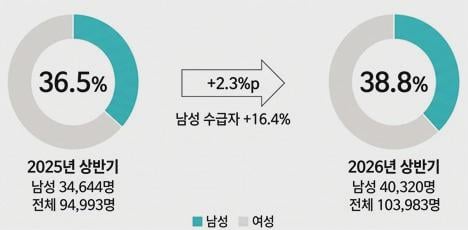
According to data on the use of work-family balance support programs in the first half of 2026, released by the Ministry of Employment and Labor on the 12th, 103,983 people received parental leave benefits during the first half of this year, up 9.5% from 94,993 during the same period last year.
The increase among male recipients was particularly notable. In the first half of the year, 40,320 men received parental leave benefits, accounting for 38.8% of the total. The male share entered the 30% range for the first time in 2024, rose to 36.5% last year, and came close to the 40% mark in the first half of this year.
Overall use of work-family balance support programs has also reached record levels. A total of 199,911 people received benefits under the four major programs in the first half of this year: parental leave, reduced working hours for childcare, maternity leave, and paternity leave. That figure has already comfortably surpassed half of last year’s full-year total of 342,388 recipients. The number of people receiving paternity leave benefits also reached 15,820, 1.5 times the figure recorded during the same period last year.
The Labor Ministry attributed the increase in men’s use of parental leave to higher benefits and improved conditions for taking leave. Following the introduction of the 6+6 Parental Leave System for Couples in 2024 and an increase in parental leave benefits last year, the government expanded subsidies this year for replacement workers and employees who share the workload of colleagues on leave, reducing the burden on both workers and employers.
Further improvements to the system are scheduled for the second half of the year. Beginning August 20, short-term parental leave, which can be used once a year in one- or two-week increments, will become available to cover temporary childcare gaps caused by daycare or school closures, school vacations, illness, and similar circumstances.
Beginning September 18, a three-part spouse support package will be introduced to help men provide care during their partners’ pregnancy and childbirth. A key element is stronger support during pregnancy. Parental leave for men, previously available only after a child’s birth, will also be permitted before birth when their spouse faces a risk of miscarriage or premature delivery. Paternity leave, which in principle could previously be taken only after childbirth, will also be made more flexible, allowing it to be divided into separate periods beginning 50 days before the expected delivery date. A new leave program for spouses following miscarriage or stillbirth will also be introduced, guaranteeing men’s right to provide care throughout pregnancy. Beginning November 27, the paid portion of the six days of annual fertility-treatment leave will be expanded from two days to four.
The remaining problem is that workers at small and medium-sized businesses, as well as workers outside the traditional employment system such as special-type workers and freelancers, still face significant barriers to using these programs. Labor Minister Kim Young-hoon said, “It is encouraging that a culture of shared childcare is taking root,” but added, “We will continue to develop support measures so that all working parents, including employees of small and medium-sized businesses, special-type workers, and freelancers, can balance work and childcare.”
Posted by Freewhale98
1 Comment
1. Summary
Male parental leave use in South Korea continued to rise sharply in the first half of 2026. 40,320 men received parental leave benefits, accounting for 38.8% of all recipients, up from 36.5% in 2025 and from below 30% before 2024. Overall parental leave recipients rose 9.5% year-on-year to 103,983.
The Labor Ministry attributed the increase to more generous benefits and policies that make parental leave easier for both workers and employers. These include the “6+6” parental leave scheme for couples, higher parental leave benefits, and expanded replacement-worker and workload-sharing subsidies, which reduce the cost and staffing burden on employers when employees take leave.
2. How is this related to the sub
(1) Fertility crisis: Korean government attributes recent rise in birth rate to introduction of better parental leave policy & subsidies on parents.
3. My opinion
“Pro-family” policy of Korean government which faced criticism from the West for being “sexist” and neglecting cultural issues while focusing on socioeconomic incentives is finally showing results. Korean bureaucrats focused on fixing long working hour issues, better financial incentives to get married and have children, better parental leave policy, protecting women from career disadvantage from pregnancy and encouraging men sharing household burden with their wives. This pro-family policy has faced criticism from the west for being tone-deaf on gender equality and “paying people to have children” while ignoring underlying issues of Korean society.
Whether recent surge of birth rate would reach the desired target number set by Korean bureaucrats is unclear ( the first target number is reaching 1.0 by 2030 and the second target number is expected to present when it is reached ), but it is an interesting development that challenges western consensus.