
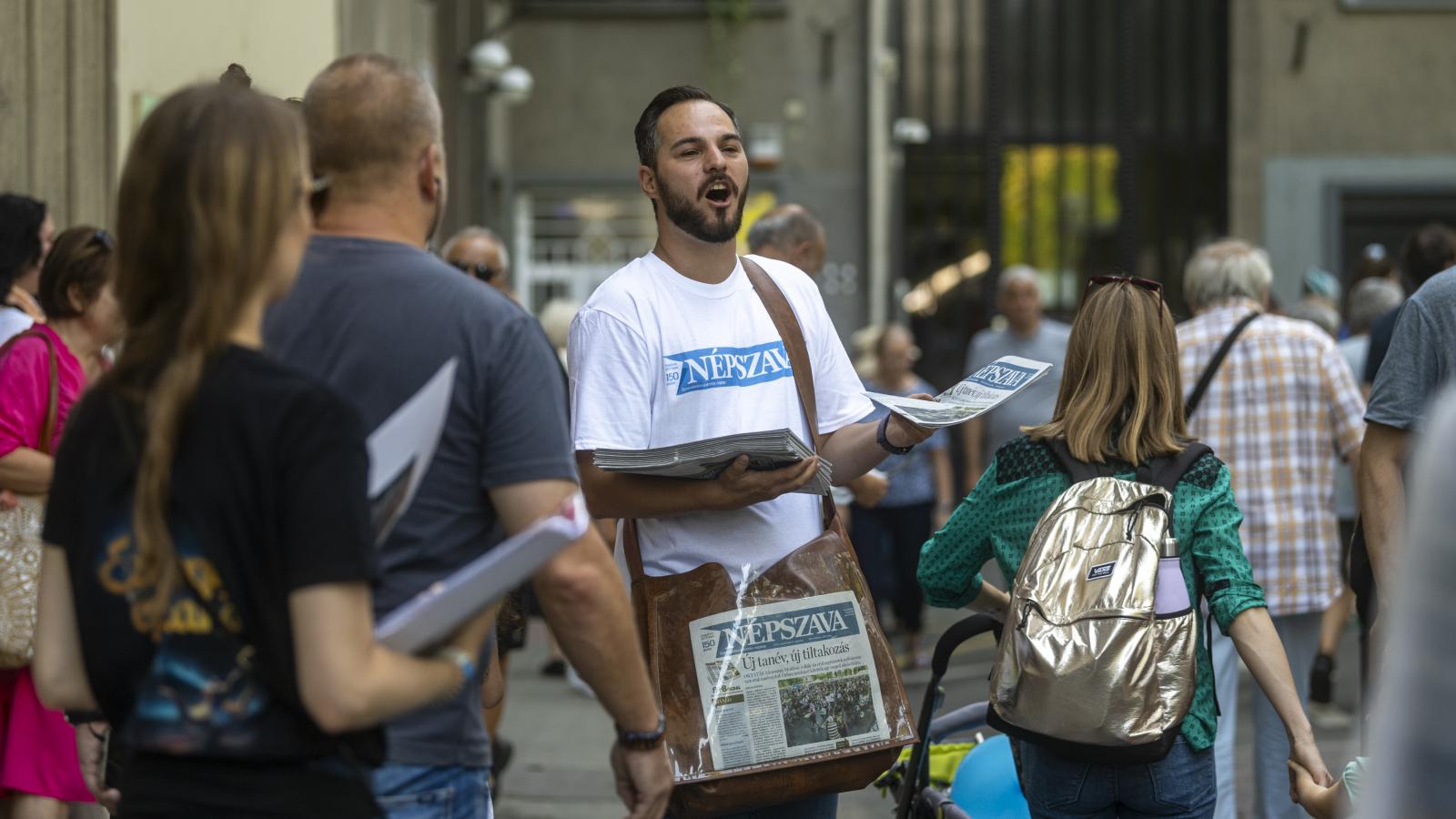
Something that seemed unimaginable over the past 180 years is happening: the daily political print press in Hungary is coming to an end.
It is not only the propaganda press that has suffered from the collapse of the NER; in this distorted market, much of the independent media is also struggling. An overview.
As things stand now—and we hope this is only a temporary situation—our subscribers can read the latest issue of Népszava today, though it is no longer in print but only available in PDF format. Our news, reports, features, interviews, analyses, reviews, and other articles will remain available online at nepszava.hu, but for the time being, Népszava will cease publication in its daily, traditional newspaper format. And since Magyar Nemzet will also switch to an online and weekly format starting in August, as things stand now, the Hungarian press market will be left without a national political daily in print in four weeks—meaning that the daily political print press in Hungary will cease to exist. We emphasize once again: hopefully, this is only temporary.
Yet for over 180 years, daily life in Hungary seemed unimaginable without a printed public press; the rise of the middle class created the real demand, and the technological revolution provided the infrastructural foundation for the Hungarian press—which until then had typically consisted of periodicals—to publish the first daily newspapers —though, due to postal distribution, they actually appeared only four times a week—such as the *Budapesti Híradó* in 1844 or, a year later, the *Pesti Hírlap*, previously edited by Lajos Kossuth, which doubled its publication frequency from twice a week to four times a week.
From that point on, regardless of how the country’s political system evolved, and regardless of which regimes rose and fell, a daily political press existed in Hungary throughout—with the exception of part of the Hungarian Soviet Republic and the end of World War II. Newspapers were founded and ceased publication; the one that lasted the longest was *Népszava*, founded in 1877, which merged three years later with the *Munkás Heti-Krónika* (founded in 1873), and has been published as a daily newspaper from 1905 to the present. The framework for publishing and editing, of course, changed over time; the state exercised significant control—censoring, banning, and even subsidizing newspapers to the point of shamelessness—so we cannot speak of a classic, democratic, pluralistic, and free press market until the change of regime. At least in theory.
Foreign—Western European—investors, as well as domestic—for lack of a better word—speculators—that is, publications that had previously belonged to the MSZMP, the government, or one of the affiliated organizations—SZOT, the Patriotic People’s Front—were transferred into private hands; in the rural press, for example, German and Swiss owners shared ownership. The new owners, in turn, committed themselves to certain political factions on ideological and economic grounds, leading to the relatively rapid emergence of partisan divisions, even though—as a minority shareholder—the Socialist Party remained the sole true owner.
Nevertheless, in the case of the three political dailies with the largest circulations—Népszabadság, Magyar Nemzet, and Magyar Hírlap—it was clear which party—or parties, as the case may be—they sympathized with. Alongside the older, established papers, the press market—now free from one-party state control—saw the emergence of countless new publications, typically of a semi-tabloid or full-fledged tabloid nature; however, over the past decades, only Blikk has managed to survive. Just as the newly formed political newspapers disappeared, merged, or changed their names—the classic Magyar Nemzet, founded in 1938, for example, first lost its original identity in 2000 when it merged with Napi Magyarország (which had originally launched as Új Magyarország) — and adopted its nature as party propaganda, only to change course after “G-Day” in 2015 and return to its original self, and then, after the 2018 election, for *Magyar Idők* to take on the paper’s name and once again become the flagship of government propaganda.
In other words, the optimism following the transition to democracy was quickly followed by a return to reality. The Hungarian print media—much like the media landscape as a whole—became virtually bipolar, with their positions as either opposition or pro-government shifting in tandem with changes in government. The media law that took effect on January 1, 1996, did little to help this situation, as by that time the ownership groups had already divided the political spectrum among themselves; of course, it still happened that a media outlet—primarily following its owner’s shift in economic direction and interests—would make a sharp shift. Moreover, the media law did not seek to reduce political influence; rather, it merely divided the media among the parties and their entourages. The position of public media was significantly weakened by the commercial television stations that began operating in 1997, which captured a substantial share of the advertising market. As public media’s funding became increasingly dependent on the state budget, it became a playground, a political mouthpiece, and a reluctant servant of the government in power—though not every administration used it with the same efficiency or to the same exclusive extent.
By the 2000s—following the fall of the Fidesz-MDF government in 2002—the Hungarian press had become almost entirely bipolar, though at that time there were still some centrist outlets, typically county-level daily newspapers, which tried to navigate the maze of local governments, the national government, and local economic forces—and, albeit with compromises large and small, they were somewhat successful.
In the mid-2000s, media outlets founded with explicit ties to political parties—such as Hír TV and Lánchíd Rádió—began to emerge; Fidesz—joined at that time by its now inseparable partner, the KDNP—sought to use them to counterbalance what it claimed was the left-wing media’s dominance. In contrast, the socialist-liberal camp, which at that time still partially controlled public media, failed to look ahead, and this soon had serious consequences.
Fidesz-KDNP, which began governing with a two-thirds majority in 2010, took advantage of its constitutional majority and the dwindling influence and power of the polarized opposition to launch a massive push. By merging the National Radio and Television Board—which operated with multiparty delegates—and the National Communications Authority, it created the National Media and Communications Authority under party-loyal leadership, thereby eliminating genuine, professional oversight, as the Media Council became a tool of the government—and, when necessary, its punitive weapon. In addition, the previously separate public service media outlets—MTV, Duna TV, Hungarian Radio, and MTI—were consolidated, and their employees were transferred to a joint program-production entity, the Media Services Support and Asset Management Fund, whose director was appointed by the chairman of the Media Council, who in turn was appointed by Viktor Orbán. The NER oligarchic network—recapitalized by the ruling parties, typically with state and EU funds—initially began acquiring media outlets one by one, first evening out and then drastically reversing the balance of power that had existed until then.
Their portfolio included particularly powerful media empires built around Lőrinc Mészáros, Gábor Liszkay, and Andy Vajna, each of which served the government; these empires encompassed not only national newspapers but also rural newspapers, most of the tabloids, as well as glossy magazines, local TV stations, radio stations, newspapers, and online portals. In 2016, Népszabadság fell victim to this acquisition boom; it was shut down by an Austrian adventurer-frontman before he transferred his company, Mediaworks, to Mészáros. But even this was not enough for Viktor Orbán’s centralizing ambitions, so the NER media tycoons willingly and enthusiastically “pooled” their interests into a common entity, and in 2018 the Central European Press and Media Foundation (KESMA) was established. With the regulation of the advertising market, the non-government-aligned press found itself in a vulnerable and nearly impossible situation, as companies that might have advertised on an economic basis were effectively barred from the free press; moreover, the government introduced an advertising tax—primarily to rein in RTL Klub, which it considers part of the opposition. In any case, for most of the press, the only significant source of funding—let’s call it government advertising—remained the ruling parties, who took advantage of and abused the situation: pro-government propaganda outlets received an astonishing volume and value of government advertising, while others received nothing; there were also some—including Népszava—that received just enough government-directed advertising to barely stay afloat.
It is by no means a minor point that the government has abolished the distribution of state-owned daily newspapers—the Hungarian Post now delivers only weekly newspapers and other publications—thereby granting a monopoly to the sole distribution company, which happens to be owned by Lőrinc Mészáros, allowing it to operate under any terms and at any rates it chose, in the absence of competition.
Even after winning two-thirds of the seats in the election, the government did not change its media policy, retaining control over public media, TV2—the commercial broadcaster with the highest viewership—and all radio stations with national and local frequencies, as well as all print daily newspapers except for Népszava, to serve its propaganda agenda—with the exception of a few newspapers owned by Lajos Simicska between “G-Day” in 2015 and the 2018 election— so the free press moved into the digital sphere, where, however, Fidesz-KDNP’s media dominance did not hold sway, even though it financed a multitude of propaganda sites masquerading as news outlets at a cost of tens of billions, while the independent media tried—and, as it turned out, managed—to survive and remain afloat through public donations and subscriptions, thereby contributing significantly to the Fidesz-KDNP’s landslide defeat on April 12.
The Tisza’s two-thirds victory shook the Hungarian press to its core; state subsidies were immediately cut off, while the Press Fund—which had promised to award advertising contracts democratically through competitive bidding—had not yet been established. It has become clear that the NER oligarchs, the nominal owners of the Fidesz media empire, are unwilling to invest their own ill-gotten wealth in their media portfolio; since the elections, pro-government newspapers and news portals have ceased publication, and the majority of the provincial press, along with *Magyar Nemzet*, has been forced into the online space for financial reasons and is transitioning to weekly publications. The situation is not much better for the independent press either, as the advertising market has not yet revived, so even editorial offices operating as opposition outlets until 2026 are fighting for survival. The big question is how many will survive the current interregnum; it is quite possible that more newspapers and news sites will be forced to throw in the towel, further narrowing the domestic media landscape.
Thirty-six years after the fall of communism, we still haven’t managed to establish a regulatory framework that would allow the press to make a living from the market.
Posted by Ollyfer
1 Comment
Submission Statement: This article is relevant to this sub as many here have celebrated Magyar Péter’s rise to power and downfall of Orbán Viktor like a second declaration of independence from the Soviet Union, no less because over the span of his reign, Orbán has morphed from a fighter against the Kremlin to a lapdog of the same, comparable to former German chancellor Gerhard Schröder who landed a job at Gazprom after his chancellorship, earning him the mocking moniker „Gazprom-Gerd”.
The problem, in Democracies-in-the-making as well as in incumbent Democracies, is that without a proper media landscape, the people inhabiting this Democracy are more prone to lean towards extremist political tendencies[1]. One does not need to read the study to understand that phenomenon: When people have no reliable source of information at hand, they are likelier to believe in quacks and pied pipers who will pretend to provide them with authoritative information about what is happening either in the capital city or at their governors’ offices. And those false heralds are in turn likely to lie to them for political purposes, such as the acceleration of their preferred candidates’ electoral victory. Kant advised his readers to think for themselves, to enlighten themselves, emphasising in the next sentence that for this requirement to be fulfilled, the people needed to be free; free to utilise their reason (Vernunft)[2]. What he forgot to mention in his essay was that reasonable thinking alone does not suffice: People also need access to viable information which they could process in their minds to extract useful information that helped them to form opinions and, ultimately, make decisions. Népszava makes a similar point when it recounts how throughout Hungary’s earlier history, there was always a free press recording the political activities and the country’s political evolution, although at some point, that free press was replaced with newspapers who parroted parliamentary parties’ talking points rather than reporting from an objective point of view. The authors mention this polarisation peaked with the Fidesz-MDF coalition which narrowed the journalistic press to a bipolar landscape.
Tisza’s closure of the financial faucet for government-aligned public media, with the intent of liberating them to return to proper journalistic practice, will not manage to amend what decades of Fidesz rulership have caused. A free press cannot survive without a large readership which funnels money into their registers with which they will be able to pay staff who investigate the body politic and nourish their audience the information that enables them to operate their reasonable minds, fostering a Hungarian population that is able to scrutinise its elected leaders’ actions and decisions.
This article is relevant to this sub because the change Tisza intends to bring to Hungary could fail because its media landscape is beyond repair, making the rise of (another) Orbán Viktor possible.
**————–**
**Index:**
1. MARTIN, G. J., & McCRAIN, J. (2019). Local News and National Politics. American Political Science Review, 113(2), 372–384. doi: [https://doi.org/10.1017/S0003055418000965](https://doi.org/10.1017/S0003055418000965)
2. Kant, Immanuel (1784). Beantwortung der Frage: Was ist Aufklärung? In: Königlich Preußische Akademie der Wissenschaften (Hrsg.) (1923). *Kant’s Werke*, Bd. VIII: Abhandlungen nach 1781. Berlin: Walter de Gruyter & Co. Pp. 35—42.