
The campaign for Quebec’s Oct. 5 provincial election has not yet formally begun – technically, it has not yet been called – but it is already under a shadow.
At some point after the election – after all the members of the provincial legislature have taken their seats, after they have passed any number of bills – the whole thing could be invalidated. The members might find themselves barred from sitting. Every law they passed might be thrown out. The province could potentially find itself in an unprecedented political and legal void.
No, I’m not talking about the consequences of a unilateral declaration of independence, of a kind that might follow from the election of a Parti Québécois government. Though the legal void that would plunge the province into would be profound, that remains a minor probability.
I’m talking, rather, about the consequences of a little-noticed legal case just filed in Quebec Superior Court by the Public Interest Litigation Institute, a legal advocacy group, and its founder, Lawrence David, a professor at University of Ottawa. The case may strike you as trivial, but it is anything but: not only in its potential for mayhem, but because of the constitutional issue at stake – in a nutshell, whether we are to be a society governed by the rule of law.
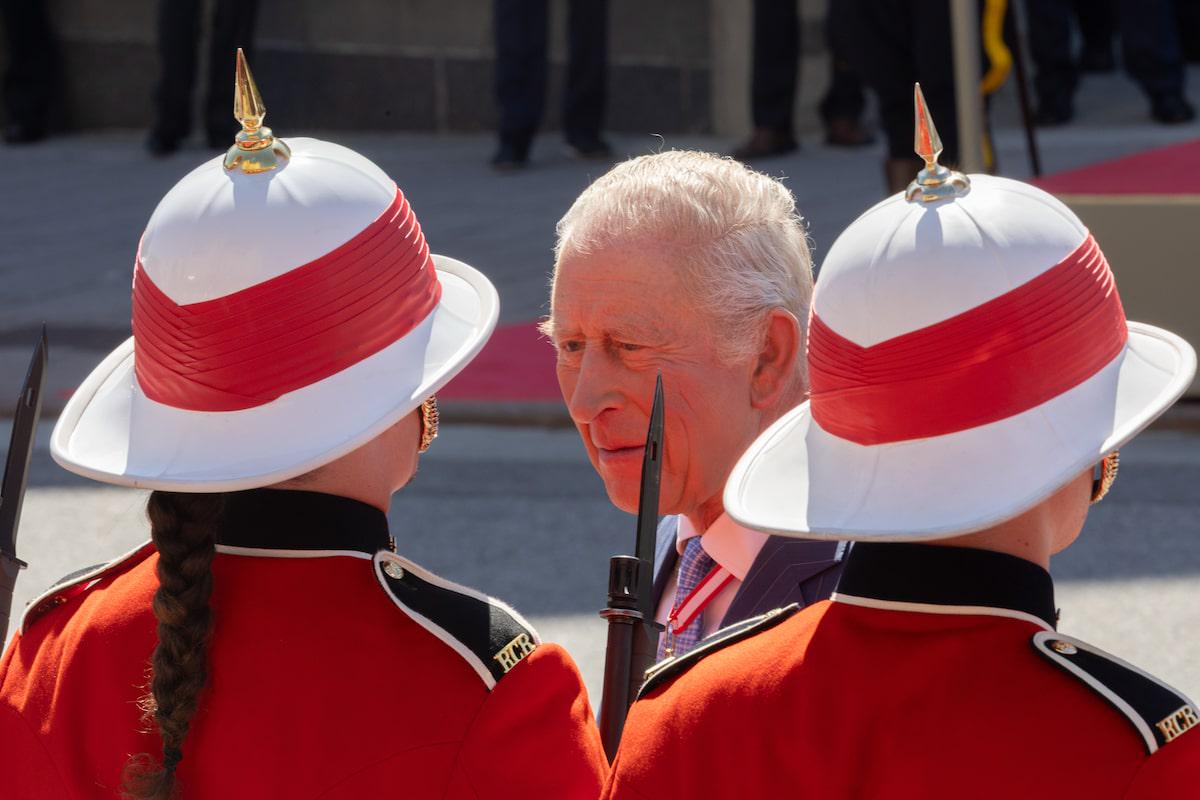
That’s the broader issue. The immediate issue is rather more prosaic: whether members of Quebec’s legislature should have to take an oath to the King before taking their seats.
The constitution of Canada is crystal clear on this. Section 128 of the Constitution Act 1867 states, in part, that “every Member of a Legislative Council or Legislative Assembly of any Province shall before taking his Seat therein take and subscribe before the Lieutenant Governor of the Province or some Person authorized by him, the Oath of Allegiance.”
The oath is spelled out elsewhere in the document: “I A.B. do swear, That I will be faithful and bear true Allegiance to Her Majesty Queen Victoria,” to be updated in the event with the name of whoever is on the throne at the time.
It is impossible to read this as meaning anything but what it says: “every Member … any Province … shall.” And yet, if you consult the copy of the Constitution maintained by the federal Department of Justice on its website, you will find another section just below Section 128, Section 128Q.1, which reads, simply: “Section 128 does not apply to Quebec.”
As a note to the section explains, this is because of a provincial law, passed in December, 2022, entitled An Act to recognize the oath provided in the Act respecting the National Assembly as the sole oath required in order to sit in the Assembly. And indeed the law, also known as Bill 4, does state:
“The Constitution Act, 1867 is amended by inserting the following section after section 128: ‘128Q.1. Section 128 does not apply to Quebec.’”
Well, that’s tidy. But you can’t exempt yourself from the Constitution just by saying it doesn’t apply to you, nor can a province unilaterally amend the Constitution – not, at any rate, the parts of it that consist of general rules to be applied to the whole country.
There is a provision – Section 45 of the Constitution Act 1982 – providing that “the legislature of each province may exclusively make laws amending the constitution of the province.” But note the words: the constitution of the province. Not the Constitution of Canada.
This isn’t like that other recent case involving the oath, the one over whether lawyers in Alberta should be compelled to take it in order to practise law in the province. That’s an ordinary provincial law, which may or may not conflict with the Constitution’s Charter of Rights.
By contrast, the requirement for members of provincial legislatures (and MPs, and senators) to take the oath is spelled out in the Constitution itself. There’s no higher law that can invalidate that – no, not even a unanimous resolution of the Quebec National Assembly.
You may think it is silly to require people to swear oaths to the King. You may wonder why it should matter to anyone if someone refused – though you might equally wonder why it should matter so much to those who insist on refusing. You may regard the whole institution of the Crown, not as the foundation stone of our system of law and government, but as an antiquated relic at best, a badge of colonial servitude at worst.
You are entitled to your opinion. What you are not entitled to do is break the law. The framers of our Constitution thought the oath important enough to include it. Whether or not you think they were right to do so, the fact remains it is in the Constitution.
When the members of the Quebec legislature voted to exempt themselves from it, they weren’t simply passing a law intended to address some social ill or other that happened to infringe on a provision of the Constitution, or that might be interpreted as having done so. They were directly and deliberately flouting the Constitution, and for no purpose other than flouting the Constitution – asserting a power they do not possess, in the name of an independence they have not established.
It would be one thing if this were the only such incident. But provinces have increasingly taken of late to passing flagrantly unconstitutional provisions, apparently for no other reason but to see whether they can get away with it.
There is Quebec’s Bill 96, for example, which asserts, not only that the sole official language of the province is French (it is not, under the Constitution, so far as its courts and legislature are concerned) – again, this is now supposedly part of the Constitution of Canada – but that in pursuit of this objective the province has the power to regulate federally regulated corporations.
There is the Alberta Sovereignty within a United Canada Act, also passed in December, 2022, whose absurdity is expressed in its very title, and which likewise asserts a power the provincial government does not possess, in this case to ignore federal legislation it dislikes.
There is the Saskatchewan First Act, passed in 2023, which like Quebec’s legislation, purports to amend the Constitution of Canada, in this case to say that “Saskatchewan has autonomy with respect to all of the matters falling under its exclusive legislative jurisdiction pursuant to this Act.”
On one level: of course it does; to say it’s autonomous in matters in which it has autonomy (“exclusive legislative jurisdiction”) is a tautology. On another: You don’t get to unilaterally make the Constitution of Canada say so, any more than you can unilaterally amend it to say the sky is blue.
It’s outrageous enough that the provinces have taken to these sorts of lawless stunts. It’s even more outrageous that no one, until now, has pushed back: not at the federal level, at any rate. Instead, the Department of Justice quietly adds each of them to its own copy of the Constitution, with a note that it “aims to amend” the constitution of the province in question. So it is good to see Prof. David (a born-and-bred Quebecker, in case anyone’s wondering) and the PILI taking up the cause.
Not only can Quebec not unilaterally amend the Constitution to exempt itself from the oath-taking requirement, they argue, but so far as removing the oath touches upon the “office of the Queen” and “the office of the Lieutenant Governor,” would require the unanimous consent of Parliament and all the provincial legislatures, as provided for by Section 41 (a) of the Constitution.
Moreover, they argue, so far as it results in Quebeckers being represented in their provincial legislature by “politicians who are not constitutionally qualified to hold office” – indeed, “whose votes on legislation and other activities in the National Assembly are constitutionally void” – it deprives Quebeckers of the right to effective representation, as guaranteed by the Charter’s Section 3.
Prof. David is aware of the consequences if the court were to declare, as the case petitions it to do, that both Bill 4 and the provision of the Constitution it purports to add were “of no force or effect.” The election in October is the first since the law was passed. The legal case is unlikely to be heard until well after the election; it could well take years to decide, after appeals.
So the strong likelihood is that a court contemplating such a declaratory judgment would be faced with a legislature composed almost exclusively of members who had not taken the oath, and were all therefore ineligible to hold office, and after they had passed any number of bills, all of which would be invalid.
As the PILI factum calmly puts it, “the automatic and instantaneous invalidation of all laws passed by the National Assembly by a majority of Members who did not take the Oath prior to taking their seat after the October 2026 election would undoubtedly plunge Quebec into an unprecedented legal crisis threatening the rule of law in the province.”
Needless to say, that is not what they recommend. Rather, they advise the court to issue a “hybrid suspended declaration of invalidity.” Bill 4 would be declared ultra vires, meaning all members of the National Assembly would have to take the oath if they wished to continue sitting. No further laws could be passed until they had.
But the declaration would be suspended with regard to existing laws – meaning they would remain in effect – for a period of time sufficient for MNAs to take the oath and re-pass all the laws they had illegally passed before then.
That’s sensible enough. And yet it’s hard to see how the doomsday scenario could be avoided. It’s hard to see, first, how any court could rule otherwise than that the legislature of Quebec had no power to remove the oath requirement or to amend the Constitution.
And it’s equally hard to see how any Quebec government, having gotten rid of the oath, would submit to reintroducing it. And if it refuses to comply with the court’s order – or, more likely, if it drags its feet about complying with it, offering ridiculous timetables for action and even more ridiculous excuses for failing to meet even these – then what recourse would the courts have but to suspend the suspension, and throw out the lot, MNAs, laws and all?
The tiger of lawlessness, having been set loose, will be hard to return to its cage.
Posted by IHateTrains123