
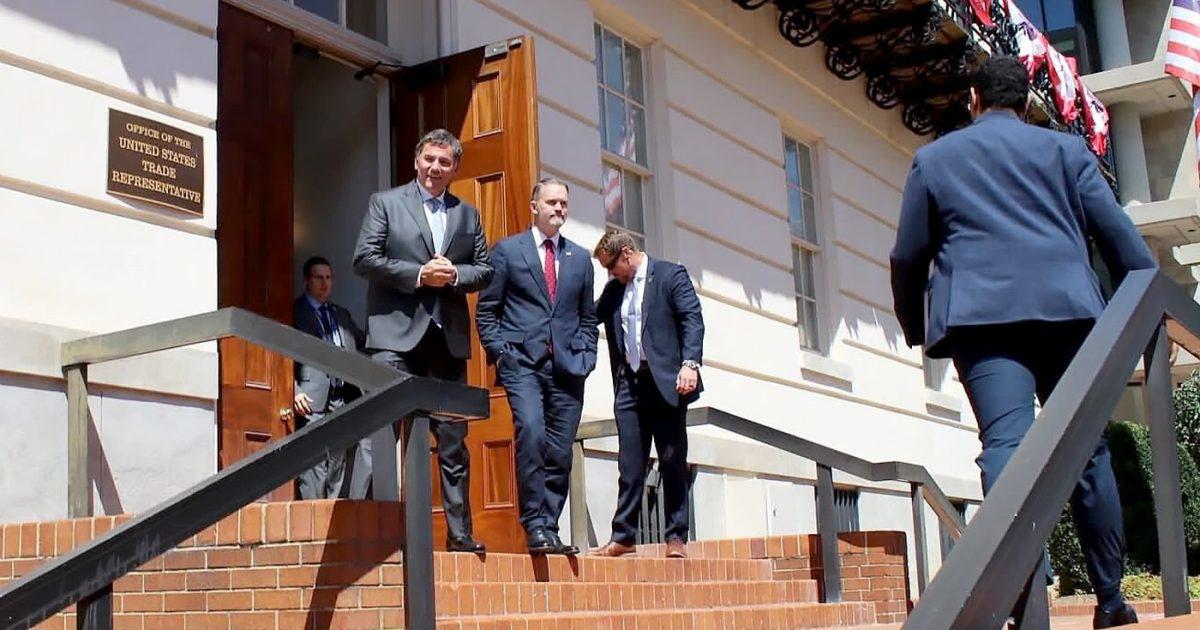
U.S. President Donald Trump's trade czar stood with Canada-U.S. Minister Dominic LeBlanc in Washington on Wednesday and touted a draft deal which appears to have averted a new round of punishing tariffs on Canada.
United States Trade Representative Jamieson Greer said he feels confident that the agreement will protect American workers and jobs while strengthening the North American market, making the continent a manufacturing and energy powerhouse.
"We certainly, I think, have eliminated some of the irritants that we've had over the past year," he said, "We also are taking a strong foot forward."
Prime Minister Mark Carney said in a statement that the new deal reinforces and builds on Canada's existing trade advantages with the U.S. He was set to brief his cabinet and Canada's premiers Wednesday afternoon.
LeBlanc and Greer had their latest meeting the morning after Trump announced a three-day pause on 50 per cent tariffs that were set to slam an array of Canadian goods just after midnight Wednesday.
LeBlanc did not provide many details about the specifics of the draft agreement he had hammered out with Greer during weeks of heightened negotiations. He did say Canada's dairy supply managed system would remain intact.
LeBlanc's spokesperson said Wednesday he was returning to Ottawa to meet with Carney and hold other meetings to put finishing touches on Canada's side of the trade negotiations.
Greer said he also will brief Congress and American stakeholders on what the two sides have been talking about.
Earlier Wednesday, Trump called the deal "very fair" and made claims about what was in the agreement, including that tariffs on U.S. farmers would be "totally eviscerated — down to zero."
When asked whether the U.S would lower tariffs on Canadian automobiles, Trump said "we're doing certain things," adding Canada was paying high tariffs on certain industries.
"We've got to give something," Trump told reporters outside the White House.
The postponed round of tariffs would have hit $28 billion of Canadian goods, ranging from hockey sticks and ice skates to honey and some dairy products.
Unlike many of the previous tariffs Trump has imposed on Canada since his return to office in January 2025, the latest duties would not exempt any goods covered under the Canada-U.S.-Mexico Agreement, or CUSMA.
The Trump administration said the duties were in response to Canada's dairy supply management system, as well as tariff-free auto quotas and provincial bans on American alcohol enacted in response to the president's earlier tariffs.
A proclamation on the delay from The White House said Canada agreed to work toward resolving these trade irritants.
The new tariff deadline if the documents aren't finalized is 12:01 a.m. ET Saturday.
Members of the prime minister's advisory council on Canada-U.S. relations, who were briefed about the deal Tuesday night, welcomed the tariff pause but said uncertainty continues to harm Canadian businesses.
Dan Darby, Canadian Manufacturers and Exporters Association CEO, said the manufacturing sector still needs to see movement on the steel and aluminum tariffs.
Lana Payne, Unifor national president and fellow Canada-U.S. council member, said the "devil is going to be in the details" of the agreement.
"Hopefully everything is much better, but as I said, we will have to see what the details are," Payne said.
Conservative Leader Pierre Poilievre said his party was relieved to hear there was a "new and excellent deal" in the works but repeated his claim that any agreement must include zero tariffs on steel, aluminum, autos and lumber as well as an exemption to the "Buy America" policies.
"We hope that over the next couple of days we'll hear the good news that Mr. Carney will have kept his promise and Canadians will get (an) even better deal than we had before," he said at a press conference in Charlottetown.
The deal could come together by Trump's latest deadline, said William Pellerin, a partner in international trade at McMillan LLP in Ottawa.
Unlike CUSMA negotiations, Pellerin said this would amount to adjustments to tariffs on the margins — those rates and retaliatory measures can be adjusted with letters, executive orders in the U.S. or an order-in-council on the Canadian side.
But Pellerin also cautioned that there's very little Canada can do at this stage to hold the United States to its word. He noted Trump has gone back on tariff deals struck with other countries.
"We have to understand that any deal that we strike could get overturned and that we're buying temporary relief," Pellerin said.
Posted by IHateTrains123
1 Comment
On top of pausing the 50% tariffs, it appears that LeBlanc and Greer have come to an agreement over some of the earlier sectoral tariffs placed on Canadian automobiles, steel and aluminium. The [CBC is reporting that Trump](https://www.cbc.ca/news/politics/canada-us-trade-talks-tariffs-9.7312405) is contemplating lowering tariffs on steel and aluminium from 50% to 25%, and automobile tariffs from 25% to 15%. Other details are fairly sparse, but apparently Canada’s dairy supply management system would remain intact.
!ping Can