
While industries affected by the U.S.’s newly imposed slate of tariffs are welcoming Ottawa’s relief measures, one industry head warns if the trade war doesn't improve by late fall, manufacturers could start rerouting supply chains outside of North America.
As sectors grapple with new rounds of tariffs on both sides of the border, one industry representative cautions that manufacturers will start looking outside of North America in the coming months, though others say Ottawa “did the right thing” by rejecting an American deal and levying counter-tariffs.
“If things have not improved significantly by late fall—and certainly as we start to enter the winter months—I think you will start seeing some announcements from manufacturers in terms of rerouting supply chains … just to stay in business,” said Kip Eideberg, senior vice president of government and industry relations at the Association of Equipment Manufacturers, in an interview with The Hill Times.
“It could not be more urgent,” stressed Eideberg, whose association includes representatives from agriculture, construction, forestry, and mining industries on both sides of the border.
Cabinet ministers announced a wide-ranging list of tariffs on American goods on Tuesday in the latest tit-for-tat in a ramped-up trade war with the United States, as well as funding to support tariff-stricken industries.
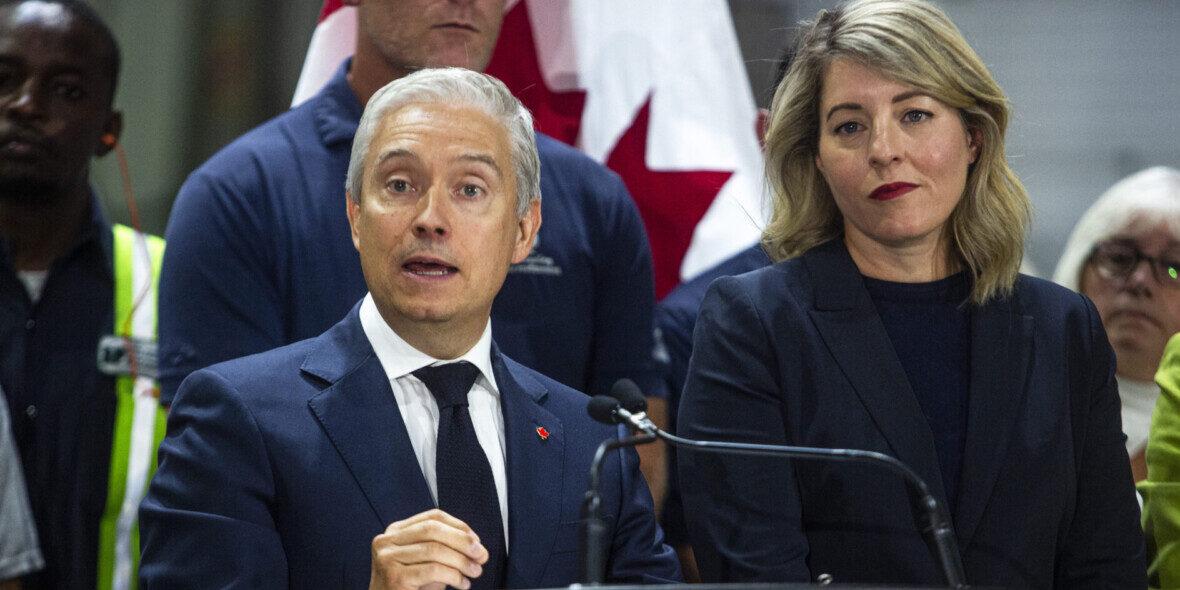
“We’re choosing our own course. We cannot wait for Washington to decide our future. We’re strengthening our economy and building a more sovereign Canada,” said Industry Minister Mélanie Joly (Ahuntsic-Cartierville, Que.) during the press conference at a metal roofing company in Ottawa.
Joly, also the minister responsible for economic development in Quebec, and was flanked by Jobs and Families Minister Patty Hajdu (Thunder Bay—Superior North, Ont.), minister responsible for the economic development agency for Northern Ontario; Evan Solomon, minister responsible for the economic development agency for Southern Ontario; and Liberal MP Mona Fortier (Ottawa—Vanier—Gloucester, Ont.).
The federal government is increasing tariffs on American steel and aluminum products from 25 to 50 per cent, as well as 50-per-cent tariffs on smartphones, golf clubs, video game consoles, fishing rods, clothing, and other U.S.-made goods, in retaliation for the United States imposing new tariffs last week on Canada.
The list of tariffed items also includes a 25-per-cent tariff on appliances, agricultural machinery, dairy products, seafood, and certain steel and aluminum derivatives products; and 15-per-cent tariffs on a smaller list of items.
Just last week, both countries seemed close to striking a deal, but Carney (Nepean, Ont.) ordered Canadian negotiators to exit Washington, D.C., on Aug. 21, citing last-minute demands, including veto power over some infrastructure projects and to limit Canada’s ability to strike new trade agreements with other countries, among others
Shortly after, Trump imposed a set of 50-per-cent tariffs on about $28-billion of Canadian goods. Trump also said tariffs on Canadian cars, trucks, automotive parts, and steel will increase to 50 per cent as of Jan. 1, 2027.
“Last-minute changes in the U.S.-proposed terms were unfair, uneconomic, and called into question the reliability of any deal,” Carney told reporters on Aug. 22, first announcing that Canada would be matching U.S. tariffs “dollar-for-dollar.”
Independent Senators Group Senator Hassan Yussuff (Ontario)—who served on former prime minister Justin Trudeau’s North American Free Trade Agreement (NAFTA) council, and who was formerly the president of the Canadian Labour Congress—told The Hill Times that there was “no way” Canada could have agreed to the terms the U.S. was offering, leaving Carney no choice but to levy counter-tariff measures.
“Symbolically, politically, I think the prime minister had to do that,” Yussuff said, but, “there’s no question there’ll be a lot of pain here for many folks in certain key sectors of the economy,”
Yussuff said the trade war will end eventually, but the only person who can answer whether the tariffs are likely to be dropped in the short term is U.S. President Donald Trump.
“There’s no question in my mind: Donald Trump does not forgive, nor does he turn the other cheek,” Yussuff added. “He’s a nasty human being, and I don’t think he’s going to be generous in any form, shape, or way to the prime minister.”
“We’re going to have to come together and remain strong because that’s the only way we’re going to get through this.”
Carney ‘did the right thing’: lumber rep
Government officials who briefed reporters ahead of an announcement at an Ottawa roofing manufacturing plant said Canada selected products from the Canadian industries most impacted by the U.S. tariffs in order to protect their market share.
“Canada must respond, and today we are, in a proportionate, targeted, and strategic way,” said Finance Minister François-Philippe Champagne (Saint-Maurice—Champlain, Que.) at the Aug. 25 press conference.
Canada’s counter-tariffs will come into effect on Sept. 8, with individual product rates matching the U.S.’s rate for the same goods. Counter-tariffs will apply to $27.6-billion worth of U.S. imports—consisting of hundreds of products—focusing on steel, dairy, appliances, agricultural equipment, pulp and paper, and electronics, the feds say.
The government announced a series of measures to aid Canadian industries who will feel the strain of the U.S.’s tariffs, boosting a series of programs to the tune of $7.5-billion. That includes: a $1.5-billion funding boost to the Regional Tariff Response Initiative, $2-billion to the Canada Strong Diversification Fund, and $3.5-billion to provide “rapid” responses to impacted workers and employers by, in part, extending employment insurance benefits.
Derek Nighbor, president and CEO of the Forest Products Association of Canada (FPAC), said the relief measures are “significant” and “welcome,” though “execution is going to matter.”
He explained that the industry sells upwards of $30-billion worth of products to the U.S. every year, with over a third of those products affected, in some part, by the current tariffs, ranging from levies of 25 to 50 per cent.
Still, Nighbor said he backs Carney’s decision to walk away from the bargaining table.
“We recognize that the prime minister did the right thing,” Nighbor said.
Yussuff echoed Nighbor’s assessment, saying the feds will have to monitor the process to see whether or not they have the desired effect.
“If not, they will have to bring in different measures, or at least change the measures in a way to say you can have greater impact and support for the people who are dealing with the challenges right now.”
But Eideberg said though relief is “obviously” going to help, the manufacturing industry needs “trade, not aid,” as it’s not uncommon for a component to move over the Canada-U.S. border five to seven times—paying a levy each time.
“For as long as that aid package or that support package is in effect, it means that we have not reached a resolution when it comes to getting back to negotiating a new trade agreement for North America, and more importantly, getting some of those other tariffs down.”
He said the association is “very concerned” about the impact on locally-owned businesses because it is harder for them to reroute supply chains.
“If things do not change, there will be real impact on jobs, on investment, and on the well-being of small towns and communities, where manufacturers are often, if not the only, primary employer.”
Conservatives push for details of draft deal, reconvened Parliament
Conservative Leader Pierre Poilievre (Battle River—Crowfoot, Alta.) is pushing for the feds to reconvene Parliament over the latest trade fall-out, calling on Ottawa to release the full draft deal, saying Canadians deserve transparency about the terms that were being proposed.
“We need to see the deal. The U.S. administration has seen it. Our government has seen it. Canadians deserve to see it,” he wrote on X on Aug. 24.
But Champagne refuted suggestions that the government wasn’t being transparent when asked about the comments by a reporter on Aug. 25, saying that the government has been regularly speaking to Canadians and media about the deal.
“I can’t remember one trade negotiation which got more coverage than the one we’re going through now,” he said, “In terms of transparency, I think Canadians have been able to follow that, even on a daily basis.”
Champagne did not directly answer the question about reconvening Parliament, but said the government is listening to stakeholders, Canadians, and “whomever may have ideas in the opposition,” calling it a “Team Canada moment.”
Joly quipped that if the Conservatives want to be “helpful,” they shouldn’t vote against policies such as the Spring Economic Update, which she highlighted included investments in skilled trades training.
Also weighing in on the talks is Ontario Premier Doug Ford, who had some harsh words for Trump on Aug. 24, telling the president to “kiss my ass”—comments he later doubled down on after Trump called him “Flunky Ford” and the “less charismatic, intelligent, and overall unimpressive brother” of the late former mayor of Toronto, Rob Ford.
Since then, Trump has threatened to change the name of Lake Ontario to “Lake America,” writing in a Truth Social post that the country doesn’t expect to be “doing much business with Ontario any longer.”
A day after Ford also warned he could cut power to homes and businesses in the U.S. in retaliation, the premier took a calmer tone, calling for a cool-down in rhetoric.
“It got a little personal yesterday between the president and myself, but I want to make a deal, a good deal for the American people, a good deal for the Canadians, and we’re the two greatest countries in the world,” Ford told CNN on Aug. 25.
Posted by IHateTrains123