
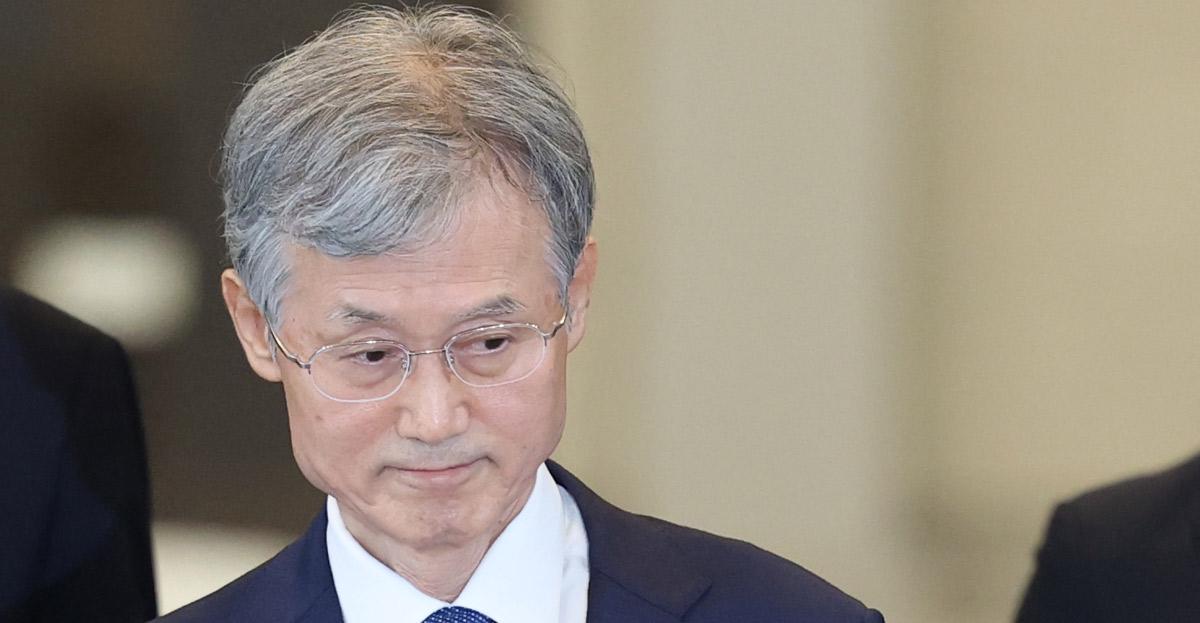
Attention is focused on what Chief Justice Cho Hee-dae will do after the presidential office requested that he submit another nominee for the Supreme Court, with particular interest in Cho’s underlying intentions. The reason Cho broke with the longstanding practice of nominating Supreme Court justices after sufficient consultation with the president appears to be an attempt to preserve the Supreme Court’s current overwhelmingly conservative composition.
From this perspective, Cho is considered likely to exclude the remaining candidates and instead establish a new recommendation committee, then nominate a conservative candidate of his choosing from among those newly recommended. Within the legal community, there are predictions that Cho will not back down as he seeks to preserve a “conservative Supreme Court” until his term expires next June.
Cho has made little effort to conceal his intention to use his authority to nominate Supreme Court justices as a means of resistance. The prevailing view within the legal community is that the reason he delayed the nomination for nearly seven months was his strong conviction that Kim Min-ki, a judge at the Seoul High Court who is considered progressive, must never become a Supreme Court justice.
Did Cho delay the nomination to prevent the appointment of a progressive Supreme Court justice?
At one point, there were claims that Cho was reluctant to nominate Kim because Kim’s spouse is a sitting Constitutional Court justice, but there is a strong possibility that this explanation was deliberately circulated. The head of the National Court Administration, appearing before the National Assembly recently, made clear that being married to a Constitutional Court justice does not disqualify someone from serving as a Supreme Court justice.
There has also been talk inside and outside the judiciary that Cho is uncomfortable with Kim’s past record. Kim is well known as one of the judges who challenged Shin Young-chul, then chief judge of the Seoul Central District Court, over his intervention in trials related to the candlelight protests over U.S. beef imports during the Lee Myung-bak administration. At the time, Shin concentrated the cases in judicial panels considered strongly conservative, prompting resistance from Kim and other judges and causing considerable public controversy.
The incident is said to have made Kim unpopular with conservative forces within the judiciary. This situation is also behind predictions that, despite the presidential office’s request for a new Supreme Court nomination, Cho will disregard the existing recommended candidates and form a new recommendation committee.
A similar tendency can be seen in Cho’s nomination of Kim Sung-soo, a presiding judge at the Seoul High Court considered conservative, to replace Justice Lee Heung-gu, who is due to retire next month. Earlier this month, the Supreme Court Justice Candidate Recommendation Committee recommended four candidates, including Kim Ye-young, a presiding judge at the Seoul Southern District Court. Cho ultimately selected Kim Sung-soo, who was regarded as one of the conservative candidates among them.
Kim Ye-young, who was also recommended, served as chair of the Conference of Representatives of Judges last year and was the only female candidate, leading many to regard her as the most suitable choice for the Supreme Court. Civil society groups and members of the legal community argued that because Lee Heung-gu is regarded as one of the Supreme Court’s leading progressive justices, his successor should likewise be a progressive figure. Cho completely disregarded those demands.
Overwhelming conservative majority on Supreme Court
There is widespread expectation that Cho will establish a new recommendation committee because the Chief Justice inevitably exercises considerable influence over how the committee is constituted. Of the 10 members of the Supreme Court Justice Candidate Recommendation Committee, four are appointed by the Chief Justice, while the Minister of National Court Administration and the senior Supreme Court justice, who serve as ex officio members, are effectively closely aligned with the Chief Justice. This means that six of the committee’s members are, in practice, under the Chief Justice’s influence. The structure makes it difficult from the outset to realize the diversity that the Supreme Court should seek to achieve.
Moreover, members of the legal community argue that Cho has deliberately excluded women and progressive candidates recommended by the committee, leaving the composition of the Supreme Court significantly unbalanced.
The Supreme Court is currently overwhelmingly conservative in its ideological composition. Once Justice Lee Heung-gu retires, only Justices Cheon Dae-yeop and Oh Kyeong-mi will remain as progressive justices. If Kim Sung-soo joins the court and Cho appoints another conservative figure, the 14-member Supreme Court, including the Chief Justice, would have a conservative-to-progressive balance of 12 to 2.
The gender imbalance among Supreme Court justices, currently 11 men and three women, would also remain unchanged. The number of female Supreme Court justices has fallen from four during the Moon Jae-in administration to three, prompting criticism that the Supreme Court is failing to reflect social diversity. Under these circumstances, further criticism that the court is moving backward would be inevitable.
Cho appears to have fallen under the illusion that he is the rightful heir to the conservative establishment within the judiciary. He seems consumed by a misguided sense of mission that he must preserve the Supreme Court’s current conservative orientation until his retirement. Cho has yet to express a single word of regret over the unprecedented situation in which a Supreme Court justice was nominated without presidential consultation. He has used his constitutionally guaranteed nomination authority as a weapon while employing a calculated tactic to shift responsibility for the prolonged Supreme Court vacancy onto the president.
Public confidence in the judiciary has plummeted because of the Chief Justice’s inappropriate conduct, yet he continues to cling to the misguided goal of “conservatizing the Supreme Court,” throwing the political situation into further turmoil. Even now, the only way to resolve the situation is for Cho to engage in sufficient consultation with the presidential office and nominate a candidate for the Supreme Court.
Posted by Freewhale98