
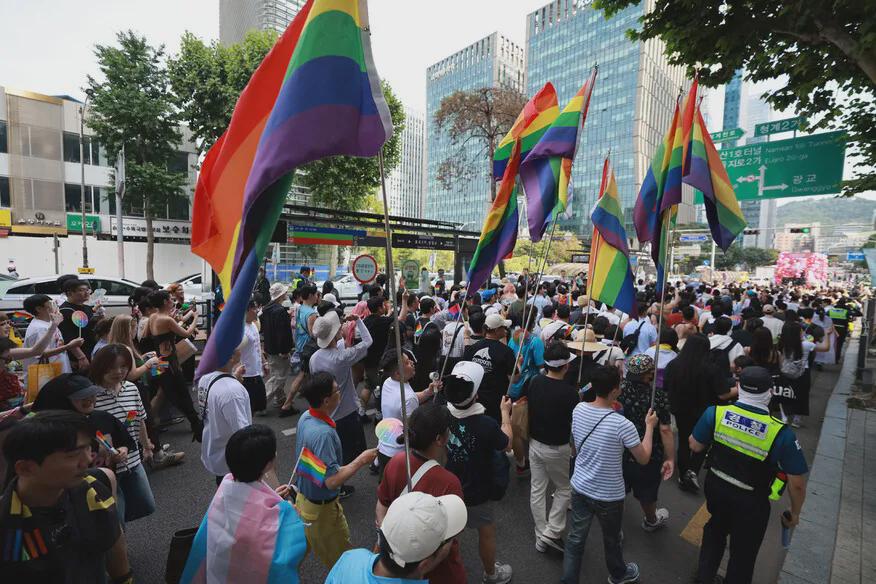
“When I was in middle school, my ethics teacher made a PowerPoint presentation about ‘why homosexuality is abnormal’ and taught material unrelated to the textbook. The teacher then made comments such as, ‘Gay people and transgender people should not come out in public.’”
Controversy continues after the Ministry of Education removed content related to sexual minorities from its “Guidebook for Responding to Hate and Discriminatory Expression.” A survey has found that LGBTQ+ teenagers routinely experience discrimination and hateful language at school, including during class, while having few channels or means to respond. The students said schools urgently need education aimed at improving awareness of LGBTQ+ people and addressing discrimination.
According to the results of an online survey on LGBTQ+ youth experiences with hateful expression conducted by LGBTQ+ youth support center DDing Dong, 76 of the 158 LGBTQ+ teenagers who responded over the four days from the 28th through the 31st said they had heard hateful remarks from teachers at school, while 151 said they had heard such remarks from their peers.
The Ministry of Education had previously prepared the guidebook following an incident in which members of the Paichai High School baseball team mocked the May 18 Gwangju Democratization Movement. However, controversy arose after the ministry removed LGBTQ+-related concepts and examples, including “sexual orientation” and “gender identity,” from the guidebook. Six of the seven experts commissioned by the ministry to review the guidebook strongly objected to the changes and withdrew their names from the review committee.
Around half of the respondents said they had heard hateful remarks from teachers during class. Respondents described cases in which teachers “held a debate on whether students were for or against homosexuality,” “stopped the lesson to give a speech about how harmful the Anti-Discrimination Act is,” and “said that same-sex families should not be included as families in an assignment about future family structures.” Most respondents also said they had heard peers describe LGBTQ+ people with remarks such as “disgusting,” “creepy,” and “they deserve to be discriminated against.”
The survey also found that most of the teenagers had no way to respond when confronted with such remarks. Of the 158 respondents, 129 said they had “endured it without saying anything.” Reasons included fears of being bullied and concerns that responding could forcibly reveal their sexual orientation or gender identity, effectively outing them.
Addressing the Ministry of Education and local education offices, respondents said, “We’re not asking for anything that extensive. We just want people to be taught what hate is,” “Just respect us,” and “Please don’t leave LGBTQ+ teenagers isolated in situations where they face hatred simply because of the excuse that there might be complaints.”
DDing Dong plans to submit the survey results to the Ministry of Education and demand revisions to the guidebook. Jeong Min-seok, head of DDing Dong, said, “If the guidebook is distributed as it is, with LGBTQ+-related content removed, students who routinely experience discrimination and hatred may interpret it as the Ministry of Education tolerating such behavior, leaving them feeling even more afraid and powerless.”
Meanwhile, the Ministry of Education met that day with experts who had participated in reviewing the guidebook and with civic groups, including the Solidarity Against Disability Discrimination, to hear their views on the removal of LGBTQ+-related content. The groups called for the material to be restored. A Ministry of Education official said, “We will gather opinions and review the contents of the guidebook.” Civic organizations, including the Solidarity for the Enactment of the Anti-Discrimination Act, the Korean Teachers and Education Workers Union, and DDing Dong, plan to hold a press conference at Gwanghwamun Square in Seoul on the 1st, demanding an apology from the education minister and the preparation and distribution of a guidebook that includes content related to LGBTQ+ people.
Posted by Freewhale98
1 Comment
1. Summary
Recent survey prompted by Ministry of Education push to remove LGBTQ+ from anti-discrimination education guideline has shown that homophobia is prevalent in Korean classroom and taught by teachers to students.
2. How is this related to the sub
(1) Minorities rights: Korean education system found to be riddled with homophobia.
3. My opinion
Former PM/ Current Democratic Party Chairman Kim Min-Seok: “If humanity chooses homosexuality, they will not be able to sustainable themselves.”
https://preview.redd.it/808tfjwm73nh1.jpeg?width=1170&format=pjpg&auto=webp&s=0f4ae3fbc215362f89cc0ff1b37faf1b8adf3c7c
Yeah….the ignorance about LGBTQ+ is widespread in Korean society. Even in the ruling Democratic Party, you will easily find homophobes. The consensus that homosexuality is morally unacceptable is dominant.