
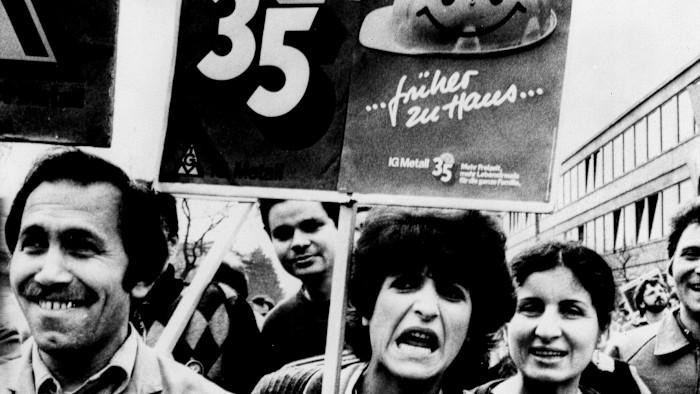
Four decades after German metalworkers won one of the most acrimonious labour disputes in the country’s postwar history to secure a 35-hour week, some of the largest industrial employers are reviving the totemic debate over longer working hours.
Prominent executives, including at Mercedes-Benz and toolmaker Stihl, have called for employees to work 40 hours a week without extra pay, arguing that high labour costs are eroding the country’s competitiveness.
“Labour has become too expensive here by international standards,” Martin Brudermüller, chair of Mercedes-Benz Group AG’s supervisory board, told the German newspaper Handelsblatt earlier this summer, adding that the country had lost its “productivity advantage over important competitors”.
“We should seriously consider a return to the 40-hour week,” he argued.
Labour costs in Germany are among the highest in the EU. An hour of work in manufacturing costs €49.50, 47 per cent more than the EU average of €33.70 and three times as much as in Hungary, where it costs €15.60.
While German employees are more productive than their eastern European peers, unit labour costs measuring workers’ output have risen significantly faster since 2023 than in previous years, according to a survey by IMK, a think-tank financed by Germany’s unions.
The calls to return to a 40-hour week come before industrial unions start their latest pay negotiations in October. The 35-hour week was introduced gradually over more than a decade that followed a dispute in 1984 that saw tens of thousands of metalworkers in the former West Germany stage a seven-week strike to secure shorter hours.
Today, 35 hours a week is the collectively agreed standard for about a fifth of German employees, concentrated in sectors including automotive, engineering, iron and steel. Across all sectors, the length of the average working week stands at 37.8 hours. Germans work fewer hours a year on average than employees in almost any other OECD economy, although the comparison is heavily influenced by the country’s high share of part-time employment.
What has transformed a decades-old argument into an urgent competitiveness debate is the deepening crisis in German manufacturing. Since peaking in late 2017, German industrial production has fallen more than 15 per cent as manufacturers have been hit by successive energy price shocks, intensifying competition from China, US tariffs and the disruptive shift towards electric vehicles.
High labour costs were once offset by Germany’s other attractions for employers, including political stability, strong infrastructure, skilled workers and dense industrial clusters, according to Marcus Berret, global managing director at consultancy Roland Berger.
But those advantages were eroded just as the cost gap with countries in eastern Europe and beyond widened. “When it comes to labour costs, we are not talking about a difference of 10 or 20 per cent [with rival economies]. In some cases, we are talking about a factor of three or four,” he said.
So far employment in German manufacturing has fallen much more slowly, leaving about 6.5mn people working in the sector despite the steep decline in output.
But Berret expects further job losses. “If I put together what I know from individual companies, I expect that we will end up with fewer than 5mn people employed in manufacturing.”
Currently about 12,000-15,000 manufacturing jobs are disappearing per month, and large employers such as Volkswagen have already indicated that many more positions in Germany will have to be axed.
For workers who manage to retain their jobs, an increase in working hours may become inevitable, argue economists.
Martin Werding, a member of the German Council of Economic Experts, says that the mechanisms manufacturers once used to compensate for high labour costs — such as using temporary agency workers who can be let go during periods of weaker demand — are no longer enough.
“Today’s challenges have become so big that this flexibility is no longer sufficient,” he said. Moving from 35 to 40 hours without additional pay would increase working time by 14 per cent while leaving weekly wage costs unchanged. The debate about working hours is “much more than symbolic politics”, Werding added.
IG Metall, Germany’s biggest and most powerful trade union with more than 2.2mn members, rejects the premise that factories are constrained by a rigid 35-hour week. Nadine Boguslawski, the IG Metall executive in charge of collective bargaining and member of Mercedes’ supervisory board, said agreements with employers already allowed companies considerable flexibility to increase or reduce hours.
“The rigid 35-hour week that is sometimes portrayed simply does not exist in the companies I know,” said Boguslawski. Moreover, IG Metall was open to finding bespoke solutions for companies in trouble, she said.
At the heart of the debate is a fundamental disagreement between unions and employers about whether longer hours would destroy jobs by spreading a fixed amount of work among fewer people or preserve them by making German factories more competitive.
Boguslawski argued that one of the key reasons that IG Metall fought heavily for the 35-hour work week in the 1980s was “to get more people into employment” by spreading the available work among more people. “If you turn that around and increase working hours to 40 a week, regardless of whether those additional hours are paid or unpaid, you tend to need fewer workers,” she warned.
But economists like Werding counter that the amount of work available is not guaranteed and depends on firms’ competitiveness. If lower labour costs per unit of output make German factories more competitive, companies could retain production and jobs that would otherwise move abroad or disappear, they argue.
Whether the push for longer hours will make it on to the negotiating agenda between unions and employers this autumn is unclear. Gesamtmetall, the metal industry employers’ association, declined to comment on calls to abandon the 35-hour week, citing “internal considerations”.
Berret fears that the political and public debate has yet to catch up with the scale of the crisis facing German industry. “A lot of people are living in a different reality when it comes to what is heading our way,” he said.
Posted by Desperate_Wear_1866
1 Comment
Forget about the whether or not this is a good idea. What mechanism do you propose to get people to work more without an increase in pay ? If anyone said such a thing we’d laugh at them for being economically illiterate but when the board of an industrial says it….