It deliberately recalls Stravinsky’s ballet **_Le Sacre du printemps_ (The Rite of Spring)**, whose story involves an archaic ritual sacrifice.
This imagery is connected with the real human cost of the project.
**Nine workers died during construction of the Gotthard Base Tunnel.**
Hesse specifically explained that the spinning imagery begins with the **rotating cutting wheel of a tunnel-boring machine**.
The mechanical rotation gradually transforms into human spinning and ecstatic dancing.
The white spinning figures that resemble dervishes. These became controversial because many viewers thought they resembled **Sufi whirling dervishes**.
The demons, strange masks and straw-covered creatures
These are much more specifically connected with **Alpine folklore**.
For centuries Alpine communities developed stories about:
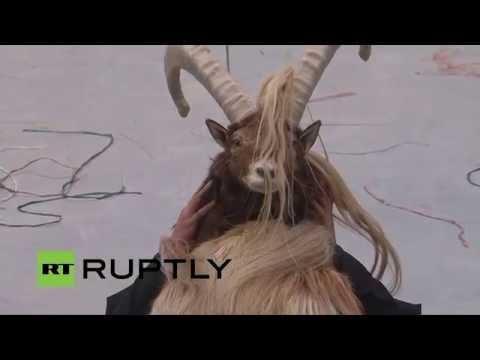
A horned male creature appears prominently, leading many viewers to identify it with:
**Baphomet, Satan or the Devil.**
There is an obvious visual resemblance to traditional horned-devil imagery.
However, the documented context of the production is **Alpine mythology and mountain spirits**, and contemporary coverage identified the creature with the **ibex**, the wild Alpine mountain goat.
Horned animals also naturally fit the production’s theme:
**the mountain becoming alive and confronting the humans who have entered it.**
the contrast between two worlds:
**the rational technological world**
versus
**the irrational natural/animal world**
That is one reason the goat/ibex figure behaves less like an ordinary animal and more like a mythological fertility or nature creature.
Because horned fertility gods such as **Pan** exist in European mythology, viewers can reasonably see such associations.
It was telling a story about **the Gotthard as a mythic Swiss mountain**.
The mountain existed culturally for centuries before the engineers drilled through it.
Toward the conclusion, Saint Barbara symbolically blesses the trains and passengers entering the new tunnel.
**Saint Barbara is traditionally the patron saint of miners and tunnel workers.** A religious symbol.

2 Comments
🐐 is the god of the wild, the untamed
It deliberately recalls Stravinsky’s ballet **_Le Sacre du printemps_ (The Rite of Spring)**, whose story involves an archaic ritual sacrifice.
This imagery is connected with the real human cost of the project.
**Nine workers died during construction of the Gotthard Base Tunnel.**
Hesse specifically explained that the spinning imagery begins with the **rotating cutting wheel of a tunnel-boring machine**.
The mechanical rotation gradually transforms into human spinning and ecstatic dancing.
The white spinning figures that resemble dervishes. These became controversial because many viewers thought they resembled **Sufi whirling dervishes**.
The demons, strange masks and straw-covered creatures
These are much more specifically connected with **Alpine folklore**.
For centuries Alpine communities developed stories about:
– mountain spirits
– devils
– goblins
– supernatural beings
– storms
– avalanches
– dangerous mountains
A horned male creature appears prominently, leading many viewers to identify it with:
**Baphomet, Satan or the Devil.**
There is an obvious visual resemblance to traditional horned-devil imagery.
However, the documented context of the production is **Alpine mythology and mountain spirits**, and contemporary coverage identified the creature with the **ibex**, the wild Alpine mountain goat.
Horned animals also naturally fit the production’s theme:
**the mountain becoming alive and confronting the humans who have entered it.**
the contrast between two worlds:
**the rational technological world**
versus
**the irrational natural/animal world**
That is one reason the goat/ibex figure behaves less like an ordinary animal and more like a mythological fertility or nature creature.
Because horned fertility gods such as **Pan** exist in European mythology, viewers can reasonably see such associations.
It was telling a story about **the Gotthard as a mythic Swiss mountain**.
The mountain existed culturally for centuries before the engineers drilled through it.
Toward the conclusion, Saint Barbara symbolically blesses the trains and passengers entering the new tunnel.
**Saint Barbara is traditionally the patron saint of miners and tunnel workers.** A religious symbol.