
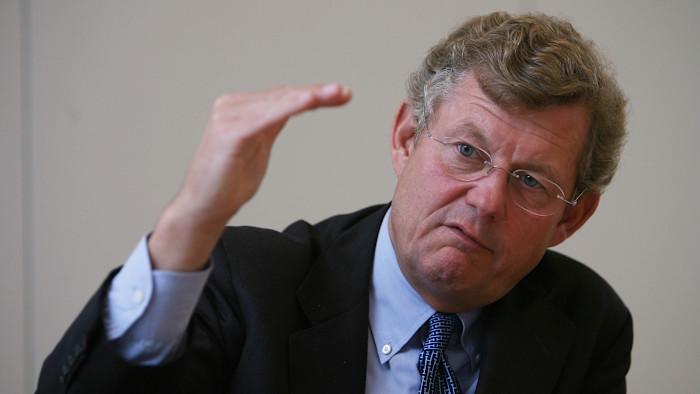
Sweden risks its world-leading status as a home to start-ups and vibrant equity markets if the leftwing opposition wins next weekend’s elections, according to the Scandinavian country’s most prominent industrialist.
Jacob Wallenberg, whose family’s foundations hold large stakes in companies including AstraZeneca, Ericsson, ABB and Saab, told the FT that decades of pro-business reforms by both the left and right were at risk from various opposition proposals.
“The opposition has pointed to more government engagement, higher taxes in a number of different areas . . . also a discussion about working less hours. I’m deeply concerned about these things,” he added.
The intervention of Wallenberg, who also chairs the Confederation of Swedish Enterprise, is significant and underscores the depth of concern from local businesspeople before an increasingly tight election on September 13.
The current centre-right government has gained plaudits for combating gang crime as well as lowering immigration to its lowest level in 40 years, but has long trailed the leftwing opposition led by the Social Democrats in the polls. In recent days, that gap has narrowed but the opposition has held on to a small lead. The coalition also includes the Left, Centre and Green parties.
Politicians from these parties have tabled proposals including new taxes on overall wealth, inheritance, banks and higher levies on savings. A tax on billionaires has also been proposed.
Wallenberg said he was not singling out individual parties in his intervention on behalf of the business community. “Our concerns are directed at specific suggestions that we feel could be impediments for the continuous development of businesses in this country. This is voiced by the opposition,” he added.
On a per capita basis, Stockholm has more tech unicorns than any other region in the world outside Silicon Valley. This refers to companies worth more than $1bn and includes Spotify and Klarna.
Additionally, the country’s stock exchange has attracted more IPOs in the past decade than France, Germany, the Netherlands and Spain combined.
Wallenberg acknowledged that the rise of start-ups had led to an increase in inequality as new billionaires in Swedish krona terms were minted.
But he added that these entrepreneurs, including Daniel Ek from Spotify and Sebastian Siemiatkowski from Klarna, were also “employing more people” and contributing more tax revenue, which is “quite fundamental for our economic development for the good of society”.
Magdalena Andersson, the Social Democrat leader and frontrunner to become prime minister, told the FT recently that her party had “good co-operation” with companies and wanted to say “clear and loud in the world: Sweden is back and we’re open for business”.
But business leaders from Spotify, truckmaker Volvo and Atlas Copco have worried in recent days about the leftwing coalition partners that Andersson would need to rely on to gain a majority in parliament.
Wallenberg said Sweden needed to remain competitive against rivals from the US and China, especially with Europe recording lower economic growth. “It seems counterintuitive that you will become more competitive by working less and by making it more difficult for companies to develop,” he added.
A Swedish investor in many of its most successful start-ups argued that tech companies merely wanted no change: “Don’t mess things up. But I’m afraid the left might.”
Wallenberg said there was a danger that the opposition took Sweden’s success for granted. He added: “They appear for a reason. Because we have promoted entrepreneurship, we have created forms of financing for very early stage [companies], we have university programmes that support this research and development thinking.”
Richard Milne in Stockholm
Posted by SirRousseau
1 Comment
!ping SWEDEN