
Germany’s democracy has suffered an earthquake.
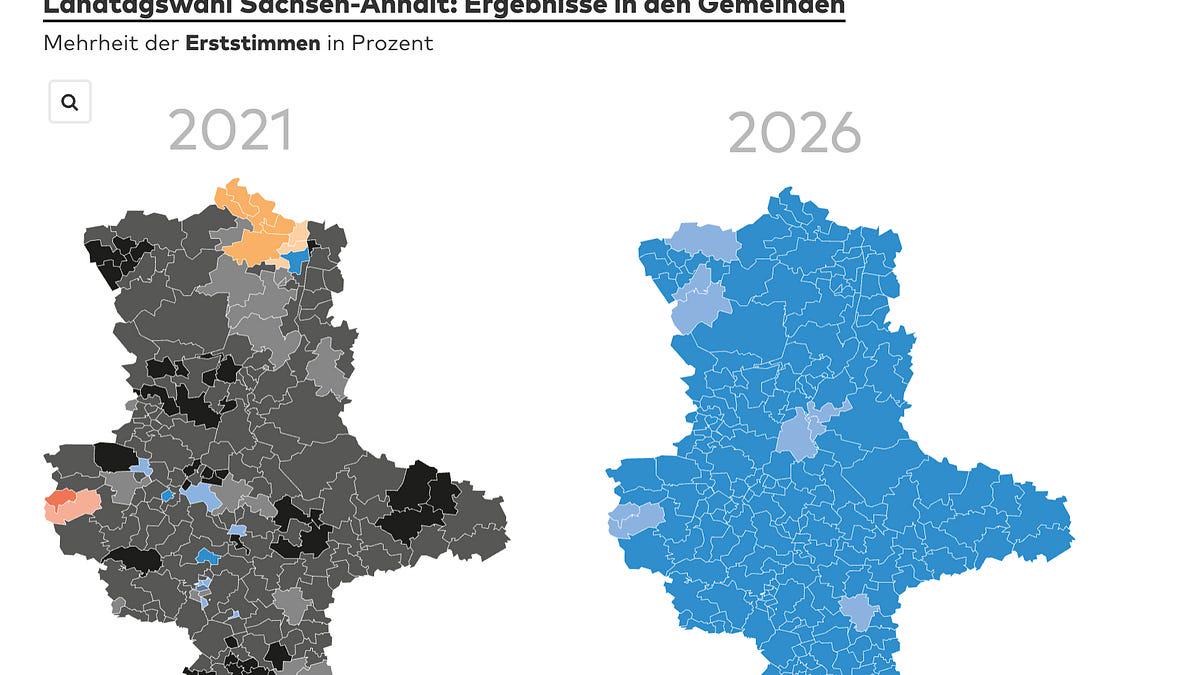
In its regional elections at the weekend, the tiny state of Sachsen-Anhalt – population of just over 2 million souls – gave a stonking 44 percent plurality to the AfD (Alternative für Deutschland). The AfD has pulled off an astonishing transformation of the electoral map.
Despite their remarkable showing, it is not obvious that the AfD will form the next government in Sachsen-Anhalt. The other parties may arrange themselves to keep the AfD out of power. At the national level, the AfD are even further from government. Nevertheless, this result shakes Germany’s political system. It shows how far the familiar political norms of the Federal Republic have disintegrated. Mecklenburg Vorpommern, another small East German state, will vote on September 20th and the outcome may well be similar. The crisis of German democracy has long been forecast. It now seems to be upon us.
The AfD comes in political different shades. In Sachsen-Anhalt it has been officially classified by the German authorities as right-wing extremist. The AfD’s candidate, Ulrich Siegmund, is a charismatic former corporate scent salesman who once tried to convince the government of Berlin that perfuming underground stations with the scent of vanilla would reduce crime. You can’t make this stuff up!
Born after end of GDR, Siegmund both evokes the memories of the Stasi and SED repression and lionizes the memory of a small German state with its own distinct identity, represented by quirky and distinctive machinery such as the Simson moped. When the (Jewish) founders of Simson protested at his instrumentalization of their family’s name, Siegmund dismissed them as unwelcome American busybodies out of touch with East German realities.
Siegmund became notorious for his attendance at a secret meeting at which members of the German right-wing discussed a program of mass “remigration”. This policy position that was once denied, has since come to be espoused by the AfD. Siegmund regards the scandal surrounding his attendance as a welcome publicity coup.
If you want to get a flavor of the right-wing milieu around the AfD in Sachsen-Anhalt, I recommend watching this video of the Simson rally. Check out the dudes in the security cordon!
Also, if you have the stomach for it, check out this casual use of the n-word at a family friendly “rally”.
The AfD are a party of racist xenophobes, to put it mildly.
As has been pointed out, Anhalt was the first German state in 1932 to elect a Nazi Prime Minister. But Sachsen-Anhalt, also has a left-wing history. That alternative is more recent. In the late 1990s, the voters of the state made the SPD the largest party and PDS, the forerunner of Die Linke, came in a strong third. The SPD formed a minority government with the Greens, benefiting from the tacit endorsement of the PDS.
So what needs to be explained is not so much the deep continuity of nationalist sentiment, so much as the collapse of a potential progressive majority. To answer this question, I broadly find convincing the kind of narrative offered by East German journalist and commentator, Jana Hensel.
She argues that the breakdown of trust happened in the 2000s due to the Red-Green government’s dramatic assault on the German model of welfare and labour market administration – known as the “Hartz IV reforms”. These changes, that began to be rolled out in 2003, dramatically increased pressure on welfare recipients and went hand in hand with a surge in the pre-tax gini of inequality. In political terms, Hensel argues, they shocked East Germans out of any illusion of a common, shared community of fate.
Initially, this was profoundly alienating and demotivating. The left-progressive energies of the late 1990s and early 2000s, dissipated. Sachsen-Anhalt’s previous claim to fame in electoral history dated to 2006, when it set the record for the lowest popular participation in a regional election, with a turnout of only 44.4 percent.
The AfD has changed all that. From the lows of 2006, turnout surged at the weekend to 78 percent, up from barely 60 percent in 2021. The main driver and beneficiary of this electoral mobilization is the AfD. Of its huge surge in support by far the largest part came from previous non-voters.
As heroric empirical work by political scientist Julius Koelzer has shown, this mobilization is most dramatic in the rural areas of the state. Not for nothing, political economist Philip Manow speaks of the “democratization of democracy” brought about by Germany’s populist surge. It seems hard to disagree with the basic diagnosis that what we are witnessing is a highly mobilized protest vote against the German democratic establishment couched in terms of a xenophobia and an embrace of national and regional belonging. Heimat has been the rhetorical touchstone of the election. But this reassuring message is paired with a dramatic sense of crisis and the demand that something radical and new needs to be done. Unsurprisingly, right-wing commentators like Ulf Porschardt of Die Welt are declaring the end of the Berlin republic as we know it.
Even those who do not want to share this mood of Untergang, have to reckon with the dramatic vista that this regional election opens up. Faced with a protest vote, it is tempting to ask familiar questions about social disadvantage, the state of the Sachsen-Anhalt economy etc. And it is easy to find answers there for deep seated discontent.
Even by Germany’s modest standards, growth in Sachsen-Anhalt is slow. Unemployment is relatively high. Sachsen Anhalt’s economy was once a major hub of “central German”, state-backed industrialism. The original Junkers factory – home of the legendary JU52 transport and passenger plane – was in Dessau. Sachsen-Anhalt once manufactured rolling stock for the entire Communist bloc. There was a major concentration of chemicals production in the GDR. To say the least, these are not sectors that are doing well. Population is aging and declining.
Against this backdrop, the AfD, like its analogues in France and Italy and the UK, strongly appeals to those who self-identify as “workers” – 60 percent of whom vote for the AfD – and to those who say they are having financial difficulties – 65 percent vote for the AfD. Neither of those are majority groups in the electorate, but the bias in their vote is telling. Meanwhile, only 30 percent of those with higher education vote for AfD.
But what conclusions follow from this finding? It might seem obvious to say that hard-up, working class right-wing voters should be “won back” by offering them improved welfare measures and price stability. If you ask AfD voters what they worry about, along with their xenophobic concerns about “too many foreigners”, they will mention the cost of living and their concerns for their standard of living. They also mention climate change and the threat of external war.
These are there worries. But if you ask them what they think about the AfD and why they voted for it, economic issues are barely mentioned. What comes first is security, foreigners, woke politics, remoteness etc.
If you are hard up and working-class it would after all be nothing short of bizarre to vote for the AfD in the hope of improved social protection. There are parties in Sachsen-Anhalt offering a progressive welfarist program – notably Die Linke and arguably the SPD and the Greens as well – and the voters are not flocking to them. In choosing the AfD, voters are opting for party that in social policy terms is far to the right of either the CDU or FDP, the traditional pro-business free-market parties in Germany.
Voting for the AfD in the current landscape, whatever your economic issues, in short, is not a vote to have your economic issues addressed by social democracy, or welfare or government intervention. It is a vote to crackdown on foreigners, which you may imagine may help with jobs and scarce welfare resources. But above all it is a vote for someone who, like you, rejects the status quo, who demands that radical action be taken and is not afraid to break eggs to make omlettes. Insofar as you are voting for a socio-economic vision in voting for the AfD, it is one aptly thoughly clumsily characterized as „nativist producerist deservism“ (Jonas Junack). Where:
- Nativism = A political policy or worldview that promotes the interests of native-born inhabitants over those of immigrants, often driven by fears that newcomers threaten local culture, jobs, or public resources. [1, 2, 3)]
- Producerism = A political ideology holding that “productive” members of society—typically working- and middle-class manual laborers, farmers, and small business owners—are exploited by both idle economic elites (like financiers) and non-producing dependents.
- Deservism = A concept centered on the moral categorization of citizens and non-citizens into those who “earn” or “deserve” support, welfare, and legal standing, versus those perceived as free-riders or outsiders. (h/t/ Gemini)
To my mind, if progressive policy hopes to engage with such voters at all – and it is open question whether it should – it must address not just the material realities of relative economic disadvantage, but above all the “outsider” credentials of the AfD.
The racism and xenophobia of the AfD are real. But they are all the more powerful because they serve as a kind of commitment device. People who act and speak in public as right-wing extremists and are labeled as such, establish a claim to authenticity. They establish an identity beyond the “Berlin Republic” mainstream and invite voters to join them. The AfD has worked assiduously to foster and build that community. In the East German states it is now approaching majoritarian status.
To believe that the answer to such a political project can lie reinforcing, reforming and improving the mainstream through improved socio-economic policies is, to say the least, a bold hypothesis. The more obvious conclusion is that to contest the political terrain with the AfD, if that is indeed something we want to do, we need to offer not more of the same (just better), but an “alternative to the Alternative”, an “alternative to the Alternative”, furthermore, that can produce something more than just material benefits. That can produce identity.
When my colleague at Surplus magazine Isabella Weber calls for an “anti-fascist economics, or when Marcel Fratzscher of the DIW calls for a major reform program that is “even more far-reaching” than that 25 years ago with Agenda 2010, they are speaking to the need for bold and radical action. Both have specific economic policies in mind – measures of price control (Weber), a whole raft of ‘reforms” in Fratzscher’s case. But after Sachsen-Anhalt, the central question must be: are such policies enough to found new political identities beyond the current mainstream of Berlin politics? Or is that a mode of politics, which we prefer to leave to the AfD?
Posted by IHateTrains123
1 Comment
If anyone is interested in the larger debate around how liberal democracies should deal with illiberal elements like AfD, there is a debate thread taking place at https://www.reddit.com/r/liberalism/s/sWW1TGcUMH