
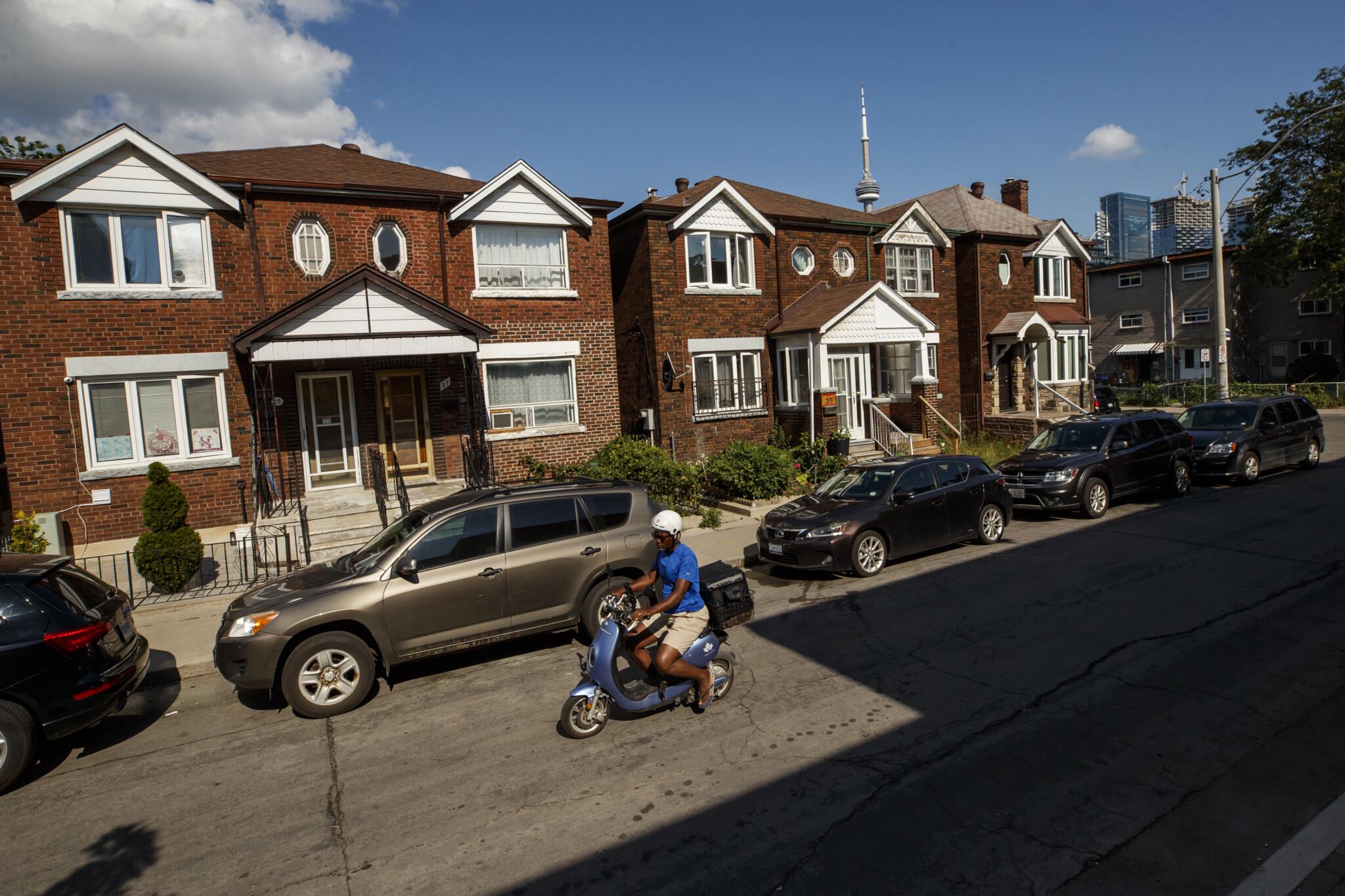
Canada’s economy is increasingly unfair to young people. Sometimes, it feels like we’ve made great progress in getting politicians to recognize this fact. Other times, they propose policies that make me wonder if they’ve been listening at all.
Despite spouting easy slogans and platitudes about understanding the generational inequity young Canadians face, governments often choose to protect the privileges of long-time property owners at the direct expense of younger Canadians trying to build a future.
Right before the summer break, Toronto City Councillor Alejandra Bravo directed staff to study whether it makes sense to limit the number of parking passes a multiplex may qualify for.
The motive for this motion is clear: they want to placate single-family homeowners who are upset that added gentle density to their neighbourhoods might force them to park a few doors down.
CBC, for example, tells the story of a woman who says she now has to sometimes drive several blocks to find a spot, which can be frustrating when she’s carrying groceries or driving her elderly mother to visit.
But what of those (often young) families in the multiplexes themselves? Don’t their grocery runs or care visits deserve the same consideration?
Barring multiplexes from accessing street parking permits would be a mistake. It would engrain a two-tier class system for residents, granting single-family homeowners who have pretty much won the housing lottery a de facto private property right over public street space, while penalizing younger residents who are settling for denser housing as their only options.
Essentially, it asks young people to accept a lower standard of living beyond what’s already being asked of them.
Parking spots in Toronto are highly subsidized by taxpayers. The true market cost to store your private vehicle on a public road should be much higher than the roughly $25 a month it costs. Subsidizing it so much has meant high demand for parking spaces in limited space.
As neighbourhoods densify in an attempt to meet the demand for more homes in our city, that’s led to an increase in demand for parking spaces. Tax subsidies have led to a distortion in market demand and artificial scarcity in this public asset.
Until recently, cities mostly allowed density on main streets, protecting neighbourhoods from experiencing the allegedly dismal experience of living around more people. Combine that with fewer people living in households than in previous generations, and many urban neighbourhoods are less densely populated than they were in the 1970s.
Our policies that, until recent years, limited neighbourhoods to single-family homes, combined with seniors staying longer in their homes than urban planners expected, have led to younger Canadians facing a reality where they are stuck in increasingly small apartments.
At the Missing Middle Initiative, we’ve found that most people looking to raise a family hope to live somewhere that has at least three bedrooms. These units are incredibly expensive in condos, and the alternative of single-family homes is simply out of reach for so many.
Graphic 1: Adjusted homeownership for young Canadians aged 25-39.
One good solution is these multiplexes. Housing several units on the lot traditionally occupied by a single-family home gives the opportunity for people to live in cities, even if they don’t have the wealth needed to access a traditional house. These homes are typically not going to be subsidized homes, but rather market-rate houses that are more affordable, on average, to the middle class than a neighbouring house would be.
That said, they come with trade-offs. People who live in them often are choosing location over the full privacy that a detached house provides.
Right now, anyone in the neighbourhood can apply for a street parking permit, and if capacity permits, they will be approved. No one is guaranteed a spot right in front of their house, or even within blocks of their home. That’s the trade-off when you buy a home without a private parking spot.
When I bought my home, I had to weigh the trade-offs of a private parking spot. I chose to sacrifice the convenience of guaranteed parking in front of my home so that I could afford a better house than I otherwise would have been able to afford on my budget.
On winter days, when the city hasn’t gotten around to plowing the spots yet, I sometimes have to either avoid using my car (since I know digging it out means I risk losing my space) or I have to park several blocks away from my house. I have two young children, so I truly understand how frustrating it can be when the only spot is a five- or 10-minute walk from home, but I understood the trade-off when I bought the home.
If people who own a single-family home want to guarantee parking outside their front door, they ought to buy a home with a dedicated parking spot.
It’s not a good compromise for relatively wealthy homeowners to prevent the less well-off from accessing parking spots while we all continue to pay to subsidize the cost. It isn’t fair, and it isn’t progressive. Either let the free market dictate who can access parking, or allow anyone living nearby to access it.
Younger Canadians are already dealing with major housing challenges. Artificial constraints due to zoning, urban growth boundaries, and many other policy choices have led to prices being completely out of whack with the median income. To compensate, they’re making choices to move farther away, live in smaller spaces than their parents considered comfortable, or even forgo having children if they can’t afford a home big enough to comfortably house them.
It would be a huge injustice to young Canadians who are already accepting a lower standard of living than their parents had, to use government regulation to codify the downgrade.
City leaders must recognize that using public regulation to guarantee convenience for asset-rich incumbents ultimately forces younger Canadians to pay more for less. Let’s look for progress on the housing crisis rather than create further generational divides.
Posted by IHateTrains123
1 Comment
Interesting that they frame living in density as “settling” or “the only choice available to them” as if it were an inferior preference.