
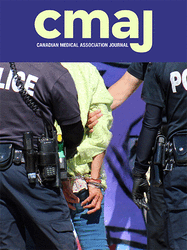
In this issue of CMAJ, Gaudreault and colleagues compare drug-related health and criminal justice outcomes during drug decriminalization and partial recriminalization in British Columbia with those in other Canadian provinces.1 They found that decriminalization in BC was associated with a decrease in incidents of personal drug possession but not with changes in drug-related hospitalizations or deaths, which leaves many unanswered questions. Why were decriminalization’s effects limited, how should success be judged, and what’s next for drug policy reform? We discuss the study’s findings and provide insight into these questions by considering decriminalization as a complex systems intervention — one that depends on implementation and interactions across health, social, and legal environments — rather than a discrete policy reform.
British Columbia’s government expected decriminalization to reduce stigma, encourage help-seeking, and improve access to health and harm-reduction services, with reduced drug-related hospitalizations and deaths over time as an indirect consequence. 2 However, drug poisoning deaths declined in BC across the study period in a manner similar to other provinces and independent of decriminalization, as supply-and-demand drivers of the crisis evolved.1 Both a 2026 analysis of North American government and social media data and a recent ecological analysis of Health Canada data suggested that declining opioid-related deaths in Canada and the United States partly reflect Chinese restrictions on export of fentanyl precursors, which disrupted fentanyl production in North America.3,4 The prevalence of drug use, and safety practices, also influence overdose rates. Fewer youth initiating opioid use may contribute to fewer deaths as the at-risk population ages and decreases.4 Administrative data and consultation with government and community representatives suggest that expanding take-home naloxone programs contributed to the decline.5 However, although opioid agonist therapy (OAT) may reduce exposure to the unregulated supply, increased use of OAT did not contribute substantially to recent decreases in overdose deaths in Canada.5
The design of decriminalization in BC may partly account for its lack of impact on rates of drug-related deaths. The province removed criminal penalties without establishing a structured referral mechanism or administrative penalties to incentivize supports. Although BC expanded addiction medicine services, capacity continued to lag need, particularly in nonpharmacologic approaches such as contingency management, holistic Indigenous services, and rural and remote care. Therefore, BC may have removed a barrier to care without ensuring that accessible and acceptable care was encouraged or even available. In contrast, the paradigmatic model of decriminalization in Portugal is unique because it was embedded in a broader health and social policy response. People found to possess drugs in Portugal are referred to multidisciplinary dissuasion commissions, which connect them with services, such as treatment, as a structured pathway that is incentivized via administrative penalties (e.g., fines) that can be avoided by voluntary health system engagement.6
The clearest effect of BC’s policy was a significant reduction in drug-possession arrests.1 This aligns with evidence from other jurisdictions, including in Oregon, Washington, and Portugal, where arrest rates declined immediately following reforms, with continued reductions in Oregon.7,8 Reduced arrests and charges for possession are more than administrative outcomes — they represent a meaningful change in how people who use drugs experience and interact with the justice system. Extensive research documents the harms of criminalization, including justice system costs, criminal records and their socioeconomic consequences,9 and barriers to health and harm-reduction services.10 In Canada, Indigenous Peoples are overrepresented in the criminal justice system, including for drug-related offences, reflecting harms shaped by residential schools and other aspects of colonialism.11 Mitigating such harms was central to the rationale for BC’s decriminalization policy, and losing this benefit has led BC First Nations’ leaders to criticize the end of BC’s decriminalization pilot.12 Its termination raises a further question of why substantial reductions in criminal penalties were not enough to sustain the policy. Even people who otherwise support criminal justice measures, whether to discourage the normalization of drug use or for individual change, may regard fewer arrests without adverse health harms as something of a success, particularly if it lowers policing costs or redirects resources to more serious offences.
Evaluating the effectiveness of decriminalization policies is difficult, particularly over a short implementation period. Outcomes such as drug-related hospitalizations and deaths may be unhelpful in determining policy success, given that these may have been strongly affected by factors within the illegal drug supply that are not affected by decriminalization policy.3 Indeed, future drug policy reform will need to consider measures to affect the drug market, particularly as adulterants become increasingly problematic in the illegal supply. The broader potential health benefits of decriminalization may take years to emerge and may be difficult to observe directly or capture through population health metrics. Anticipated social and tertiary benefits may not materialize if system actors change practice, such as if health care spaces increase use of private security forces or police wield their authority to stop, search, and displace people who use drugs under other offences.
A further challenge lies in evaluating a policy whose scope and implementation may change over time. Concerns about public drug use prompted changes midway through BC’s decriminalization pilot. Media reports portrayed homelessness and street disorder increasing after the COVID-19 pandemic, not only in BC, but nationally.13 Unfortunately, no systematically collected data on the prevalence of public consumption are available for an analysis comparable to that of Gaudreault and colleagues. Whether decriminalization in BC increased public drug use or contributed to intensified public scrutiny of an already-visible practice will remain unknown. If anything, decriminalization may have further politicized drug use itself, potentially undermining its aim of reducing stigma. Polling of public opinion in BC found that, between 2024 and 2025, ratings of perceived community safety declined, opposition to the policy rose (from 41% to 47%), and skepticism that the policy reduced stigma increased.14
Reflecting on the lessons from BC’s decriminalization experiment, a renewed attempt at drug liberalization policies may be most successful in a jurisdiction with broad community support, acceptable and accessible health services, and mechanisms to encourage treatment and discourage problematic public consumption. In 2026, however, few jurisdictions meet those criteria. As it is, supporters and opponents of decriminalization may be wise to focus on areas of consensus to address the harms of substance use. These include school-based prevention programs; expansion of welcoming, effective, and culturally safe substance use treatment programs; and use of emergency response measures such as naloxone. Interventions that seek to eradicate Indigenous-specific and all forms of racism in health care and create healthy early environments for children — broadly supported interventions with benefits across numerous social, legal, and health parameters — are also fundamental to decreasing substance use harms in the longer term. Focusing on consensus may help develop the relationships needed to address more contested interventions, including new versions of decriminalization and supply-side interventions that seek to displace the unregulated market. In the meantime, police officers and prosecutors maintain discretion in their work, and we encourage a sustained health-based approach under existing laws.
Decriminalization may be best understood as a complex systems intervention, with myriad effects — and possible unintended consequences — emerging from interactions across institutions and sectors. The lesson from BC is not that decriminalization is irrelevant, but that such policies must be supported within prepared, trusted, and adequately resourced systems.
Posted by IHateTrains123
2 Comments
For the commentary on the study: [https://www.cmaj.ca/content/198/31/E1224](https://www.cmaj.ca/content/198/31/E1224)
The study itself: [https://www.cmaj.ca/content/198/31/E1212](https://www.cmaj.ca/content/198/31/E1212)
* New evidence suggests that a policy of drug decriminalization in British Columbia did not affect drug-related hospitalizations and deaths relative to other Canadian provinces; however, multiple factors can and likely did affect these outcomes.
* The clearest benefit of British Columbia’s decriminalization policy is reduced arrests for drug possession, which represents a meaningful change in how people who use drugs experience and interact with the justice system.
* Developing supportive social, health, and legal environments is important to support an effective decriminalization policy itself.
!ping Can-BC&Social-policy&Broken-windows
On a philosophical level, I support the decriminalisation of drugs.
Unfortunately it’s a nightmare in practice because the political movement to decriminalise hard drugs is always entwined with the movement to decriminalise crime.
If you could buy cocaine and heroin at every corner store, but shoplifting and assault got you sent to prison, then it wouldn’t become so untenable.