
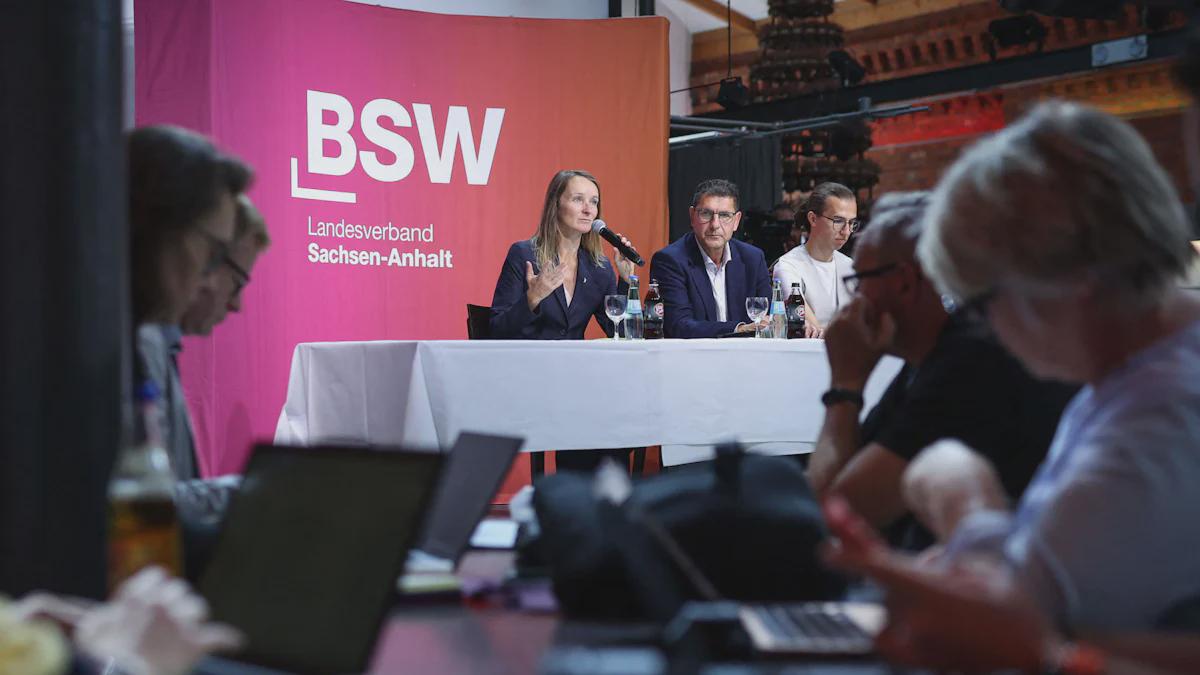
It remains unclear who will govern Saxony-Anhalt in the future. The BSW is now ruling out a coalition with the AfD—but also with all other parties.
Just over a week after the state election in Saxony-Anhalt, it remains unclear whether and how the AfD will translate its decisive election victory into actual governance. However, it is becoming increasingly clear which options are off the table. Claudia Wittig, deputy leader of the BSW parliamentary group, has now definitively ruled out a coalition with the AfD. Wittig told the Magdeburger Volksstimme: "We are not entering into coalition talks with the AfD, and we are not entering into any coalition—neither with the AfD nor with other parties."
Last week, BSW parliamentary group leader Thomas Schulze had declined to commit clearly despite repeated questioning, thereby at least leaving open the possibility of a coalition with the AfD. The BSW has entered the state parliament with five members, while the AfD holds 39 seats—exactly the same number as the CDU, SPD, Greens, and Left Party combined. Consequently, no political camp holds an absolute majority without the BSW. The AfD invited all parties to talks; only the BSW agreed, while all others declined. Wittig clarified in the Volksstimme that these discussions would focus on policy issues rather than exploratory talks for a formal alliance. The BSW intends to abstain en bloc during the vote for the state premier.
BSW leader sees "panicky fear" within the AfD
AfD lead candidate Ulrich Siegmund is three votes short of the absolute majority required in the first two rounds of a vote for state premier. A simple majority would suffice in a third round. Assuming the five BSW MPs abstain, just one additional abstention or a "yes" vote from the democratic bloc would therefore be enough.
Since election night, the AfD has been hinting at the possibility of individual CDU MPs defecting to the party. While all CDU lawmakers have ruled out switching parliamentary groups, it is conceivable that some might vote for Siegmund in a third round—even though incumbent State Premier and CDU state chairman Sven Schulze publicly rules this out. Schulze stated on Monday, following a parliamentary group retreat, that the AfD would receive no support from the CDU in forming a government. The 47-year-old had been unexpectedly elected parliamentary group leader last week by the narrowest possible margin—a result that did little to bolster his standing within the party.
Following the retreat, Schulze announced that the CDU would engage in constructive opposition work, meaning issues would be addressed on a case-by-case basis. The scale of the election result had been unexpected; the CDU suffered a historic defeat on September 6, with its vote share dropping from 37.1 percent to 17.2 percent and failing to secure a single direct mandate. The AfD emerged as the strongest force by a wide margin, garnering 43.8 percent of the vote.
During the campaign, the AfD had ruled out a coalition with other parties. Oliver Kirchner—re-elected as the party's parliamentary group leader—has now struck a similar tone regarding the BSW. In an interview with *Compact* magazine, Kirchner commented on the two BSW federal leaders, Amira Mohammed Ali and Fabio De Masi, saying: "Suddenly, I’m supposed to engage in politics for five years alongside people under the leadership of Mohammed Ali and that half-Italian guy—who goes around saying everyone else is a Nazi and that none of this is acceptable. I mean, what kind of situation is that supposed to be?" De Masi countered this statement on Tuesday via the social media platform X, asserting that the AfD—amidst the general shortage of skilled labor—was in a "state of panic" that the BSW might "drag them out from behind the 'firewall' and force them to prove themselves through substantive policy work."
Meanwhile, lead AfD candidate Ulrich Siegmund announced plans to continue campaigning for the time being. He intends to make appearances on Friday and Saturday alongside Leif-Erik Holm, the AfD’s lead candidate in Mecklenburg-Western Pomerania, where a new state parliament is being elected on Sunday.
Translated by Google Translate, mistakes are my own.
Posted by IHateTrains123
2 Comments
https://preview.redd.it/8fb6szh62pph1.jpeg?width=1080&format=pjpg&auto=webp&s=bbff46257cfa60fe3c44445f764af97cfd587858
