
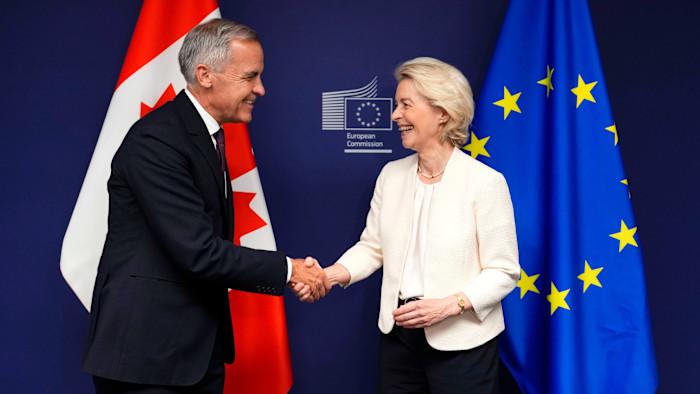
"Ursula von der Leyen’s audacious offer to make Canada the EU’s first “associate member” won her a standing ovation from European lawmakers and a warm embrace from Prime Minister Mark Carney."
"But away from the ringing applause, officials in Berlin and other EU capitals were far less impressed with the European Commission president’s decision to promise something that not only does not exist, but is not in her power to give."
A difficult meeting between von der Leyen in the European Commission, and the 27 national government in the Council of the European Union, appears likely.
Various figures within the EU are sceptical of a bespoke pr preferential arrangement for Canada, concerned about the precedent it could set for future candidate countries. They are also wary of prioritising Ottawa over other trade partners, and alienating the US president.
Posted by Desperate_Wear_1866
3 Comments
Ursula von der Leyen’s audacious offer to make Canada the EU’s first “associate member” won her a standing ovation from European lawmakers and a warm embrace from Prime Minister Mark Carney.
But away from the ringing applause, officials in Berlin and other EU capitals were far less impressed with the European Commission president’s decision to promise something that not only does not exist, but is not in her power to give.
German government spokesperson Stefan Kornelius promptly noted that while Berlin was open to “discussing new partnership models” with Canada, the term “associate member” should be “reconsidered”.
In Brussels, diplomats predicted a clash between the head of the EU’s executive and the member states to which she answers.
“We cannot decide on something that does not exist,” quipped one diplomat. A second said the idea would probably “die” in negotiations with member states. “It’s classic [von der Leyen],” noted a third. “Promise first, get approval later.”
Von der Leyen said on Wednesday that closer ties with Canada would include defence-industrial co-operation, a tech alliance and joint Arctic projects, as well as initiatives on energy, critical minerals and economic security.
“In short, we want to bring the relationship with Canada to the highest level possible,” von der Leyen said.
Carney, who was partly educated in the UK and served as the Bank of England governor, started his premiership with a trip to Europe when he declared that Canada was “the most European of non-European countries”. His push for deeper ties with the EU has accelerated in recent months as his relationship with the Trump administration has soured.
In January, Carney made an impassioned plea at the Davos economic forum for “middle powers” to coalesce to stand up to the US and China. Four months later, on the sidelines of a summit in Armenia, Carney and von der Leyen sketched out the broad strokes of this “associate membership”.
At that meeting, the Canadian leader also accepted her invitation to travel to Strasbourg for her “State of the Union” speech — and to give his own address to the European parliament. Carney is due to speak to MEPs on Thursday.
“We need partners,” Carney told senior EU officials in May, according to people briefed on the discussions in Yerevan. He cited Donald Trump’s tariffs on Canadian goods and Washington’s general belligerence towards Ottawa.
But in the days leading up to von der Leyen’s speech, aides repeatedly revised how she would describe Canada’s proposed status, according to people briefed on the process — a sign of the delicate balance she must strike between proposing ambitious ideas to EU capitals and keeping them on side.
“We must urgently reimagine our partnerships,” von der Leyen ultimately told EU lawmakers. “So, I would like to work with you on opening the door for Canada to be the first associate member of the EU.”
Many EU ambassadors consulted ahead of the speech voiced caution about any major upgrade in ties with Canada, citing the failure to fully implement the 2017 Ceta trade deal, the risks of prioritising Ottawa over other important partners and the danger of provoking Trump.
EU capitals, which in May rejected a German proposal to grant a form of “associate membership” to Ukraine, have also been historically opposed to creating ad hoc special categories for third countries.
Even some of von der Leyen’s own officials voiced scepticism. Trade commissioner Maroš Šefčovič told reporters after the speech there would be no special treatment for Ottawa, given that partners such as Norway and Switzerland follow EU rules and even pay into the bloc’s shared budget.
“When it comes to the single market, the rules are the same for everyone,” he said, adding: “But I think with Canada, we still have so much possibility to explore.”
Many in Strasbourg were enthusiastic about von der Leyen’s pitch.
“We know we can’t upset the member states, but we also can’t upset third countries who want closer ties,” said an EU official in defence of von der Leyen’s decision.
“And what was she supposed to say? Carney was sitting right in front of her, in a room full of European lawmakers that love him,” they added. “If you don’t push the envelope, you get left behind.”
Valérie Hayer, president of the EU’s liberal Renew Europe political group and a close ally of President Emmanuel Macron, said she was “delighted” that the Commission president had adopted her long-held call for a “deeper, more strategic EU-Canada relationship”.
“Canada wants to turn to Europe and in this more dangerous world, we must be bold and embrace them,” Hayer told the FT.
Still, the Commission president faces a battle to get capitals on board with her proposal before a summit with Carney in Canada on October 29-30, EU officials said.
“There is no appetite [among EU capitals] to set a precedent that could later apply to other candidate countries,” said a fourth EU diplomat. “In an optimistic scenario, this could lead to a deeper trade relationship and one or two additional summits.”
“Making Canada the EU’s first associate member could be a major step towards the integrated partnership Europe needs with like-minded countries,” said Fabian Zuleeg, chief executive of the European Policy Centre, a think-tank. “But the label must now be filled with concrete substance, not remain another announcement.”
Anyone concerned about Alienating Trump has not been paying attention. Trump actively wants to annex EU territory. No amount of excluding Canada will spare them from him trying to get Greenland
Any leader who thinks it will is proving themselves exceptionally naive, or otherwise incapable of learning from the past 20 months
Oh my god I can’t listen to this anymore. Every day I am hearing politicians and people complain that the EU is “too slow”, “too restrictive”, “regulates too much”, “hinders economic development” and so on. Then they do something, and the first reaction of local politicians is “no I don’t like this, why does the EU get to do anything??”.
This is the biggest problem of the EU right now. Theoretically it is one of the biggest and most powerful markets in the world, with an economic power close to the US. But in practice, the EU is still just 27 countries in a trenchcoat and can’t actually do anything. I am so happy that Carney went to the EU directly, instead of going to Merz or Macron, as most leaders usually do.
If the EU wants to stay relevant, it needs the power to make decisions on its own.