
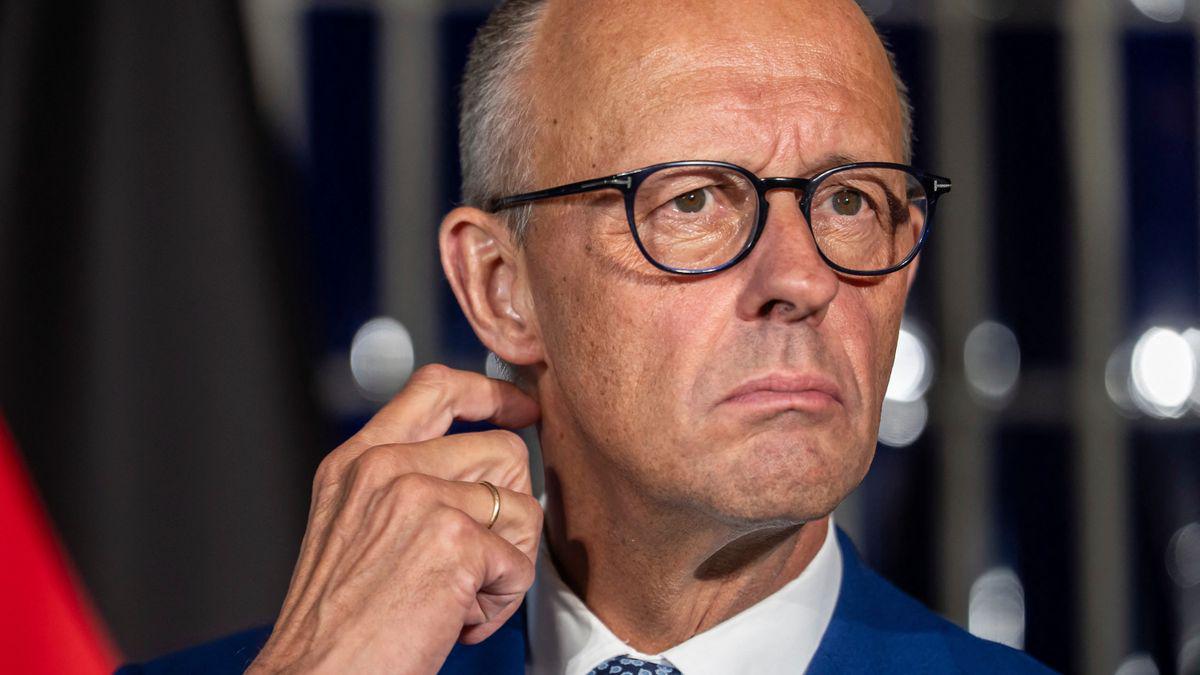
Friedrich Merz is fighting to hold onto his position. The Chancellor wants to unite the Union’s powerful figures behind him, yet they are already positioning themselves to succeed him.
What is the Chancellor doing there? Surely he isn't plunging into the floodwaters?
Monday midday in Rovaniemi. Friedrich Merz has traveled to the Finnish city on the Arctic Circle to discuss European security with his counterparts. Russia begins less than 200 kilometers to the east. The politicians have just posed for a photo on the terrace and the group is now walking toward the conference building when Merz steps aside and leans over the railing. The Ounasjoki River flows beneath him; Merz watches the dark water for a moment. Then he turns to the camera crews and calls out: "I don’t jump."
It is a macabre joke. Merz evidently wants to make it clear that he does not intend to give up—that he wants to carry on. In doing so, he reveals just how bleak things look for him internally right now.
Merz has been Chancellor for only 16 months. In that time, he has already weathered numerous crises: the judicial appointment dispute, the pension row, and constant coalition infighting. Yet none of these posed as great a threat to him as the three state elections taking place this late summer. The Chancellor is faltering.
In the Saxony-Anhalt election, the CDU’s parliamentary group shrank by more than half. The AfD triumphed, falling just short of an absolute majority. Another nosedive likely awaits this Sunday. In Berlin, the CDU could lose the "Red City Hall" to The Left party. In Mecklenburg-Western Pomerania, the party is even at risk of being ousted from the state parliament entirely. Will the Chancellor still be faltering then? Or will he fall?
Within the Union, very few would still bet on Merz completing his term. Some do not even expect him to still be Chancellor by Christmas. Speculation about his replacement is rife, and scenarios involving a change of Chancellor are circulating. Never before in the history of the Republic has a Chancellor lost standing and authority so rapidly. A collapse of power in fast-forward.
And Merz?
He puts on a brave face. At public appearances, he insists that he still intends to implement the reforms agreed upon by the black-red coalition. He emphasizes his determination to tackle high fuel prices—though exactly how remains unclear for now. Merz evidently hopes that this announcement will suffice to prevent Sunday’s election results from being quite so disastrous for his party—that his word still carries weight.
Merz had actually planned to fly to New York next week to address the UN General Assembly. It would have been an opportunity to present Germany as a reliable partner on a global stage and, at the same time, hold talks with world leaders. Merz, whose passion lies in foreign policy, had already been forced to cancel the trip last year due to domestic political reasons. Now he has cancelled it again, as his presence in Berlin is required—according to sources close to him.
That is a way of saying: the situation is serious.
Merz has summoned the CDU executive committee to party headquarters in Berlin for Sunday at 5 p.m. The last time—during the Saxony-Anhalt election—only Daniel Günther, the Minister-President of Schleswig-Holstein, came to the Konrad-Adenauer-Haus, even though other CDU state leaders were also in the city. Merz was annoyed by this. This time, he wants everyone around him. Merz wants to rally his troops and assure himself of their loyalty.
It may well be too late for that. Behind the Chancellor's back, powerful figures within the Union are positioning themselves as his potential successors. Belief that elections can still be won with Merz is fading within the CDU and CSU. The search for alternatives is underway.
No sooner had the results of the Magdeburg election come in than a remote duel broke out between North Rhine-Westphalia Minister-President Hendrik Wüst and Bavarian leader Markus Söder. Ostensibly, the issue was how the Union should deal with the AfD. Wüst signaled openness to a ban proceeding, while Söder took the opposing view. It was a peculiar moment for such a debate, coming so soon after the Union's defeat by a surging AfD. The actual arguments quickly receded into the background; what stuck was the impression that two rivals were testing the waters.
—
Hendrik Wüst, 51, is coming across as strikingly apolitical these days. He travels to Duisburg for the Canoe Polo World Championships, signs a declaration against loneliness in Essen, and makes an appearance at the German Television Awards in Cologne. He favors these kinds of emotionally resonant engagements.
Yet what appears harmless is often a calculated move on Wüst’s part. When Merz tried to explain the disaster the day after the election loss in Saxony-Anhalt, Wüst was eating Currywurst in front of the Brandenburg Gate—part of a campaign event with Stefan Evers, the Berlin CDU’s lead candidate. Some within the Union are unwilling to view the timing as a coincidence; the prevailing theory is that Wüst wanted to position himself in the spotlight following the CDU’s foreseeable defeat in the East.
Wüst is the Minister-President of Germany’s most populous state, governs quietly alongside the Greens, and is regarded as a centrist figure with strong approval ratings. He would arguably be the natural successor to Merz. Those who know him well say he believes he is up to the job—and that he wants it. But not right away.
The state election in North Rhine-Westphalia is coming up in April. How would it look if he walked away now? That is the question being asked within the CDU parliamentary group in Düsseldorf. The lawmakers want to be re-elected with their current level of strength; without Wüst, that could prove difficult. The fact that the CDU in North Rhine-Westphalia is polling more than ten percentage points above the national trend is largely thanks to him.
People who have worked with Wüst for a long time describe him as someone who plans for the long term, weighs his options, and assesses risks. "Stumbling into the chancellorship unprepared is surely not what he has in mind," says a long-time associate.
Furthermore, Wüst has few close allies in Berlin. In Düsseldorf, he spent a long time carefully assembling his team and building a support network he relies on; in Berlin, he would have to start from scratch.
Wüst would evidently prefer a bit more time before making the move to Berlin. Whether he gets that time may well be decided in Munich. If Markus Söder were to make a bid for the Chancellery, the word in Düsseldorf is that Wüst would likely be prepared to make a sudden move to the capital after all.
—
Markus Söder has not forgotten April 2021. At the time, the path seemed clear for him to become the Union’s chancellor candidate—and potentially the first CSU chancellor in the history of the republic. After all, both he and his team considered it highly likely that he would defeat Olaf Scholz in the federal election.
The polls were unequivocal: Söder would have been the better candidate than Armin Laschet, the CDU chairman at the time. The CDU rank and file largely shared this view, and calls for Söder grew increasingly loud. But things turned out differently; the CDU executive board voted for Laschet as the chancellor candidate.
That stung Söder deeply—so deeply, in fact, that he couldn't resist repeatedly taking petty digs at Laschet during the campaign. That, in turn, rankled the CDU; for a long time, Söder was considered a political liability. That now appears to have changed. Amid the height of the crisis regarding the chancellorship, he is suddenly being viewed as an option again. This, too, illustrates the depth of the CDU's desperation.
Söder, 59, is lying low for now because he knows he cannot afford to make a single mistake or get caught doing anything wrong this time around. And because he distrusts the CDU—especially its leadership.
Just a few days ago, Söder assured Bild that his CSU would not move to oust Merz. However, he noted that he could not speak for the CDU. It was a hint—a discreet message to the Christian Democrats that he was standing ready. This time, Söder does not want to push himself forward; he wants to be called upon.
Those in Söder’s inner circle believe he can afford to wait a while longer—unlike his rival in Düsseldorf. The closer the state election in North Rhine-Westphalia gets, the harder it would be for Wüst to make the move to Berlin, should Merz ultimately be forced out. At least, that is the thinking in Munich.
The two men are sizing each other up. But if the upcoming election Sunday ends in disaster for the Union, a dynamic could emerge that no one can control. Merz’s days might well be numbered. In that event, an all-out battle could erupt between Söder and Wüst, says an influential Union figure.
—
Then there is Boris Rhein. His name, too, comes up when the conversation turns to a potential successor to Merz.
Rhein would certainly consider himself up to the task—or so the word goes within the Union, accompanied by a mocking undertone. The Hessian Minister-President and state CDU leader is fond of offering advice from the sidelines, suggesting that reforms should be tackled systematically—not all at once, but one by one. His team points out that Rhein has been leading a "black-red" coalition for two and a half years—a government that is successfully implementing its agenda. Berlin, they suggest, could learn a thing or two from that example.
To some within the Union, Rhein evidently appears to be a versatile all-purpose asset. Over the summer, he was already being touted as a future Federal President—speculation that likely originated within his own state party branch.
As for the top job at the Chancellery, Rhein would have, at best, an outside chance. He himself seems to share this view. "Our country needs decisive action and bold reforms right now, not debates about personnel," he recently stated. Then again—"right now"? These days, that is a relative term.
—
On Wednesday, the CDU state premiers issued a statement. It speaks of "unity" and the need for stability in Germany. The Chancellor is mentioned only in passing, and Merz’s name does not appear at all. Söder did not sign it. A genuine show of solidarity would look different.
Replacing a Chancellor from one’s own party is no easy task. He can only be forced out of office against his will through a constructive vote of no confidence. The Union would have to field a new candidate against its own Chancellor in the Bundestag—a scenario that is unthinkable.
That leaves only one option: persuading Merz to step down voluntarily. In the scenarios currently circulating within the Union, the ideal approach would be for the leaders of three major CDU state chapters to take on this unpleasant task.
"Friedrich," they would have to say, "you no longer have a majority. The party and the parliamentary group have agreed on a successor. In the interests of the country and the CDU, you should clear the way."
It is unlikely that Merz would resist this—though not impossible.
However, this scenario presupposes that a successor has already been agreed upon, and that is far from being the case.
—
Last week, CDU and CSU MPs in the Bundestag gathered. Following the Magdeburg debacle, they expected Merz to use the general debate to deliver a speech that would set a clear course. Afterward, many were appalled.
AfD leader Alice Weidel had spoken before the Chancellor, launching a sharp attack on him. Visibly incensed, Merz ignored his prepared text and lashed out at Weidel. He lectured the AfD on failing to meet its election goal—speaking as the leader of a party that had seen its own vote share more than halved.
One MP described the performance as "muddled," while another called it "extremely clumsy." Since then, support for Merz within the parliamentary group has been rapidly eroding. Newly elected MPs and those from eastern regional associations, in particular, are talking about replacing the Chancellor; they are well aware of the disastrous mood among the party rank and file. Even within the leadership of the parliamentary group and among the heads of the state delegations, some are discussing how to get rid of Merz.
Many MPs from the East want Söder; those from the West tend to favor Wüst. One influential Union MP with years of experience suggests: "Dobrindt could do it." There is no sign of consensus.
Many within the AfD harbor a desire to split the CDU—to tear it apart. It now appears as though the CDU is doing the AfD’s work for it. There is no longer a center of power capable of halting this process of self-destruction.
Becoming Chancellor was Merz’s lifelong ambition. He waited until his perennial rival, Angela Merkel, initiated her departure and made three attempts to become CDU leader. He was fortunate that the German public had grown tired of Olaf Scholz in less than three years; what could not have been foreseen was that they would lose patience with Scholz’s successor even more quickly.
Merz evidently has a realistic assessment of his situation. The idea is now gaining traction within his inner circle that the Chancellor should push through the necessary reforms while signaling that he will not run again in 2029. He might even step down as party leader before then. It would be an attempt to preempt an "operation to oust the Chancellor" by orchestrating an orderly withdrawal.
Posted by IHateTrains123
4 Comments
Will Mr. Burns last this Christmas?
Place your bets.
Wow that was a thorough explanation. Definitely worth reading the entire text. Though if someone posted a short summary I wouldnt be mad
He has terrible instincts. Could have worked under normal times, but its nothing like normal in 2020s.
I know we should be working closer with these guys but it is a bit disheartening to see how incompetent establishment EU politicians seem to be.