
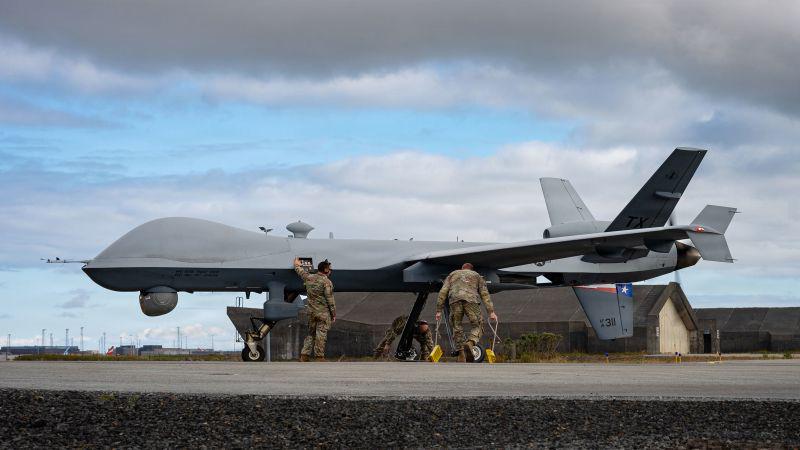
The US military is expected to send MQ-9 Reaper drones operating over Africa to the US command responsible for South America, six sources familiar with the planning told CNN, part of a wave of military equipment that has moved to the region as US officials trumpet military partnerships for anticipated counternarcotics and counterterror operations.
Last year, the US military moved a combination of MQ-9 drones, F-35 fighter jets, and at least one AC-130 gunship to the Caribbean as part of its campaign targeting alleged drug boats. But the latest shift comes as Trump administration officials have publicly outlined plans to escalate operations on land with partner nations in South America.
It’s unclear how many of US Africa Command’s MQ-9s will be transferred to US Southern Command; one of the sources familiar said it was “most” of them. That source familiar and two others also indicated the transfer of the drones — used for collecting intelligence and carrying out precision strikes — comes ahead of anticipated counternarcotics and counterterrorism operations in the region, including potential operations in Ecuador. That country began conducting military operations with the US earlier this year against “designated terrorist organizations.”
Another of the sources said there are still discussions underway about whether to send some of the drones to the Middle East, as the US military has lost assets in its war against Iran, including MQ-9s.
The shift away from Africa comes despite ongoing concerns about terrorism on that continent. US military leaders have warned that groups like ISIS and al-Shabaab continue to flourish as the US’ presence has decreased in recent years. Nonetheless, there has remained a steady drumbeat of strikes and joint military operations targeting those groups.
While sources told CNN that the targeting of terror groups would continue, some also voiced concern that transferring assets like MQ-9 drones out of the command’s hands could make those operations more challenging.
Defense Secretary Pete Hegseth named defense of the US homeland and the western hemisphere as the Pentagon’s number one priority in the department’s official National Defense Strategy released in January. And with competing interests abroad — between the Pacific, the Middle East and Europe — the US military’s activity in Africa has long fallen near last in the list of military priorities.
The Pentagon declined to comment for this story.
CNN previously reported that the Trump administration produced a classified legal opinion last year that justifies lethal strikes against a secret and expansive list of cartels and suspected drug traffickers, according to multiple people familiar with the matter.
The opinion, which was produced by the Justice Department’s Office of Legal Counsel, argued that the president is allowed to authorize deadly force against a broad range of cartels because they pose an imminent threat to Americans. It also appeared to justify an open-ended war against a secret list of groups, giving the president power to designate drug traffickers as enemy combatants and have them summarily killed without legal review, according to legal experts.
During remarks at a joint conference in Panama in August, Hegseth praised Ecuador, Honduras, Guatemala, Jamaica and Colombia for their partnerships with and invitations to the US to partake in joint military operations against “narco-terrorists” in their countries.
“Colombia has already requested the Department of War join Colombia in its fight against narco-terrorism, authorizing joint military operations to destroy terrorists and terror networks,” Hegseth said.
Last week, Secretary of State Marco Rubio said during a visit to region that the US was looking to usher in a “golden age” of the relationship with Colombia, saying the “natural state of things” is for the two to be “strong allies and partners.” CNN reported earlier this month that Colombian President Abelardo de la Espriella reached an agreement with the US for three MQ-9A Reaper drones to be loaned for monitoring drug-trafficking corridors and carrying out potential precision strikes.
And on Thursday, the US Embassy in Panama announced more than $6 million worth of long-range drone systems — not MQ-9s — were delivered to Panama to give that country’s National Aeronaval Service “the capability to monitor remote borders, safeguard strategic maritime corridors, and dismantle illicit drug trafficking and human smuggling networks.”
The Defense Department has already spent months conducting strikes on alleged drug traffickers in the Caribbean and eastern Pacific, which have killed at least 230 people.
Law enforcement officials and experts previously told CNN it’s unclear if the strikes have had any real, lasting impact on the region’s drug trade. One official said that a projected drop in the amount of seaborne cocaine seized could be explained by cartels finding new routes or ways to traffic in drugs. Another expert said that trafficking is typically not done through the kinds of boats that have been targeted, calling the strike campaign “performative.”
In recent weeks the US has largely undertaken a change of tactics, interdicting more than a half-dozen boats, removing their crews and transferring them to partner countries before sinking the boats.
Rubio said the change stemmed from the US conducting the operations in coordination with other countries.
“When you’re conducting a joint operation in territorial waters, you have to reach an understanding as to how those operations are going to occur,” Rubio said. “And every one of these countries have their own laws, they have their own systems that they have to comply with. Some can be more aggressive than others.”
However, the US has not abandoned strikes on crewed boats. The US military said it had killed three crew members during an attack on an alleged drug-trafficking boat in the Caribbean on September 9.
Posted by John3262005
1 Comment
Seems like more strikes are on the mind of the Trump administration
Also, in the discussion of moving drones from Africa to Latin America is whether to send some to the Middle East due to Iran taking down a number of them (at least 2 in recent days)
A repeat of the aircraft carrier situation but with drones? (Not enough drones, so many locations)